The first customer of the company that would become Mintlify could not edit his own documentation. Han Wang and Hahnbee Lee had built him a handsome static page over a weekend, but there was no back end and no update button. When Declan, a friend from their Y Combinator class, said he had no time to set up docs for his startup Hyperbeam, they did the setup themselves. They migrated and improved the writing. The response was good. Hyperbeam paid. By the time it needed to change a page a month later, the founders had built that feature too.
- Mintlify sells a platform for creating, hosting and maintaining documentation, API references and knowledge bases.
- The founders found the idea after seven pivots and a failed attempt to charge $7.99 a month for an automatic docstring tool.
- The company says more than 20,000 organizations now use it; its newer tools help AI agents read and maintain the same knowledge people use.
That first payment was modest, but its meaning was large. Earlier products had collected attention. This one solved a problem somebody would pay to make disappear. A broken editing workflow was tolerable for a few weeks; bad documentation was not. There is a useful asymmetry in that bargain. The founders did not have to guess which part of the product mattered most. Their customer had told them with a cheque.
The popular tool nobody bought
Wang and Lee began with Figstack, a tool that translated code into plain English. They built it in ten days, reached the top of Product Hunt for a day and attracted thousands of users in its first week. Retention, Wang later wrote, was poor. Then they noticed a narrower behavior: some users copied generated explanations into code as docstrings. So they made Doc Writer, an editor extension that generated those strings automatically. It grew quickly. It still had an awkward quality for a business: people liked using it free.
The founders put a $7.99 monthly charge behind heavier use. Most of the users confronted with the paywall uninstalled. Selling to companies was another dead end. Buyers wanted code to stay inside their own infrastructure, while the founders' implementation depended on externally hosted AI models. Doc Writer was a neat trick with a reluctant buyer. The founders kept the problem - documentation - and discarded the product.
“Your real runway is the number of pivots left in you.”Advice Wang recalls hearing at Y Combinator
They tried several more approaches over five months, including tools to detect when code and docs had drifted apart. In September 2022, after seven pivots, they returned to the simplest version of the job: host the documentation itself. The eighth idea was less clever than automatically writing docstrings. It also had a budget owner who could see the result.
The sales pitch was the finished work
For their first ten customers, Wang and Lee did much of the writing, polishing and migration themselves. To reach 100, they sometimes rebuilt a prospect's docs before sending a cold email. The email arrived with evidence attached. The method consumed hours, sometimes days, for one account. It also revealed the features a self-service product would need. They eventually turned those recurring tasks into onboarding software because doing the work by hand had shown them what to automate.
There is a limit to copying that tactic. It suits a small team with time to spend, access to the buyer and an output that can be demonstrated before purchase. It is less useful where implementation demands deep access to private systems, or where a buyer cannot judge the result from a preview. Mintlify's founders had a favorable combination: documentation is public enough to improve speculatively, and painful enough that a good replacement is obvious.

A documentation site became a product surface
Today a Mintlify customer can keep documentation in Git, publish a branded site, create an API reference with a request playground, and use a browser editor for colleagues who would rather not open a repository. Search, analytics, changelogs, authentication and collaboration sit in the same system. That combination is the pitch: a developer can preserve the workflow of code review, while product and support teams can help keep the explanation current.
Its customers include developer companies such as Anthropic, Resend, Coinbase and Vercel, alongside larger organizations with internal knowledge needs. Anthropic says more than 1.5 million developers visit its Mintlify-powered docs monthly. Resend's founder says Mintlify moved its documentation in under two days. RV Tech, the Rivian and Volkswagen software venture, reports using the platform for public, internal and air-gapped documentation. These are different jobs united by an unglamorous constraint: when instructions are wrong, somebody else must absorb the confusion.
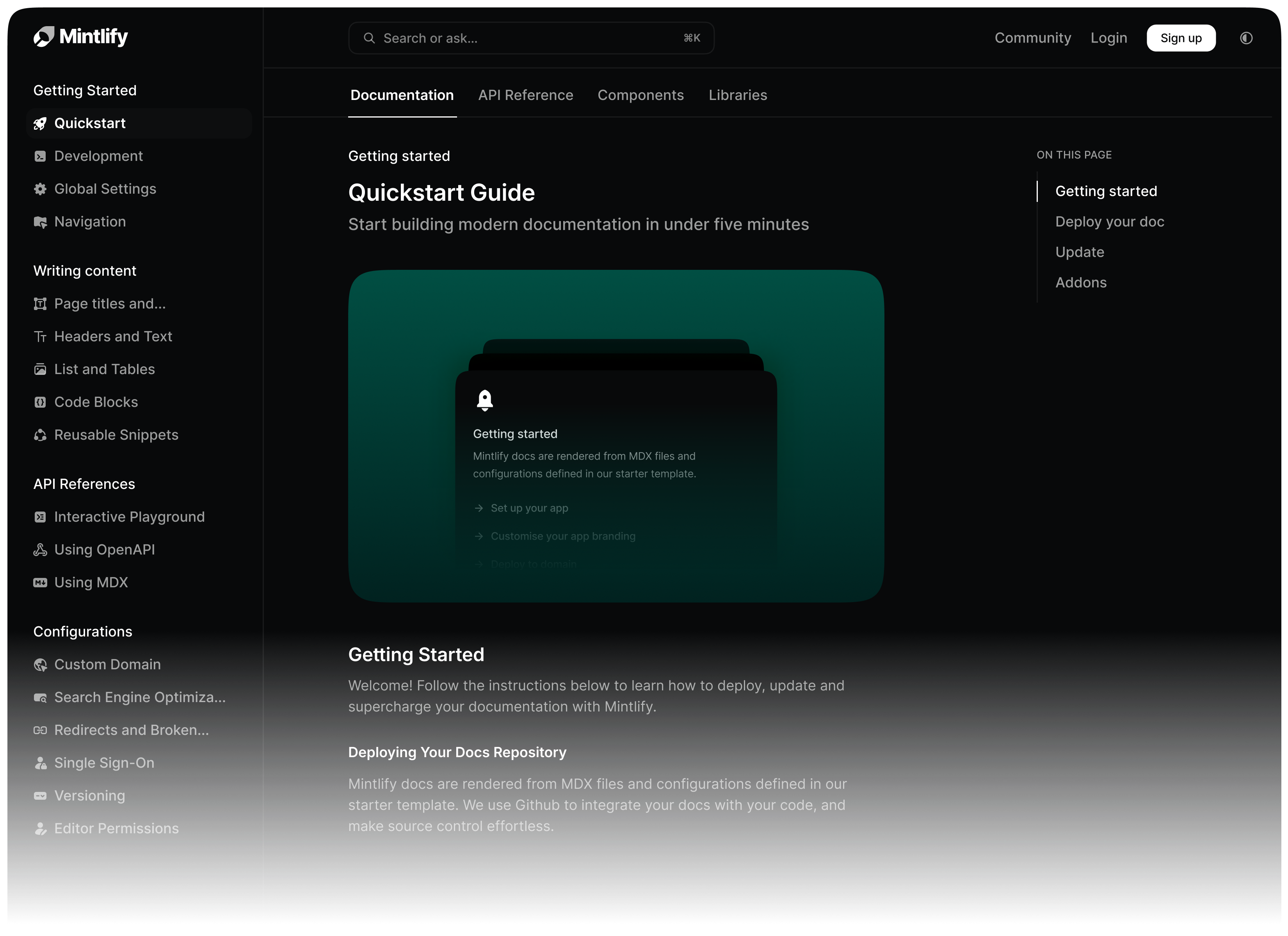
Mintlify charges as software, with a free Starter tier, a Pro plan listed at $450 per month in September 2026, enterprise pricing by quote and credits for certain AI actions. That makes it a competitor to hosted documentation platforms such as GitBook, ReadMe and Fern, and to teams building their own sites with open-source tools. Its case is strongest when a company wants the whole stack - publishing, API experience, collaboration and AI retrieval - in one managed product. A team with a simple static manual or strict control over every part of the stack may find an in-house or open-source route more sensible.
The reader who never opens a page
Mintlify's more recent bet starts with a strange visitor. In a 30-day sample reported in April 2026, the company counted roughly 790 million requests across its documentation sites. Identified coding agents made 45.3% of them, almost level with browsers at 45.8%. The classification relied on user-agent headers, so it is a view of requests, not a census of people or companies. But it explains why Mintlify now treats documentation as material to be retrieved by software as well as read on a screen.
Who requested the docs? / March 2026 sample
The product followed. An embedded AI Assistant answers questions against a site's content. A writing agent proposes documentation changes using context from code and other work. Mintlify acquired Trieve, a retrieval company whose technology it had already used for search, in July 2025. Its Index service, launched in beta in August 2026, lets coding agents retrieve information across thousands of eligible Mintlify sites. In September, the company added WebMCP tools that expose search and reading functions directly to supported browser agents.
There is an appealing symmetry here. The company began because developers did not want to write explanations nobody could find. Now those explanations must be structured well enough for a machine to find the right one. Mintlify says its platform serves more than 20,000 organizations and reaches more than 100 million readers a year. It announced a $45 million Series B in April 2026, at a $500 million valuation. The numbers are impressive; the old lesson is more useful. An answer engine is only as good as the knowledge it can retrieve, and a knowledge base is only as good as the person willing to update it.
The eighth idea succeeded by making that maintenance somebody's actual job, then gradually turning the job into software. The first version was a page the customer could not edit. The current one can draft an update, serve a developer, answer an agent and narrate a guide aloud. Both versions are recognizably about the same thing: helping someone understand what a product does before frustration sends them elsewhere.