The feed was supposed to display fashion. Instead, it displayed a problem. Fashiolista, the social network Thierry Schellenbach co-founded after university, had grown into a community of millions. Every new member brought more follows, likes and activity, and every burst of activity put another small strain on the machinery beneath the screen. The visible product was taste: dresses, shoes, collections, discovery. The invisible product was a system that had to decide, at speed and at scale, who should see what.
Schellenbach was meant to be building the community. He found himself nursing its circulatory system. It was an engineer's irritation and a founder's education. Twitter and Facebook had wrestled with the same class of problem, but knowing that giants also suffered offered little comfort at three in the morning. Fashiolista needed its feed to work, not merely to be interesting.
Years later, he described the origin of Stream with unusual economy: “This is really just about solving a personal pain point.” The sentence is almost comically modest. Personal pain, properly examined, can have a very large addressable market.
The boy who preferred the machinery
The appetite for systems appeared early. At 14, Schellenbach taught himself to program and launched a website that made money. He later studied International Business Administration at Erasmus University Rotterdam, graduating cum laude in 2008 with honours. It is a useful combination: the education of a manager and the habits of a builder. His public code has ranged across Python, Django, Go, JavaScript, Kotlin and React. His advice to younger founders similarly crosses boundaries. Borrowing an idea he attributes to Paul Graham, he argues that founders should master two of three disciplines: engineering, design and marketing. He chose engineering and marketing.
That pairing made Fashiolista more than a scar. It became research. In a 2013 presentation titled “Accidental Scaling Issues,” Schellenbach laid out the numbers with a programmer's lack of melodrama: 1.5 million members, 17 million monthly “loves,” 94 million pageviews. The stack included Django, PostgreSQL, Cassandra, Redis, Solr, Celery and RabbitMQ. A fashion site had become a graduate course in distributed systems, with no option to skip the exam.
Amsterdam supplied another early lesson, this one without a line of code. At an open-coffee gathering, Schellenbach overheard three people discussing a payments startup. That little group became Adyen. He remembered the scene years later because the contrast pleased him: a conversation small enough to fit around a café table could precede a public company. “It's inspiring to see other founders start small and grow into huge companies,” he said. The observation suited his own temperament. Size was an outcome; the work began with a few people taking an unglamorous problem seriously.
He and engineer Tommaso Barbugli began turning what they had learned into Stream Framework, an open-source Python library for news feeds and notification systems. Schellenbach had already published Django Facebook and other packages; open source was where private frustration became public utility. Fashiolista was eventually acquired. The harder technical lesson stayed with him.
A company assembled across an ocean
Schellenbach and Barbugli founded Stream in Amsterdam in 2014. Their first commercial proposition was disarmingly direct: instead of rebuilding a feed from scratch, a product team could make an API call. The founders had lived the alternative. They knew how quickly “we can build that” turns into a maintenance department.
The technical thesis was clear. The financing environment was not. Schellenbach had found European fundraising slow, particularly for a company expecting to compete with American software businesses. So Stream joined Techstars New York in 2015. Two days after demo day, an email arrived from HubSpot co-founder Dharmesh Shah. Shah had struggled with feeds too and wanted to invest $100,000. Schellenbach later recalled that they never even had a phone call. Recognition had done the work of persuasion.
Boulder came next through a mixture of strategy and ordinary life. Schellenbach was having difficulty arranging a visa. His wife worked for an American company with an office near Boulder and could transfer internally. That opened a route. Boulder also offered the network around Techstars and Foundry Group, while Amsterdam offered a deep engineering pool. Schellenbach moved nearly 5,000 miles; Barbugli remained in the Netherlands and built the technical organization there.
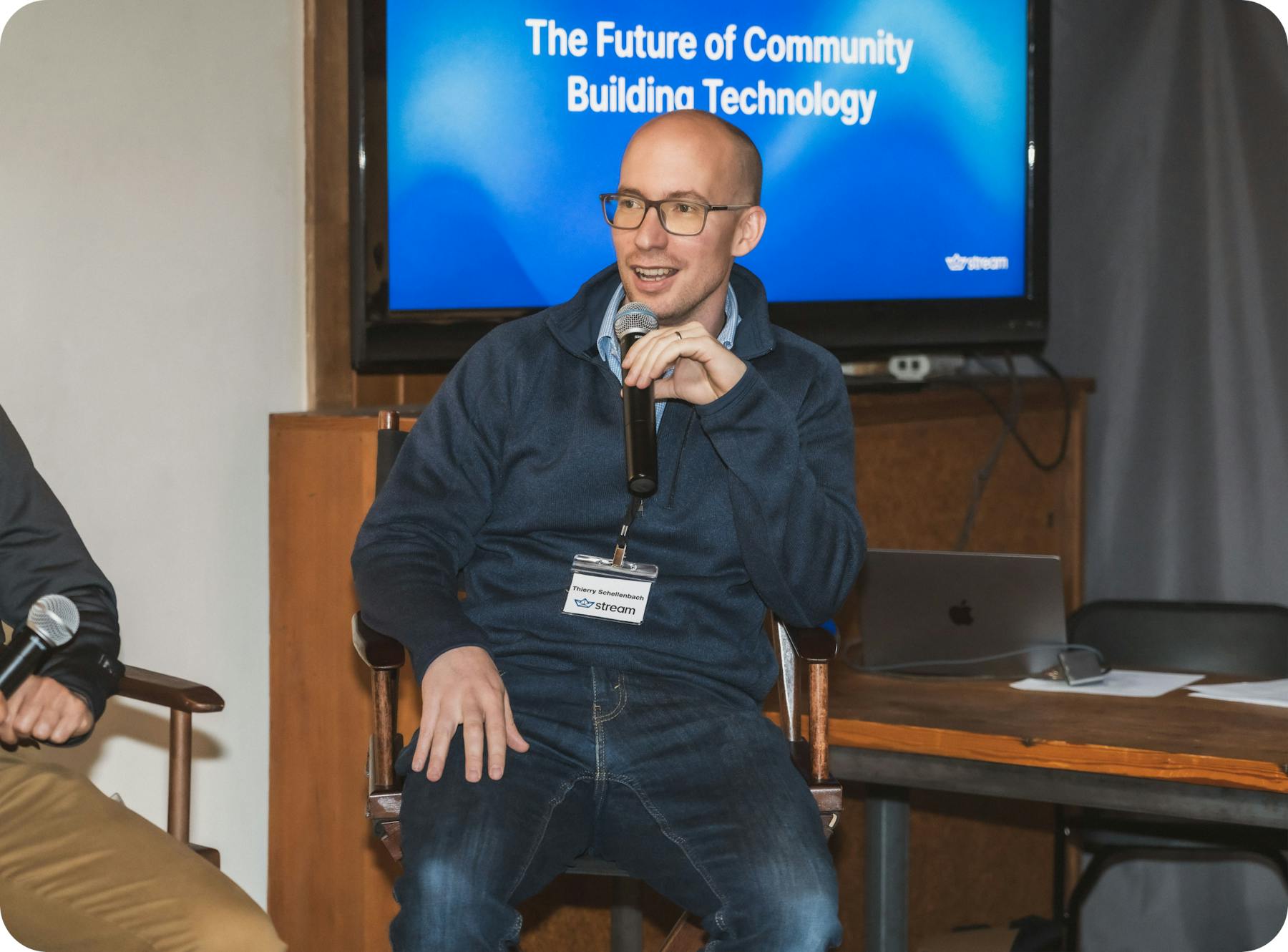
The arrangement might have looked improvised. It became architecture: headquarters and market access in Colorado, a substantial engineering base in Amsterdam, colleagues distributed elsewhere. The company itself resembled the kind of distributed system it sold - separate nodes, one shared purpose, reliability achieved through careful connection.
Fashiolista launches and grows into a fashion community with millions of users.
Schellenbach and Barbugli found Stream in Amsterdam around a hosted activity-feed service.
Techstars NYC helps Stream build an American network; Boulder later becomes headquarters.
Stream launches chat, widening the company beyond its original feed API.
Vision Agents carries the real-time infrastructure idea into voice and visual AI.
The lucrative art of giving time back
Stream expanded from activity feeds into chat in 2019. The logic remained the same. Chat looks friendly in a product mock-up and behaves like a small republic once actual users arrive: messages, reactions, threads, attachments, moderation, permissions, presence, offline delivery and an expectation of instant response. Each feature is easy to name. Their reliable combination is not.
Demand accelerated in 2020 as education, events and other services moved more interaction online. Stream raised a $15 million Series A that August. Six months later, it announced a $38 million Series B led by Felicis Ventures. The company reported that chat API revenue had risen 517 percent during 2020 and that its chat and feed products supported more than a billion end users.
The two rounds also showed how far the network around the company had widened. Series B participants included GGV Capital and 01 Advisors; individual backers named in the announcement included Datadog chief executive Olivier Pomel, GitHub co-founder Tom Preston-Werner and Hopin founder Johnny Boufarhat. Dick Costolo, Twitter's former chief executive and an 01 Advisors co-founder, praised both Stream's technology and the team's clarity of purpose. For a founder who had crossed the Atlantic partly because capital moved too slowly at home, the speed was hard to miss: $53 million announced across two major rounds in half a year.
Schellenbach framed the value less as technological spectacle than recovered attention. “The API economy creates a golden age for engineers and product teams,” he said when the Series B was announced. A proven component lets a team move from concept to launch without reinventing infrastructure. The customer buys software, certainly. More importantly, the customer buys back the hours required to become expert in a problem adjacent to its actual product.
That is a peculiar kind of ambition. Stream's work is most successful when somebody else's application feels natural. The chat loads. The feed ranks. The video call connects. Users notice conversation, not middleware. There is no applause for the pipe when the water arrives.
One thesis, more forms
The product surface has continued to widen. Video joined feeds and chat. Moderation became part of the stack. Activity Feeds v3 brought ranking and personalized “for you” patterns to a new feed architecture. In 2025, Stream launched Vision Agents, an open-source SDK for real-time voice and vision agents. The fashionable vocabulary changed dramatically from Django feeds to multimodal AI. The underlying question did not: which difficult, repeatable systems should product teams be spared from rebuilding?
His own GitHub profile still reads like that of an engineer rather than a ceremonial chief executive: “Love using Go. Python, JS, Kotlin, React as well.” Its pinned repositories include Stream Framework, Winds, chat SDKs and Vision Agents. The old code and the new company share a family resemblance. Both take a complicated mechanism and invite other builders to use it.
His personal blog offers the same continuity in miniature. MellowMorning moves from contact importers and Facebook integrations to scalable feeds, Android chat and iOS tutorials. Some posts are only a minute long. They are closer to field notes than manifestos, small records of what he was building and what had changed. Even after management became the daily job, he wrote about returning to Android development and enjoying how the ecosystem had evolved. The chief executive title did not cancel the pleasure of opening the hood.
Schellenbach's stated values are equally practical. He has said he wants future children to attempt hard things, respect discipline and hard work, and be honest about problems rather than hide them. Asked what he would like to be remembered for, he pointed to Stream's impact on billions of users, then allowed that a successful company provides the record and means to pursue larger ideas.
There is no need to decorate that ambition. It is already large. The revealing part is how often Schellenbach's career begins with something stubborn and specific: an overloaded feed, a slow funding market, a visa problem, a communication feature too costly for every team to build alone. His preferred response is not to admire the obstacle. It is to turn the obstacle into infrastructure.
A feed once distracted him from growing a community. Now his company sells the feed, the chat and the video so that someone else can tend to theirs. Revenge, in software, is a system that scales.