A car breathalyzer makes its decision in a small space: a mouthpiece, a sensor, a reading. The business behind it stretches much farther. Someone has to install the device, service it, explain the bill and get the results to the people supervising the driver. A missed appointment can matter almost as much as a missed breath test.
Mindr has built a company around that larger problem. Its best-known brand, Intoxalock, supplies ignition interlocks that prevent a vehicle from starting when a breath sample exceeds the programmed alcohol threshold. Around that hardware sit insurance brokerage, installation services, portable testing and software for authorities. The customer is buying equipment, but the desired outcome is wonderfully ordinary: getting to work, collecting the children, completing the requirements and moving on.
That makes Mindr an unusual consumer business. Many customers arrive because they must. Its newer products ask people to volunteer. And its growing investment in software exposes a consequential dependency: a device attached to a car can rely on systems well beyond the dashboard.
A business built around the next errand
The parent company announced the Mindr name in June 2024. Consumer Safety Technology, the business behind it, was already decades old. A 2012 investment announcement names Kevin Doyle and Scot Lewton as co-founders and dates the company to 1992. ClearLight Partners took a significant ownership interest that year; Welsh, Carson, Anderson & Stowe followed in 2017, and L Catterton acquired the business in 2022.
The portfolio follows a recognizable sequence of needs. Intoxalock and ADS Interlock supply vehicle alcohol-monitoring technology. Breathe Easy brokers insurance, including coverage associated with SR-22 and FR-44 filings. DUI.org provides information and help navigating services. Keepr puts alcohol testing into a portable device. A driver can encounter several of these businesses while dealing with the consequences of one incident.
There is a commercial logic to that arrangement: each brand addresses another task the same person may face. There is also a reason for customers to look closely. DUI.org belongs to this commercial portfolio; its name should not be mistaken for a government office. Convenience does not remove the need to compare providers or understand which services are actually required.
Mindr’s public voice promises “Always Guiding. Never Judging.” Its LinkedIn profile also lists recognition for supporting working parents. In a business that meets people during stressful periods, patient explanations are part of the product. The tone sets a standard that billing, appointments and telephone support have to meet.
The competitive advantage has a street address
Ignition interlocks need physical service. That gives the neighborhood automotive shop an unusually important role in a technology company’s competitive position. Intoxalock described a network of more than 6,000 service centers in its June 2026 technician-app announcement. For a customer returning for calibration, a nearby appointment is a tangible benefit.
Competing interlock providers include Smart Start and LifeSafer. The useful comparison is local and specific: accepted devices, available appointments, required features and the complete bill. A national network count does not tell a driver whether the nearest shop has a convenient opening. The value emerges when the network works at the particular address where the car needs service.
Mindr’s partnership with InstallerNet offers a revealing example. The Easy IID program, launched in January 2025, evaluates installation complexity using the vehicle, state requirements and local labor rates. InstallerNet coordinates the transaction and sets expectations before the customer arrives. By June, Intoxalock reported a 90 percent reduction in installation no-shows.
Fewer installation no-shows reported by Intoxalock for Easy IID.
Company-reported result · June 2025 · Not a controlled studyThat result deserves attention without turning it into a universal promise. The company’s announcement supplies no study design establishing which part of the program produced the improvement. Still, the operating idea is concrete: price the actual job, explain it early and coordinate the handoff. A sophisticated sensor cannot rescue an appointment nobody attends.
A breath test leaves the dashboard
“Our new name is rooted in heritage, technology, and people”
Kathy Boden Holland · Mindr CEO · June 2024
The 2024 rebrand came with a broader ambition: reach beyond alcohol impairment and the regulated market. Keepr gives that ambition a pocket-sized form. The personal breathalyzer uses fuel-cell technology to measure breath alcohol concentration and connects to an app. Paid monitoring plans offer testing schedules, results history and sharing with authorized contacts.
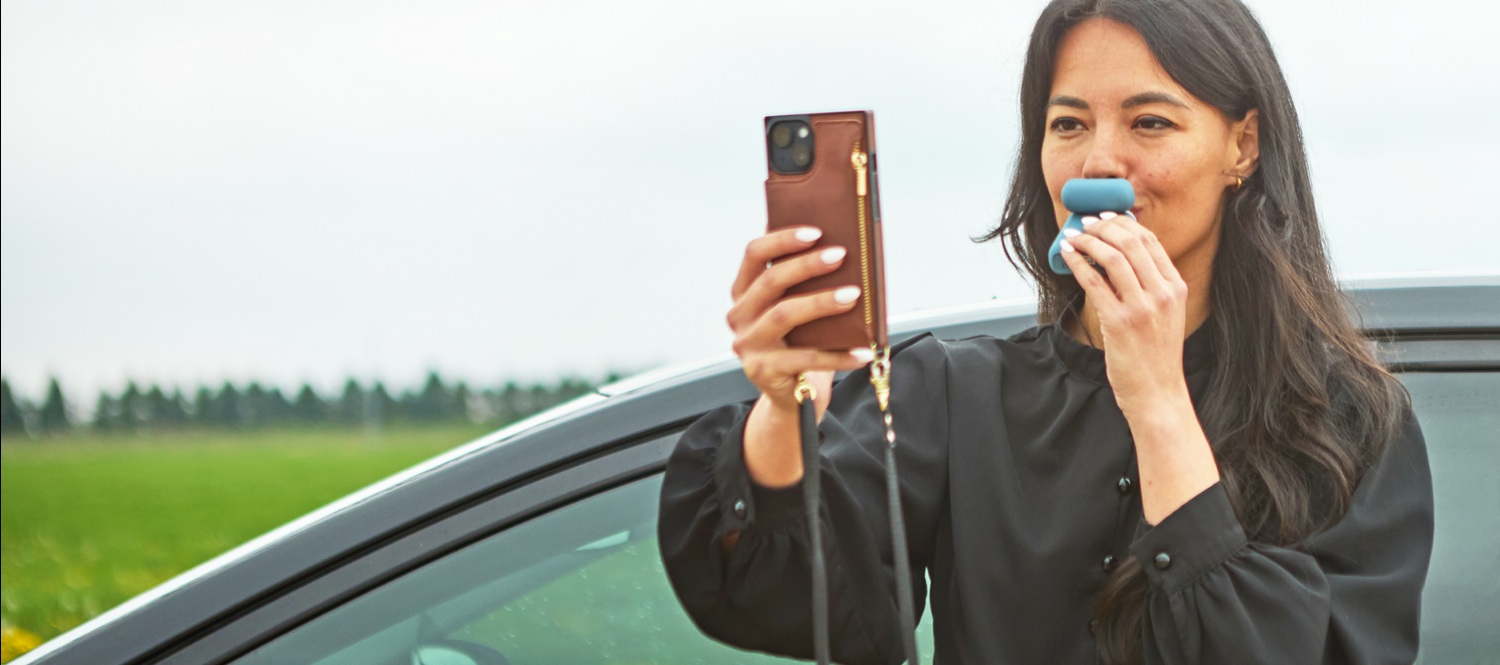
The intended audiences include co-parents documenting sobriety, people seeking accountability during recovery and individuals monitoring their own drinking. In those settings, the record can be as important as the reading. Someone else may need to see when a test happened, rather than simply hear an assurance afterward.
Mindr announced Keepr Drive in October 2025. It connects the breathalyzer to a professionally installed vehicle system and requires a passing sample before the vehicle starts when enabled. Administrators manage the arrangement through the app; the company markets it to families seeking voluntary driving safeguards.
This expansion changes the sales conversation. A mandated interlock customer needs help satisfying a requirement. A voluntary customer has to decide whether monitoring is worth the money, effort and intrusion. Competitors such as Soberlink and BACtrack already address portable or remote alcohol monitoring. Mindr brings experience with vehicle installations and regulated reporting, but those strengths still have to translate into an experience a family wants to keep using.
The sticker price is the opening number
The revenue model combines recurring services with hardware. Intoxalock devices are leased for the monitoring period. Keepr sells a device and offers subscriptions. Breathe Easy operates as an insurance broker. Customers therefore encounter different payment models even when they remain within the same corporate family.
As checked in September 2026, Keepr advertises its standalone breathalyzer at $149 and alcohol-monitoring subscriptions from $79 a month. Keepr Drive starts at $299. Its product page says the bundle includes the device, installation kit and first three months of subscription; professional installation is separate, typically about $200. After the introductory period, the monthly subscription is $49.99, with an annual option.
Different offerings, not one combined quote. Drive installation and ongoing subscription cost extra. Advertised prices checked September 8, 2026.
Intoxalock’s pricing page lists monthly leases starting at $54.99 and calibration at about $20 per appointment, typically every one to three months depending on the state. Installation varies. The page also describes possible incidental charges, including a $75 lockout fee in specified circumstances. A starting lease rate is not a total program price.
The practical move is to request an itemized quote covering the whole expected term: installation, lease, calibration, removal, required features and optional extras. Compare the same set of charges across vendors. A lower headline number can lose its appeal once travel time and service visits enter the calculation.
March 2026 tested the service promise
The dependency on central systems became visible in March 2026. Intoxalock’s public status notices described a cybersecurity event affecting customer service. Installation appointments were paused, and the company addressed missed calibrations associated with the event beginning March 14. Its March 17 update said devices were operating and told customers to continue following prompts.
The documented interruption concerned the services around the hardware. Intoxalock offered eligible customers service-date extensions and said it would reimburse certain towing expenses and cover costs directly resulting from the temporary pause. Its March 22 notice announced resumed installations, calibrations and service-center support, with state-specific qualifications and transition instructions.
For a driver, the distinction between working hardware and unavailable service can be academic. Required maintenance is part of being able to use the product. The episode makes continuity a purchasing concern alongside sensor performance: how does support respond, what records should customers keep, and how are supervising authorities informed? Those questions belong in the sales conversation because the consequences arrive on somebody’s driveway.
The next improvement is less paperwork
Two subsequent announcements show where Mindr is investing. In June 2026, Intoxalock announced the nationwide rollout of T.E.C.H., its service-center app. It combines troubleshooting, vehicle wiring information, support chat and administrative tools. The company reported service-time reductions of up to 25 percent and said pilot adoption in North Carolina and among Mobile Electronics Specialists Association members drove the decision to expand.
On September 1, Intoxalock announced automated reporting into the Community Supervision System used by more than 230 Texas supervising agencies. Previously, staff had to leave CSS, download driver reports from another portal and upload the files back into their case-management system. The integration places compliance summaries directly inside their existing workflow.
Intoxalock’s September 2026 reporting integration for Texas supervising agencies.
The company says feedback from probation officers helped identify that reporting step. Here is a useful answer to what changed its approach: staff described a repetitive task, and the product removed it. These announcements document workflow improvements; they do not establish that the earlier cybersecurity problem caused either project.
Copy the handoff, read the conditions
Mindr’s story offers a specific operating lesson. Follow the work surrounding the product. Ask the installer what makes a job difficult, the customer what makes an appointment confusing and the caseworker which report must be transferred by hand. Those questions can reveal something more useful than another feature on the device.
The limits deserve the same attention. A personal alcohol test does not replace a required interlock, and monitoring must meet the relevant program’s acceptance rules. Keepr’s own terms warn against treating a reading as permission to drive after drinking. Measurement is useful, but the number alone cannot decide whether a person is safe behind the wheel.
Shared results also require deliberate choices about recipients and privacy. And an alcohol-monitoring business cannot simply declare the cannabis problem solved: Mindr’s ElectraTect acquisition and recenTHC research concern a different detection challenge. The compelling part of this company is the work already visible - arranging appointments, supporting devices and moving records. For its customers, success often looks like a thoroughly uneventful day.