Forty-one firms. Each with its own relationships, habits and history. That was the integration tally attached to Dan Galbraith when Baldwin announced his promotion in January 2024. A deal can be announced in a morning. Getting the people on either side of it to work together takes considerably longer. Galbraith’s career has come to occupy that less photogenic stretch of time.
He is president of The Baldwin Group and chief executive of its retail brokerage operations, based in Tampa. His responsibilities include the everyday business of profit and loss, operational execution and sharing practices across the organization. Those phrases can sound bloodless. Applied to dozens of businesses, they describe an unusually human problem: how to build something larger without mislaying the knowledge that made its constituent parts worth buying.
His route to that problem ran through Cornell, Cintas, Shred-it and Stericycle. Insurance arrived in 2019. Before that, he had spent years in sales and operations, including the document-management business. In an industry concerned with protecting things people value, an executive who had previously worked around the secure destruction of documents made an interesting arrival. The paper had changed sides.
Partner firms integrated under Galbraith’s oversight, as reported at his January 2024 promotion.
Before the policy, the paper
Galbraith graduated from Cornell University in 2003 with a bachelor’s degree in Government and a minor in Economics. He joined Cintas that year and progressed through operations and sales leadership roles, eventually becoming head of sales in its Document Management division. His early career therefore combined selling a service with the machinery required to deliver it.
In May 2014, Cintas Document Management and Shred-it entered a joint venture. Galbraith became executive vice president of sales, responsible for sales and sales operations. In October 2015, Stericycle acquired Shred-it, and he became senior vice president of sales for its North American compliance-services businesses. His team’s remit encompassed $2.5 billion in annual revenue.
The sequence matters. Before he joined an acquisitive insurance group, he had already held leadership roles through a joint venture and an acquisition. The names on his business card changed while the responsibility for a sales organization continued. It is an early version of the question that would follow him to Tampa: what happens to the work when the corporate structure changes?
Baldwin Risk Partners announced his appointment as chief operating officer on March 19, 2019. Trevor Baldwin highlighted his experience developing leaders and building teams. The brokerage was extending its geographic reach after partnerships in Florida and expansion into Texas, Alabama and Georgia. Galbraith arrived with more than 15 years in operations and sales, at a company preparing to become something substantially larger.
A bell is easier to ring than a business is to integrate
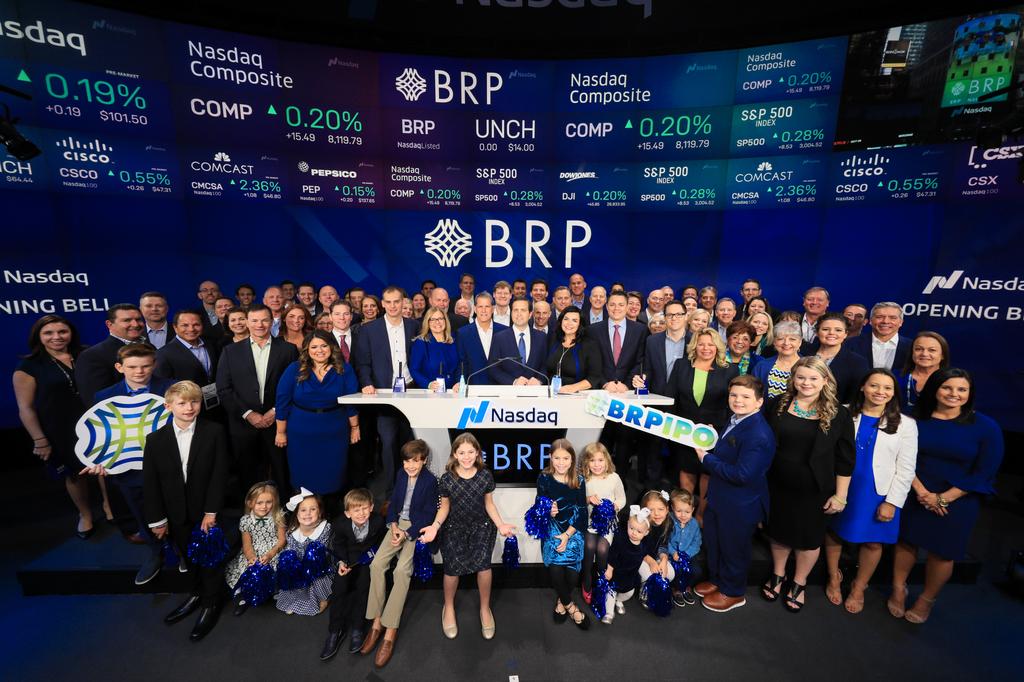
In October 2019, BRP went public. The bell-ringing photographs show colleagues and families gathered beneath Nasdaq screens, an unusually crowded frame for an industry often pictured through solitary executives. The company had more than 40 offices and 466 employees around the time of the flotation. Public-market capital offered another means of expansion; integrating that expansion would require its own discipline.
By the November 2022 investor day, Galbraith was presenting the evolution of the middle-market business. Its slides put pro forma revenue at about $60 million in 2019 and $540 million for the trailing twelve months through the third quarter of 2022. The later figure incorporated businesses acquired during the period. It measured the assembled operation, rather than a ninefold increase in sales from the same original businesses.
The distinction deserves space on the page. Acquisitions and organic growth answer different questions. One enlarges the collection of businesses. The other describes growth within the relevant existing operations. A company that buys firms needs to make the collection useful, while continuing to win and retain clients. Galbraith’s responsibilities sat at that intersection.
During the investor-day discussion, he described a timetable for consolidating agency-management systems after partnerships, identifying Epic as the principal property-and-casualty system. It is a revealingly practical detail. The romance of an acquisition rarely includes software migration. Yet common systems help determine whether an enlarged organization can actually behave like one.
A larger business, carefully measured
The number behind the promotion
On January 19, 2024, BRP promoted Galbraith and Jim Roche to co-presidents, with both continuing to report to chief executive Trevor Baldwin. Galbraith took the retail brokerage brief; Roche took underwriting, capacity and technology operations. The arrangement divided operating responsibilities while giving them shared responsibility for the firm’s performance.
The announcement credited Galbraith with overseeing the integration of 41 partner firms, building a national platform and putting a specialization strategy into practice. He had also led work on shared services. Taken together, those assignments describe the connective tissue of the organization: the systems and support that allow separate specialists to reach beyond their original offices.
Shared services have a public-relations disadvantage. Nobody rings an opening bell because several offices can use the same internal process. Nevertheless, the usefulness of a larger firm depends partly on those arrangements. A specialist’s expertise has more value to the wider organization when colleagues can find it, understand it and bring it into a client relationship.
Galbraith’s promotion placed day-to-day accountability alongside that integration work. A national platform must carry the consequences of its own design: how it performs, how its teams cooperate and whether it can pass useful practices from one part of the business to another. The appointment made those operating questions explicit.
Nearly 40 names, one introduction
In May 2024, BRP announced that it would become The Baldwin Group. Nearly 40 regional retail brands were to transition to a single name. The firm reported that revenue had moved from approximately $140 million in its IPO year to more than $1.2 billion at the end of 2023. These were company figures, reflecting a broader story than any one executive’s contribution.
The naming change gave the integration effort a visible exterior. Clients who knew individual regional businesses would encounter a shared brand. Within the firm, specialists who had arrived through different partnerships would increasingly introduce themselves under the same name. The company planned a phased transition, recognizing that names accumulated over years cannot all be changed in an afternoon.
Galbraith welcomed the change publicly on LinkedIn, describing the organization as “one integrated team”. That small phrase is a useful statement of his professional ambition. It connects the work inside the business to the promise made outside it. The challenge for an operator is to give those words practical meaning across offices, specialties and client relationships.
“one integrated team”
Dan Galbraith, on the 2024 brand change
The next combination arrives
By January 2026, there was another integration assignment. Baldwin had closed its merger with CAC Group and announced a leadership structure for Insurance Advisory Solutions. Erin Lynch became president of specialty insurance. Jeff Hughes became president of middle-market insurance. Joe Valerio continued as the segment’s chief operating officer. All three reported to Galbraith.
The responsibilities were deliberately different. Lynch would guide industry practices and product specialties for more complex risks. Hughes would lead the middle-market network serving business clients across the United States. Valerio’s brief covered client experience, broking and placement, and national operations. Galbraith sat above a structure connecting specialist capability, distribution and delivery.
In describing the appointments, he emphasized a “thoughtful combination”. His stated objective was to bring the two brands’ strengths into a structure capable of serving clients across differences in complexity, size and geography. It was an ambition expressed through appointments and reporting lines, rather than an abstract prediction about the future of insurance.
The CAC agreement had highlighted capabilities in areas including construction, real estate, private equity, cyber and surety. Bringing that expertise into a national distribution network supplied a concrete reason for the combination. The operating question remained familiar: how does an enlarged firm make specialist knowledge available where a client actually needs it?
A different scorecard in Ithaca
Long before the integration counts, Galbraith appeared on Cornell’s squash score sheets. He played four years of varsity squash. The 2001-02 roster lists him as a junior from West Simsbury, Connecticut, who attended Westminster School. That February, he beat Navy’s Mike Brennan 3-0 at No. 7 in Cornell’s 7-2 team victory.
There were less accommodating afternoons. In January 2002, Cornell lost 8-1 to Yale, and Galbraith lost his match 3-0. The two results offer a welcome correction to the uninterrupted ascent of an executive biography. A team season contains individual wins, individual defeats and a collective score that belongs to everyone.
As a senior that November, he looked ahead to a home match against Harvard with unmistakable anticipation: “It’s going to be an epic match.” That is a younger voice than the one discussing operating structures, but recognizably engaged with a team and what it might accomplish. The record leaves the connection there; a squash court need not be turned into a management seminar.
Today his home is Tampa, where he lives with his wife and their five children. Fishing and racquet sports remain among his interests. The details give the public career a little breathing room: Connecticut, Ithaca, a family in Florida, and games whose outcomes are mercifully available without an earnings reconciliation.
Another change in ownership, familiar work ahead
On September 14, 2026, Baldwin announced an agreement for a majority investment by Sequence Holdings and DFO Management, Michael Dell’s family investment office. The proposed transaction valued the enterprise at approximately $7.7 billion. It was expected to close in the first quarter of 2027, subject to shareholder and regulatory approvals and other closing conditions.
The plan would return Baldwin to private ownership, with eligible colleagues retaining a significant minority stake. Its announced rationale included investment in engineering and technology. For Galbraith, whose career has repeatedly crossed changes in corporate ownership, the setting is familiar even as the scale has changed. His retail role still centers on turning organizational ambition into daily performance.
A signature can settle who owns a business. It leaves plenty of questions about how that business will work tomorrow. Galbraith’s most distinctive achievement so far lies in that continuing assignment: helping a growing collection of firms operate together. After the handshake, someone still has to make the introductions count.