In January 2019, Trevor Baldwin and his partners pulled the plug on a possible stock-market debut. By October, they were on Nasdaq. It is an awkward sequence for anyone who likes a business story to proceed in a straight line. Baldwin’s explanation, offered years later, was simple: the original ambition had been to build a company that would last. A listing was one way of financing that ambition. The bell was incidental.
Seven years later, another change of direction arrived. In September 2026, The Baldwin Group announced an agreement to return to private ownership through a transaction valued at approximately $7.7 billion. Baldwin remained its chief executive. The proposed partners included Sequence Holdings and DFO Management, Michael Dell’s family investment office. The same executive who had helped open the company to public investors was now explaining why a different ownership arrangement suited its next stage.
There is a useful question inside that apparent reversal: how much can you change while keeping the original purpose intact? Baldwin has spent his career answering it in an industry whose product is, conveniently, a promise about the future.
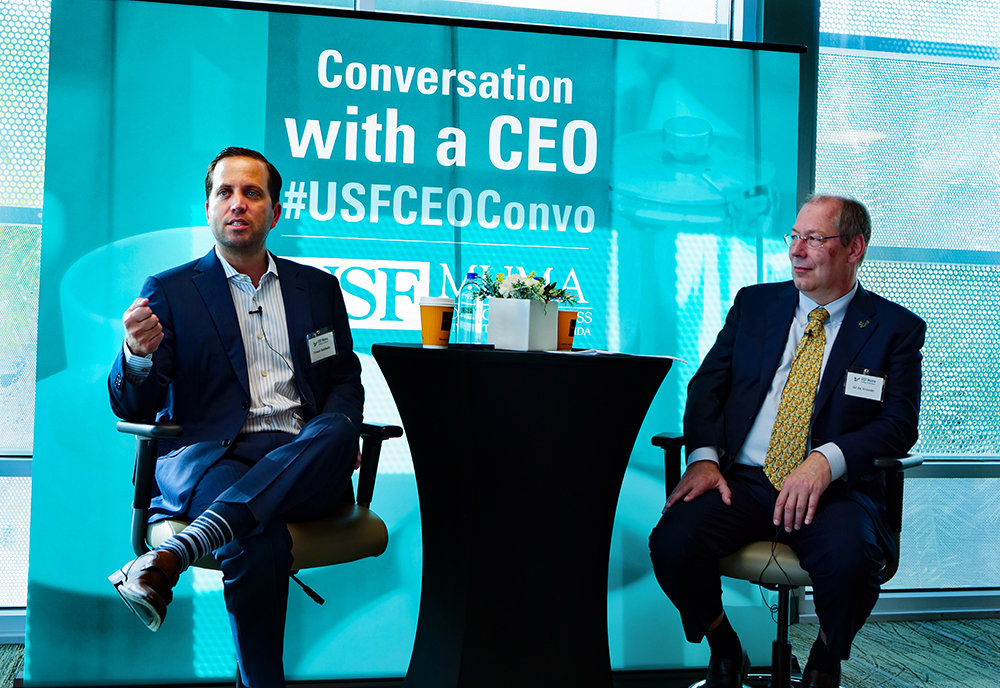
“We were setting out to build a forever company.”
Trevor Baldwin, speaking at USF in 2023
A family name, an advisor’s apprenticeship
Baldwin is a Tampa native and represents the fourth generation of his family to work in insurance. His father, Lowry, had already built and sold a brokerage before co-founding Baldwin Krystyn Sherman Partners with Elizabeth Krystyn and Laura Sherman. Trevor’s surname therefore came with a history, colleagues who knew that history, and an unusually specific family business. Most children inherit advice. Some inherit an informed discussion of commercial risk.
He studied risk management and insurance at Florida State University, attending from 2004 to 2008. Before joining the family firm, he worked at HealthEdge Investment Partners. There, his responsibilities included helping portfolio companies improve operations and assisting with new transactions. He was learning both the deal and the work that followed it, two activities that share a spreadsheet but ask quite different questions.
In 2009 he joined the insurance business as a commercial risk advisor. He later led its Commercial Risk Management Group as managing director and became president and chief operating officer. In 2011 he co-founded the holding-company business with Lowry Baldwin, Krystyn and Sherman. He became CEO in May 2019.
The sequence matters. His first job inside the firm involved advising clients; the chief executive title came a decade later. A family connection is an introduction. Advising a business on its risks requires a continuing explanation of why you deserve to stay in the room.
What the opening bell bought
BRP Group began trading on Nasdaq on October 24, 2019, at $14 a share. Baldwin approached public ownership as a means of continuing to invest in the business. He argued that the scrutiny could improve its operating standards and accountability. The associated work was decidedly less theatrical than ringing a bell: finance, legal expertise, compensation practices, cybersecurity and governance.
He also acknowledged that he had no previous public-company operating experience himself. Several senior executives did. It is a small admission with a useful implication: the CEO did not need to arrive knowing everything, provided the people around him knew their respective jobs. The business was going to require more expertise than one surname could supply.
At the time, he described five constituencies whose interests mattered: clients, colleagues, insurance-company partners, communities and shareholders. He planned to reinvest cash rather than begin paying dividends. That put the emphasis on what the firm could become, with the additional obligation of showing investors how the spending would earn its keep.
Those choices produced a much larger enterprise. The company’s reported revenue rose from approximately $5 million in 2011 to roughly $140 million in 2019, then exceeded $1.2 billion in 2023. Acquisitions formed part of that expansion. The figures describe the company’s changing scale, rather than a claim that every dollar came from existing operations.
The compass has a name
The firm calls its cultural guide the Azimuth, a word borrowed from navigation. It supplies a shared vocabulary and a framework for decisions. For a company absorbing other businesses, that is a practical concern. Each acquired team arrives with established habits; somebody must decide which habits travel and which stay behind.
In 2021, employees nominated BRP for an agency workplace award, which it won in the Southeast’s gold category. Their comments singled out communication from leadership and feeling valued. The firm also seeded a colleague-support fund with $500,000. These are more tangible expressions of culture than a photograph of people smiling beside a wall of corporate values.
Baldwin’s hiring shorthand is “Attitude over aptitude.” At his 2023 university conversation, he emphasized initiative and collaboration, and allowed room for mistakes when people learned from them. He also stressed surrounding himself with specialists. Taken together, those preferences suggest a demanding balance: know your craft, act without waiting for instructions, and remain teachable when the first attempt misses.
That balance is particularly relevant to his own position. A fourth-generation insurance executive might be expected to defend inherited methods. Baldwin’s public career has involved repeated alterations to the business around those methods. The compass metaphor earns its place here: a direction can remain useful even when the route needs correcting.
A $5.2 million answer to the talent question
In August 2022, the company and the Baldwin family committed $5.2 million to the University of South Florida’s risk management and insurance school. The partnership supported education, scholarships and connections between students and employers. The school took the firm’s name.
Baldwin himself is an FSU graduate. That makes the USF relationship a pleasingly practical detail. The investment followed the industry’s need for people and the company’s ties to the region, rather than requiring the chief executive’s own diploma to match the sign over the door.
For an advisory firm, recruiting is close to product development. Its clients buy judgment and expertise, delivered by people who need training before they can earn trust. A university partnership offers an earlier point of contact than a vacancy notice. It also makes the career visible to students who might otherwise know insurance chiefly as a bill.
By 2026, USF reported that the Baldwin Group employed nearly 100 of its graduates, alongside interns. The relationship had acquired an observable result: students became colleagues. A school naming is a public occasion. A graduate taking a first job is the part that makes it useful.
Company and Baldwin family commitment to USF’s risk management and insurance school, announced in 2022.
Forty names, then one
In May 2024, BRP introduced The Baldwin Group as its firm-wide brand and announced plans to bring nearly 40 regional retail brokerage brands under that name. Some specialist businesses retained their own identities. The retail change reflected an attempt to make the combined expertise easier for clients to recognize and use.
A collection of businesses can become very large while remaining a collection. A common name raises a more awkward expectation: that the parts will work together. For Baldwin, integration had become part of the proposition. Buying a specialist is one transaction; helping another team’s client reach that specialist is an operating task.
The completed merger with CAC Group, announced on January 2, 2026, added further specialty and middle-market capabilities. Erin Lynch took responsibility for specialty insurance in the advisory segment. The organizational decisions following the deal showed the less photogenic side of expansion: deciding who leads, how capabilities fit, and how clients find the right expertise.
The financial record also requires more than a celebratory growth chart. For 2025, the company reported $1.5 billion in revenue and 7% organic revenue growth, alongside a GAAP net loss of $54.2 million. Its adjusted measures told a different earnings story, including $341.5 million in adjusted EBITDA. These are different measures, and a fair account of Baldwin’s tenure keeps the loss visible alongside the expansion.
Forever, with a different set of keys
The September 2026 agreement would give public shareholders $32.50 per share in cash. The approximately $7.7 billion enterprise value included about $4.6 billion of equity value and $3.1 billion of net debt. Eligible colleagues would have an opportunity to retain ownership through a rollover of part of their holdings.
The transaction was expected to close in the first quarter of 2027, subject to shareholder and regulatory approvals and other customary conditions. As of this profile’s October 2026 date, it remained an announced agreement. The distinction matters because a proposed future and a completed transaction are different chapters.
Baldwin’s argument for the change centered on investing faster in talent and technology, including AI. Sequence would bring engineering capabilities; DFO would bring long-duration capital. In his September letter, he described the public-market years as useful preparation and left open the possibility of a future return to public ownership. He was treating the financing arrangement as something that could evolve with the business.
His personal biography supplies an apt final detail: he holds both an FAA pilot’s license and a US Coast Guard captain’s license, and enjoys the outdoors. Navigation is therefore more than a borrowed corporate word. Still, the interesting test ahead takes place at work. Having helped assemble the firm, he now has to make its expertise, ownership model and new technology serve the people who depend on it. Forever is a generous word. It creates a fairly lengthy to-do list.