The manufacturer had more than 1,500 landing pages. Each belonged to a retailer. Each needed a logo, contact details, a company description, and the correct promotion. The retailers fell into three categories, with different promotional calendars. A sale changed, and somebody had to change the pages. Repeat that often enough and a marketing program becomes a maintenance department.
- Mindmatrix connects partner management, marketing campaigns, and sales enablement.
- Its concierge team helps with the work partners struggle to find time for.
- Its latest bet, GTMOS, puts partner workflows inside familiar everyday tools.
The manufacturer’s answer, described in a Mindmatrix case study, was a custom script and a template system. The branding stayed consistent; retailer details and date- or region-specific promotions could vary. Mindmatrix claimed immediate savings of $150,000. The revealing detail is the task itself: copying, checking, updating. Selling through other businesses creates an enormous amount of work before anyone makes a sale.
One manufacturer’s maintenance problem. Three retailer categories. A compelling case for templates.
A campaign needs somewhere to go
Harbinder Khera founded Mindmatrix in February 1998, initially concentrating on solution selling for manufacturers, channel partners, and direct sales teams. That origin helps explain the company’s enduring interest in the space between a central marketing department and the people who actually meet customers. Headquarters can produce an excellent campaign. A dealer still has to turn it into something useful on Tuesday morning.
Mindmatrix builds software for that journey. Bridge brings together partner relationship management, through-channel marketing automation, and sales enablement. In ordinary language, that means recruiting and onboarding partners, training them, giving them usable marketing material, registering opportunities, and tracking the resulting work. The intended buyer is often a channel or alliance leader; the intended beneficiary may be a reseller with six other priorities.
Consider the marketing half. A vendor can prepare an email, landing page, presentation, or social post, then let partners personalize and distribute it. Approved material travels outward while campaign reporting travels back. Content syndication helps keep local websites aligned with the vendor’s messaging. Lead routing gives the response somewhere to go. The value lies in joining those steps, rather than celebrating the existence of another content library.
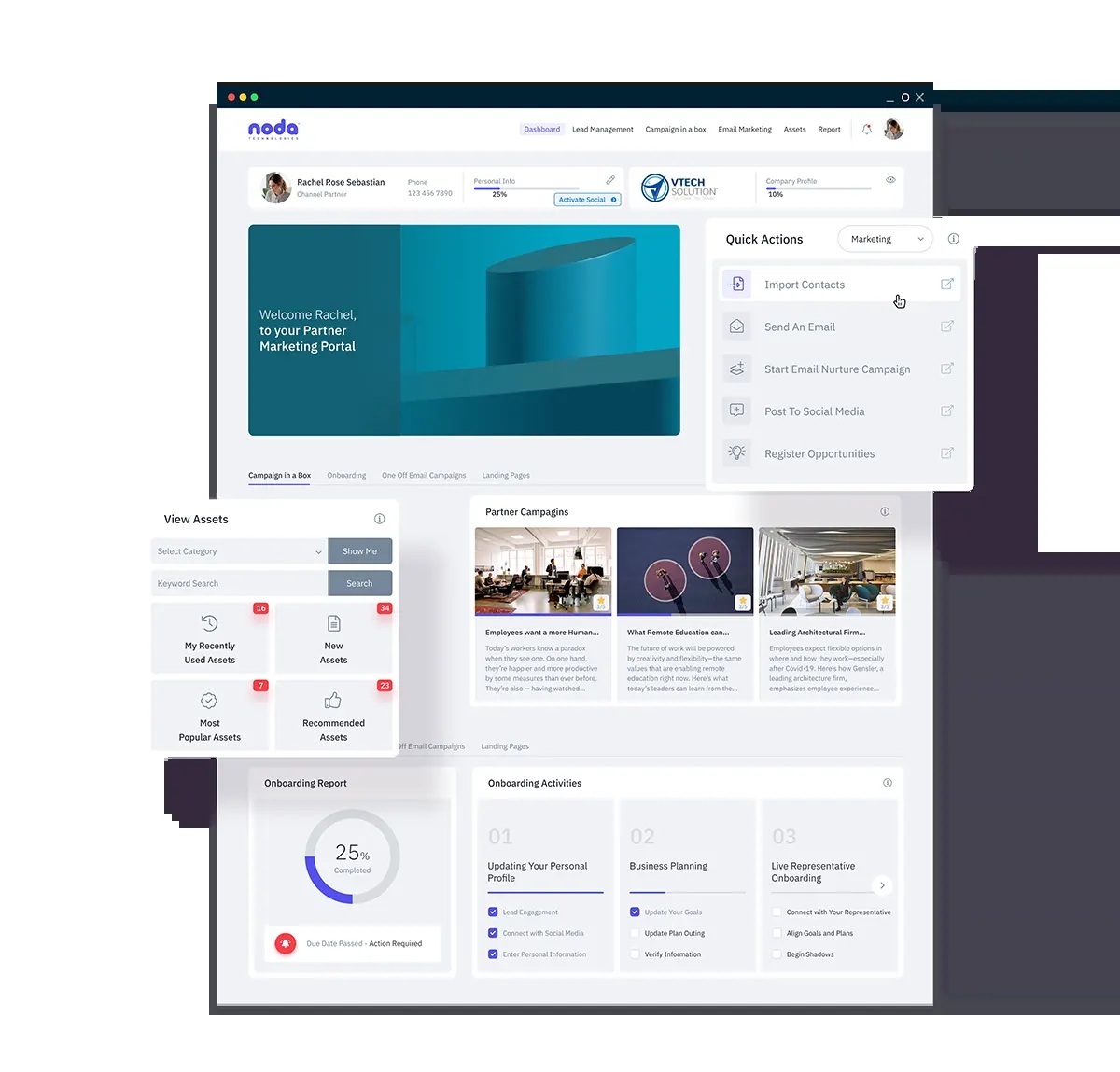
The PRM half supplies the surrounding rules: who the partner is, what they can access, where they are in onboarding, and how their opportunities progress. Mindmatrix advertises deal registration, learning tools, market development fund management, and performance reporting. Its expertise is this combination of channel operations and campaign execution. It sells the machinery behind a partner program, including the bits that rarely appear in a sales pitch.
- 01 / PREPAREApprove the campaign
- 02 / ADAPTPersonalize for the partner
- 03 / EXECUTERun it and route responses
- 04 / FOLLOWTrack the opportunity
The humans inside the software business
There is an awkward admission on Mindmatrix’s concierge-services page. Partners can have a portal, training, and marketing tools and still fail to use them. They are busy selling, meeting customers, and running their own businesses. Availability does not produce participation. This is the first thing that can go wrong: the software is ready before the person has time.
Mindmatrix consequently sells help with tasks such as importing contacts, cleaning data, editing landing pages, sending newsletters, and running campaigns. These are small jobs with an unfortunate habit of blocking larger ones. A company offering automation also offers people to operate it. That pairing makes sense when the customer’s problem includes both a missing system and a missing pair of hands.
The business model combines B2B software with implementation and service support. One public MSP package makes the economics tangible: Marketing Advantage lists $400 a month, billed at $2,400 per six months, plus $350 for basic setup or $1,000 for advanced setup. Six months with basic setup therefore comes to $2,750 at the listed rates. Enterprise buyers need a scoped proposal; this MSP package is its own product.
Six months of Marketing Advantage at $400/month, plus $350 basic setup. Arithmetic from the public listing; not an enterprise quote.
The customer mix explains the breadth. Mindmatrix lists Lenovo, Adobe, Generac, Avalara, and SAP among its clients and says it works with thousands of managed service providers. Its Litera case-study overview emphasizes engagement, visibility, and marketing coordination. Across these businesses, the common problem is coordinating sellers outside the payroll. The company’s 2025 e2open partnership adds channel-data and incentive capabilities to that proposition.
The portal starts to disappear
Mindmatrix competes in a market that includes PRM and partner-marketing providers such as Impartner and ZINFI, alongside assembled stacks of CRM, email, and asset-management tools. Its positioning emphasizes connected workflows in one platform. Buyers should judge that claim by a complete task: can a partner find the right campaign, execute it, and hand over a qualified opportunity without repeated entry?
BridgeAI, announced in February 2025, added AI-based profiling, content assistance, and insights. On October 21, 2026, Mindmatrix introduced GTMOS, extending the proposition toward intelligence and headless workflows. The announcement describes supported connections to AI assistants, email, Slack, and Microsoft Teams, so partners can carry out work without a mandatory visit to a separate portal. It also announced a transition toward mindmatrix.ai.
“We are not reintroducing Mindmatrix. We are expanding it.”
Harbinder Khera / GTMOS announcement / October 2026
The company says roughly two years of changes in AI helped drive this direction. My reading is that its old adoption problem has acquired a new possible answer: bring the task to the person. That still requires reliable data, sensible access rules, and somebody responsible for follow-through. A business with a handful of simple direct-sales tasks may have little use for the breadth.
The lesson readers can copy is smaller than a platform purchase. Find the repeated handoff. Standardize what can stay standard. Name the person responsible for what happens next. The manufacturer’s 1,500 pages make the point neatly: a channel program scales more comfortably when its maintenance work stops scaling alongside it.