Buildings introduce themselves with glass, stone, steel, signs and doors. The spreadsheet is shy by comparison. It stays backstage, counting promises: labor already committed, invoices not yet arrived, changes approved but not billed, revenue earned across a project that is still mostly weather and intention. Mina Selim has made a career in that backstage country. As Division Controller at Core States Group, he works where architecture, engineering and construction are translated into a financial language sturdy enough to support decisions.
It is easy to describe this as a numbers job and miss the interesting part. A controller in a project business deals in relationships disguised as figures. A variance can be a late permit, a redesign, a schedule that slipped, a client request or a subcontractor waiting on an answer. Each number has a biography. The useful skill is not merely recording it correctly. It is understanding what happened, explaining what it means and helping the next person act before the biography becomes an obituary.
Selim's professional shorthand contains two useful clues. The first is “EA,” the enrolled-agent credential. It signals formal expertise in federal taxation and the right to represent taxpayers before the Internal Revenue Service. The second is the phrase he uses to frame his experience: accounting in construction. Put those together and a particular kind of operator comes into view, one trained to respect both exact rules and unruly projects.
A career measured in places
Selim studied at Ain Shams University from 1996 to 2000. His career history then passes through environments attached to two conspicuous Egyptian developments: the Mall of Egypt project and Phase 3 of the Grand Egyptian Museum. Those names bring scale to mind, but the more revealing detail is that they are places rather than products. A place cannot be shipped back, patched overnight or quietly replaced. It accumulates decisions in public.
That gives construction accounting its peculiar gravity. Costs arrive from many directions. Progress is uneven. The work passes between owners, designers, consultants, contractors, jurisdictions and suppliers. A controller sees the wake left by every handoff. The role rewards people who can preserve precision without pretending that a live project will behave like a tidy textbook problem.
Selim's career footprint includes both Egypt and the United States, with professional experience in Corona and a current connection to Core States Group's Ontario office. Across those locations, the central problem remains familiar. Project work needs someone to make many moving parts legible to one another.
“The building is visible. The financial architecture is not.”An operating truth of project work
The controller as translator
Core States Group is built around integration. The firm combines architecture, civil and structural engineering, MEP and fire protection, permitting, land-use planning, surveying, general contracting, energy work and program management. It serves individual sites and national programs. That breadth is commercially useful because clients can keep more of the work under one roof. It is operationally demanding for exactly the same reason.
Every discipline carries its own vocabulary, cadence and risks. Architects think through iteration. Engineers calculate performance and compliance. Construction teams contend with labor, materials and the unromantic authority of the calendar. Permitting teams navigate jurisdictions whose requirements refuse to become uniform merely because a national rollout would find that convenient. Finance has to meet all of them without flattening the differences that matter.
This is why a useful controller is partly a translator. The job turns project events into shared definitions. Which costs belong to which period? What is committed? What is still exposed? Which change is real enough to forecast? Where does local detail affect the wider portfolio? A report is successful when the engineer, construction manager and executive can recognize the same business inside it.
Translation also runs in reverse. Finance cannot remain a distant scoreboard that flashes a result after the game has ended. It has to learn enough of the work to ask a timely question in the language of the person who can answer it. A construction manager may see a sequence problem where an accountant sees a timing variance. A designer may see an iteration where a report sees additional effort. Neither description is false. Selim's function is to help the organization hold both descriptions at once, then convert them into a responsible course of action.
The work also has a moral texture. Financial controls are promises about consistency. The same event should receive the same treatment. The same rule should survive urgency. A good system makes it harder for convenience to masquerade as judgment. In an industry where projects can stretch across months, states and teams, that consistency becomes a quiet form of trust.
A credential built on disciplined upkeep.
Enrolled agents have unlimited practice rights before the IRS and must complete continuing education on a recurring cycle. The letters beside Selim's name describe expertise, but also maintenance: professional knowledge has to be kept current.
Why “service” is the revealing award
In 2024, Core States Group named Selim the recipient of its Service Value Award. In the company graphic announcing the honorees, his portrait sits among colleagues recognized for integrity, inclusion, excellence and innovation. Beneath his name are three compact facts: EA, Division Controller, Service.
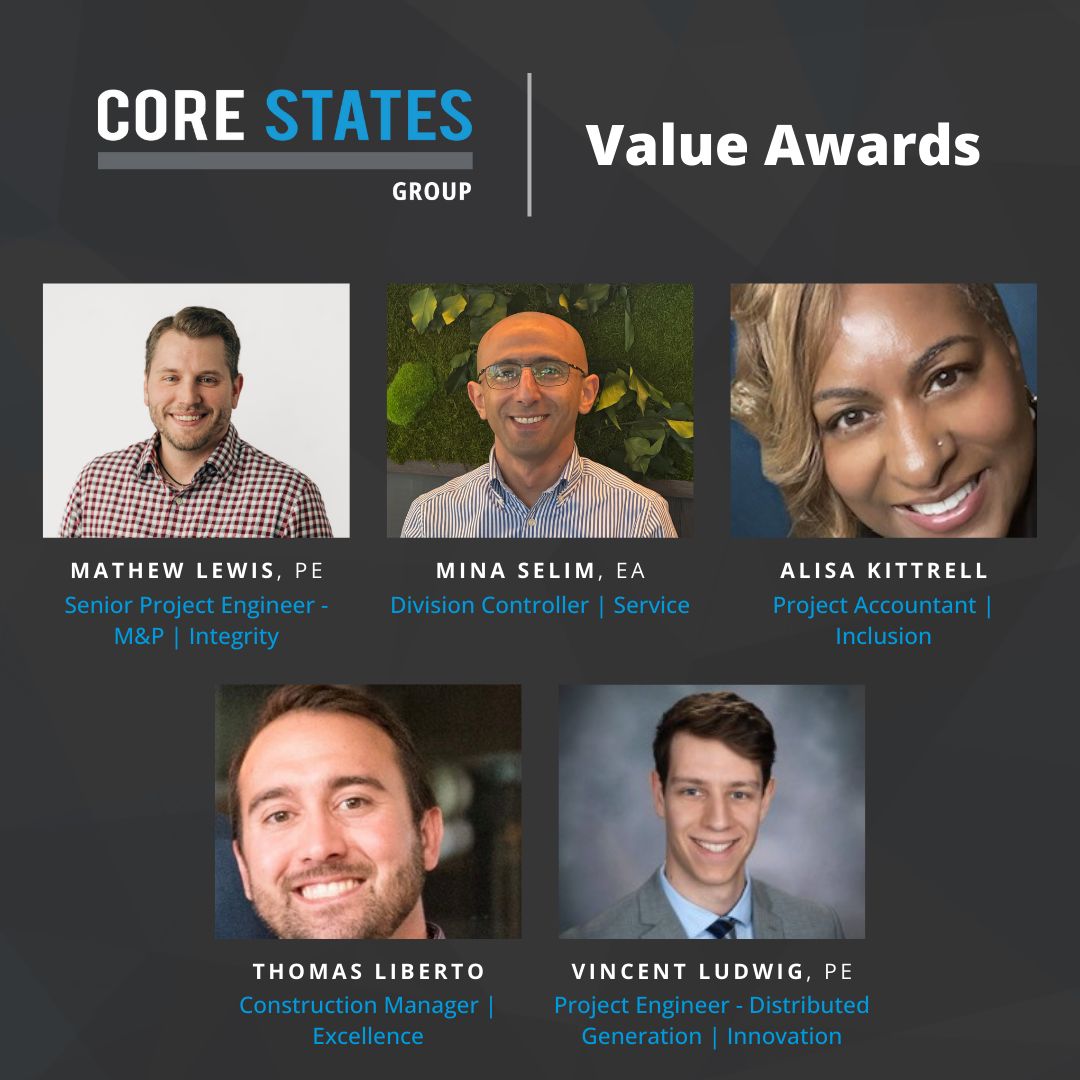
Service is a telling choice for someone whose title contains “control.” The words can sound as if they belong to opposing temperaments. One guards the boundary; the other opens the door. In practice, useful control is a service. It gives colleagues reliable information before a decision hardens into a mistake. It answers the question behind the question. It makes a rule understandable enough to follow and a problem visible enough to solve.
Selim's visible interactions with colleagues are similarly economical: congratulations offered, other people's milestones noticed, hiring needs shared. There is no grand personal brand at work. His public presence resembles the role itself, more connective tissue than spotlight. Even the award announcement is a group portrait. He is centered in it, but not alone.
As project complexity rises, translation matters more
The ledger meets the blueprint
There is a temptation to divide companies into those who make things and those who count them. A multidisciplinary project firm makes the division look silly. The counting changes the making. A timely view of cost can reshape a choice. A consistent close can reveal whether a project pattern is local or systemic. A controller's explanation can help a team distinguish an exception from a trend.
This becomes more consequential as firms grow. Core States Group now operates across the United States and Canada, serving markets that include retail, restaurants, financial institutions, housing, industrial facilities and zero-emission vehicle infrastructure. One project may require local knowledge. A national program may require the same standard repeated across dozens or hundreds of locations. The finance function must accommodate both truths: local projects are specific, while a scalable business needs comparability.
Selim works in that tension. His background joins construction familiarity with the discipline implied by the EA credential. His award connects that discipline to service. His career geography suggests comfort crossing contexts, from education in Cairo and experience around Egyptian projects to accounting leadership in California. None of those qualities calls for a hard hat in the company portrait. All of them help the people wearing hard hats understand the ground beneath a decision.
Quiet work, durable consequence
A project reaches completion through thousands of small acts that do not survive into the photograph. Someone clarified a scope. Someone caught a mismatch. Someone asked a boring question early enough for the answer to remain inexpensive. Construction is full of glamorous nouns and consequential verbs. The controller's verbs are plain: reconcile, review, explain, verify, close.
Those verbs do not produce a skyline, but they create memory. Reconciliation tells the firm what actually happened. Review creates a pause before error becomes habit. Explanation carries knowledge from one discipline to another. Verification makes confidence earned rather than assumed. Closing gives the next period a clean beginning. Repeated month after month, project after project, the routine becomes part of how an organization knows what it knows.
Selim's public story is best understood through those verbs. It is not the tale of a celebrity executive or a founder selling a sweeping doctrine. It is the profile of an operator whose work becomes more important as the organization around him becomes more complex. His recognition for service puts a human word on a technical function. His credential puts technical weight behind that function. His project background gives the numbers somewhere real to land.
The result is a career at the seam between visible ambition and invisible order. The architect can draw the future. The engineer can test it. The builder can assemble it. Mina Selim helps the organization understand, in disciplined financial terms, what that future is asking of the present. Blueprints make the promise. People like Selim help keep the promise accountable.