Every online job hunt contains a small act of betrayal. You find a role, tap “Apply,” and the platform sends you somewhere else. A new tab appears. There is an account to create, a password to invent, a résumé to upload and then, with exquisite bureaucratic confidence, a form asking you to type out the résumé you just uploaded. Somewhere during that handoff, intention evaporates.
Mikhil Raja built SonicJobs around that vanishing point. The company calls it the redirect, though the word sounds far too polite. SonicJobs says about 70 percent of candidates bounce when a job platform hands them to an employer’s application system; after the remaining obstacles, roughly 5 percent of people who begin an application complete it. Raja’s bet is that the abandoned tab is not a footnote. It is the whole plot.
His career has been an education in finding signal inside busy systems. He grew up in Mumbai, started playing tennis at four, and reached the quarter-final of India’s national under-10 tournament at eight. A scout connected to Nick Bollettieri’s tennis program invited him to Millfield School in England. At nine, Raja and his brother moved there. He remembers the courts as paradise, especially after growing up playing on surfaces made from cow dung in 1990s Mumbai.
Competitive tennis eventually yielded to business. At 14, Raja arranged for Indian films, released earlier there because of rights schedules, to arrive by post. He sold the discs at boarding school. Wallets followed and proved less cooperative. The supplier would not accept returns, leaving the teenage merchant with inventory and a compact lesson in the difference between enthusiasm and demand.
“I made decent money once I understood how it worked. I started to fall in love with business.”Mikhil Raja on his boarding-school venture
01 / TrainingThe marketplace beneath the marketplace
Raja graduated from the University of Edinburgh with a First in Economics and Business, then entered investment banking. After a summer at Rothschild, he joined Deutsche Bank. The suit-and-spreadsheet years mattered for more than the predictable polish. During his final stretch there, he worked with Auto Trader as the company shifted from magazine to digital marketplace and prepared for its public listing.
Auto Trader gave Raja a living demonstration of what deep marketplace data can do. He liked the precision: the platform could understand how the color of a Ford Mondeo changed its value and use that knowledge to help a seller price it. “I became obsessed with marketplaces,” he later said. The fascination was not merely with matching two sides. It was with teaching each side enough to make a better decision.
The stealable idea
Look for the handoff everyone treats as inevitable. Measure what disappears there. A useful product may be hiding between two existing products, exactly where neither side feels responsible.
That distinction would become the spine of SonicJobs. Traditional recruitment advertising usually charges for clicks. A click proves curiosity, perhaps a misbehaving thumb, but not an application. Raja wanted richer data and a business model closer to the actual outcome. SonicJobs would eventually charge employers on a cost-per-application basis, while building a flow that could see whether the candidate reached the finish line.
02 / The betTeaching software to survive a form
Raja co-founded SonicJobs in 2017 with Francesco Masia and Francesca Boccolini. The team spent its early years on an awkward technical problem. Job application forms are not standardized documents waiting patiently to be read. They are temperamental little kingdoms. Labels vary. Questions appear conditionally. Buttons move. Pop-ups intervene. A field that means “Are you legally permitted to work here?” may be phrased and placed in hundreds of ways.
Beginning in 2019, the company built agents using robotic process automation, computer vision and machine learning. The purpose was simple to describe and difficult to make reliable: read the employer’s application flow, ask the candidate the necessary questions inside the platform they already use, and then complete the outside form correctly. Remember an answer once given. Spare the candidate from performing the digital equivalent of introducing themselves to the same receptionist six times.
The latest generation uses computer-use models to interpret and navigate the flow. SonicJobs says employers and their application-system vendors do not need to build custom integrations. The agent works through the browser interface, much as a person would, only with fewer opinions about password punctuation. The company describes this as Hosted Apply: the candidate stays where the application began while the machinery travels on their behalf.
In December 2021, SonicJobs raised a $5.5 million Series A from investors including Triple Point, Ufi Ventures and TMT Investments. At the time, it was processing more than 250,000 applications a month and preparing for a US launch. Raja compared the conventional experience to Booking.com sending a customer to each hotel’s own website to finish a reservation. Recruitment had somehow preserved this ritual and called it a funnel.
03 / The philosophyFriction deserves an expense account
Automation in hiring carries an obvious temptation: maximize the number of applications and declare victory beneath a confetti cannon. Raja draws a more useful line. There is bad friction, such as redirection and repetitive data entry. Then there is good friction, such as identity verification and questions that reveal whether a person fits a role. Remove the first; preserve the second. More is not necessarily better when “more” means an employer receives a blizzard of indifferent résumés.
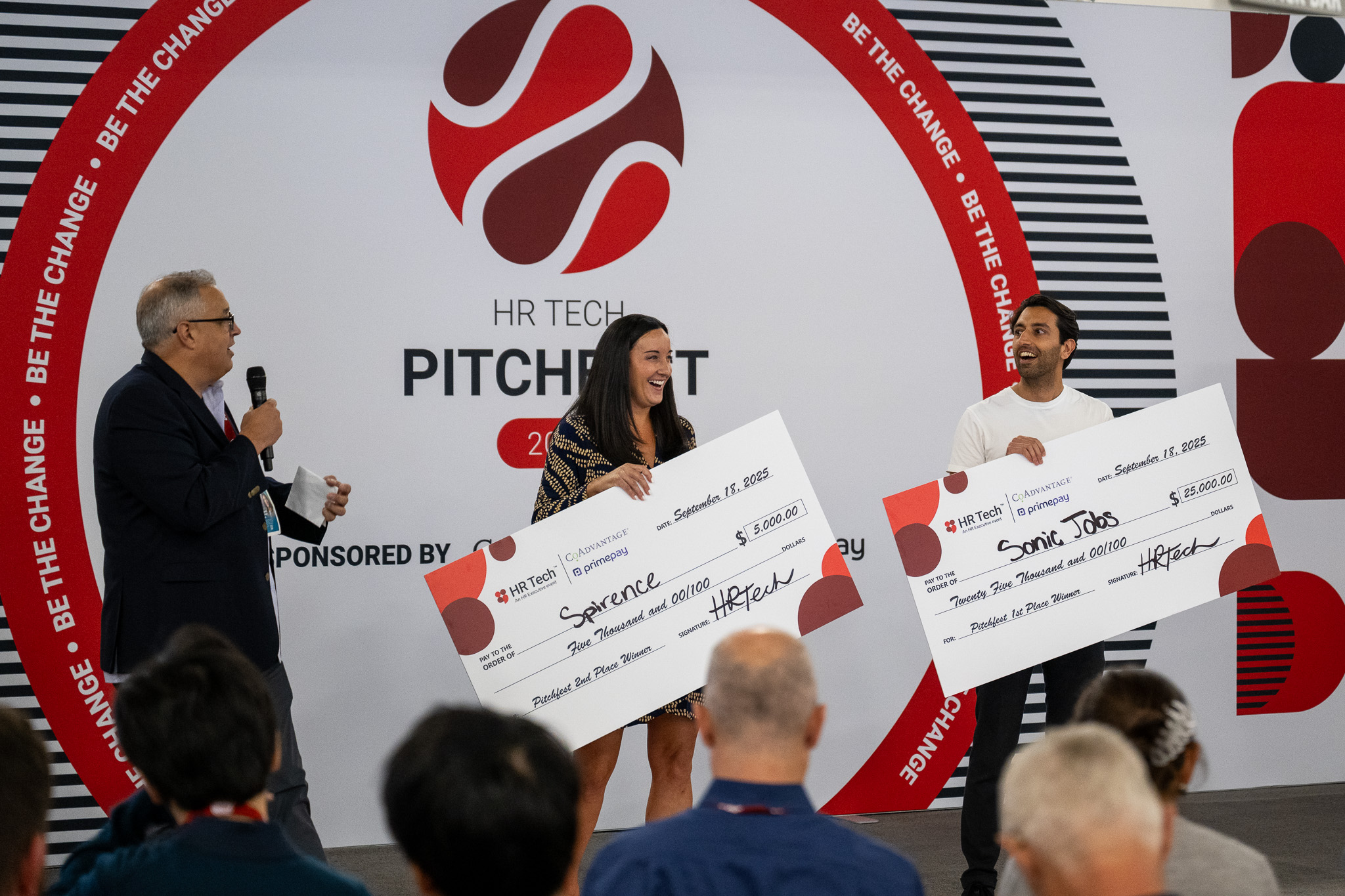
That argument shaped Raja’s pitch at the 2025 HR Tech Pitchfest in Las Vegas. More than 100 startups applied, 33 presented and six reached the final round. SonicJobs won first place and $25,000. Raja emphasized that the agent was not a mass auto-apply tool. It collected relevant answers, verified the candidate, and submitted applications intended to lead to hires. Recognition, he said afterward, mattered more than the prize money because it put the product in front of buyers and partners.
“The balance of friction is key to talent acquisition.”Mikhil Raja
The line is useful outside recruitment. Friction has acquired an unjustly shabby reputation in product design. Some of it is simply waste. Some of it creates trust, improves judgment or asks a person to pause before an important choice. A founder who removes every obstacle may discover that the obstacle was holding up the roof. Raja’s version is more discriminating: give every step an expense account, and cancel the ones that cannot explain dinner.
It also reflects the two-sided discipline Raja admired in marketplaces. A tool that saves candidates time by creating noise for employers has moved the inconvenience rather than solved it. SonicJobs must increase completion without degrading intent. The company’s more than 100 reported customers and partnerships with platforms including OfferUp and EarnBetter suggest a route built through distribution, not merely a consumer destination.
04 / The founder“Proper grit” meets the messy middle
Raja’s board has reportedly described him as “proper grit,” a phrase he traces to competitive tennis. His founder advice has the blunt rhythm of someone who has watched a long project wobble: “Startups don’t die when they run out of money. Startups die when the team runs out of energy.” He recommends Scott Belsky’s The Messy Middle, an apt favorite for a company that spent years building web agents before the category acquired its fashionable name.
There is a patient contrarianism in the sequence. SonicJobs did not wait for large language models to make agents sound inevitable. It began with RPA, vision and market-specific training, accumulating form patterns and edge cases while the tools were less glamorous. By the time computer-use models improved, the company was on its eighth generation. Technical timing is often discussed as a matter of arriving early. The harder trick is arriving early and remaining usefully occupied until the rest of the stack shows up.
Raja now works from San Francisco, where SonicJobs sits closer to the agent ecosystem that has caught up with its vocabulary. In 2024, he discussed the product on NVIDIA’s AI Podcast. In 2025, the team appeared at NeurIPS to talk about computer-use agents in production. More recently, Raja has been demonstrating a SonicJobs experience inside ChatGPT, where people can ask for work in human terms rather than reverse-engineering the correct keywords.
His stated ambition is to help the next billion people get hired. Grand numbers are easy to admire and hard to ship. The credible part begins lower down, in the fussy courtesy of remembering an answer, understanding a strange dropdown, and allowing a person to finish where they started. “A job is not just income,” Raja has said. “It’s an opportunity for a better career and life for you and your family.” The sentiment earns its weight because his product spends so much time on the unromantic mechanics beneath it.
A job application is a small act of optimism. Raja’s work asks why that optimism must pass an obstacle course designed by committee. His answer is not to abolish judgment or promise a job at the press of a button. It is to direct effort toward the questions that matter, while software handles the ceremony everyone has mistaken for seriousness. The next time a promising application survives the redirect, the victory will be almost invisible. Good infrastructure usually is.