Mike Natenshon’s favorite T-shirt had reached the stage at which affection and good judgment part company. He liked it. His girlfriend, Kelly, thought it was time for something else. The shirt went away. Most people faced with this domestic development would buy another shirt and perhaps make a small, theatrical complaint. Natenshon began a clothing business. It is an expensive way to win an argument about laundry, though the argument itself seems to have ended happily: Kelly became his wife.
The replacement proved harder to find than the original had been to lose. He wanted the softness accumulated through years of wear, available immediately. He wanted a fit that did not ask him to choose between two slightly wrong answers. Marine Layer grew from that dissatisfaction in San Francisco in 2009. Its co-founder and CEO had identified a problem small enough to sound ridiculous and familiar enough for other people to recognize.
There is something pleasingly backward about the proposition. Fashion usually offers permission to become a new person. Natenshon was trying to recover a feeling he already knew. The question was whether a new garment could arrive with the ease of an old companion, without requiring the customer to put in years of service first. His subsequent career has been a long investigation of that question.
California, viewed from a cold dorm room
Before the fabric came the setting. Natenshon traces his attraction to California to watching the surf film The Endless Summer in a freezing dorm room in Maine. The glow of the film helped persuade him to move west to San Francisco. That detail explains quite a lot about the clothes that followed. California was an imagined atmosphere before it became his address: warmth, leisure, a little distance from the sensible timetable.
Yet his working life had been in finance. The attraction of making something tangible was part of his desire for a change. A T-shirt offered a creative problem he could hold in his hands. His earlier training did not tell him how to make patterns, choose a mill, or persuade a stranger in Los Angeles to take a newcomer seriously. He went looking anyway.
While earning his Berkeley MBA, Natenshon heard that other people shared his fit problem. He was between medium and large. So were enough classmates to make the complaint worth investigating. He put savings and credit cards into the venture, and Marine Layer became material for class projects, including a pricing exercise. Business school had supplied both potential customers and homework. Few startups can say the same with quite such economy.
“I never thought it would be so hard to make a T-shirt.”Mike Natenshon, 2011
A shirt is simple until you try to make one
Natenshon’s first designs had to survive the distance between an idea and an actual body. Early production attempts came back too short or too long. Small batches limited the cost of those mistakes. The plainness of the object concealed the number of decisions inside it: the silhouette, the yarn, the hand of the fabric, the way everything behaved once sewn together. A basic tee can be an astonishingly elaborate basic.
The material eventually combined Supima cotton with MicroModal, a fiber derived from beechwood pulp. Developing the blend took more than a year. The ambition was specific: the worn-in softness that had made the missing shirt worth defending. A vague promise about quality would have been easier to satisfy. Natenshon had a memory against which to compare the samples, which is a rather unforgiving form of product testing.
Fit received the same attention. Marine Layer’s in-between size, “marge,” gave the medium-to-large predicament a name with a wink. The joke also did useful work. A customer who could not settle comfortably into either conventional size suddenly had a word for the problem. It is easy to dismiss a silly product name. It is harder to dismiss the relief of finally finding the right shirt.
MediumMARGE
In betweenL
Large
The email-list experiment that needed a lease
Early sales came through his apartment and through people who knew him. Kelly brought practical retail knowledge from her work as a merchant at Williams Sonoma. Natenshon persuaded Adam Lynch, his longtime friend, to join. The partnership gave the fledgling company an operating counterpart to its founder’s fabric preoccupation. It also meant that the business was being built by people whose relationship predated the business by years.
In 2010 they opened a pop-up on Chestnut Street. Natenshon had expected the company to sell online; the temporary shop was meant to help collect email addresses. Customers touching the shirts made the case for a more permanent arrangement. The experiment became a five-year lease. That is a substantial commitment for a mailing-list exercise, but a wonderfully direct customer verdict.
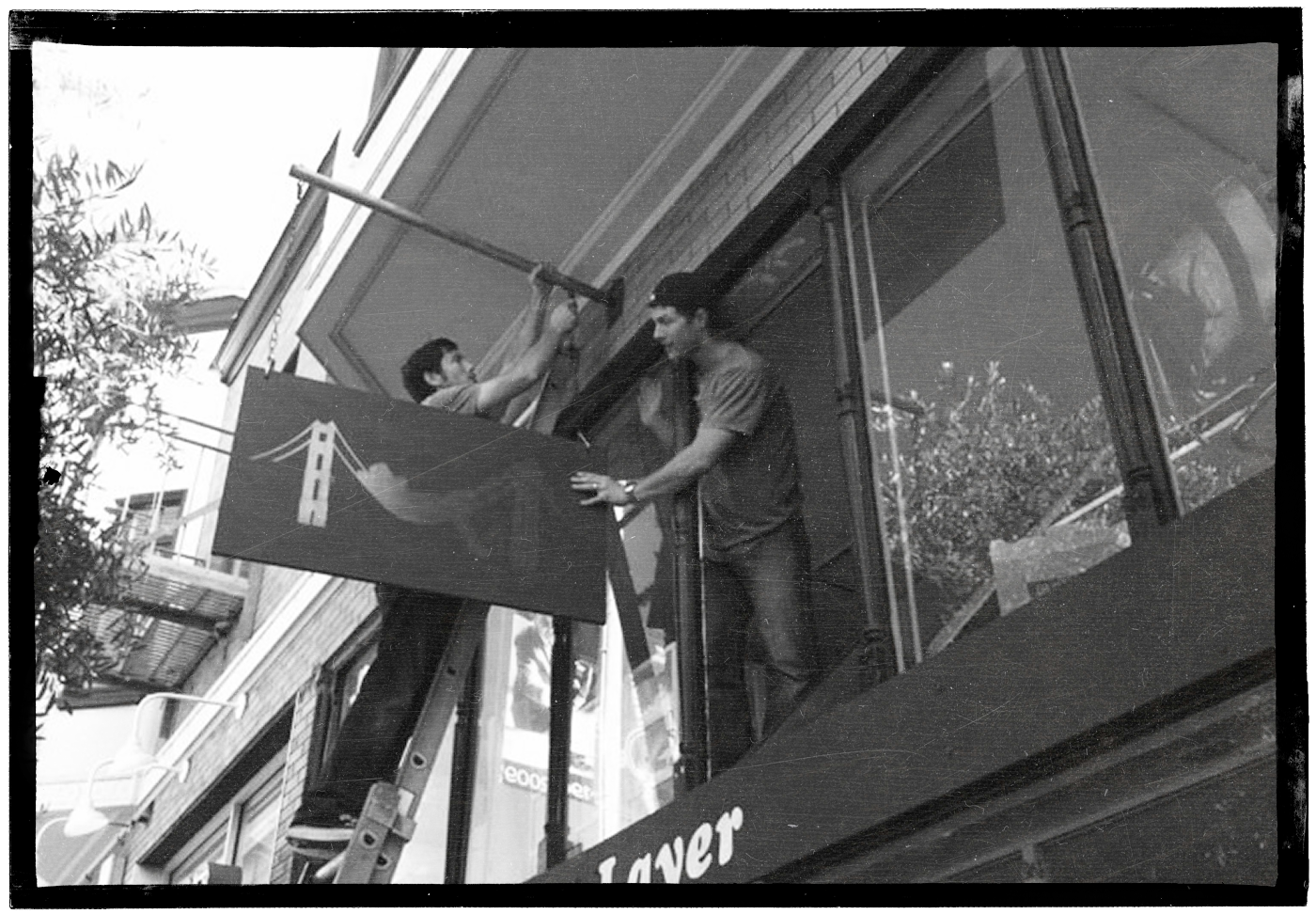
A photograph from Marine Layer’s beginnings shows the practical work of putting a sign above a store. It suits this origin better than a ceremonial ribbon. Before a retail network there is a ladder, a window, and the obligation to get the doors open. The business had to move from an appealing explanation to a place where someone could walk in, feel the fabric, and decide.
Friends, fog, and a bus with opinions
The founders bought a 1969 Volkswagen bus to transport their shirts. It became part of the brand’s traveling life and a recurring subject of Natenshon’s jokes about breakdowns. In 2020 he described a refresh that included a couch and a keg alongside the merchandise. A vehicle with that equipment seems unusually candid about its priorities. The company’s idea of a seven-day weekend had acquired wheels.
San Francisco supplied the name, too: the marine layer is the coastal fog. A wardrobe of light layers makes sense in a city where a sunny view can be accompanied by a rather chilly breeze. That relationship between place and product gave the brand something concrete to return to as it expanded beyond T-shirts. The weather was doing a little unpaid merchandising.
The humor was recognizable to the people working with Natenshon. At a 2019 fashion event, design leader Molly Getty described the brand’s voice as resembling his, with a slightly nicer disposition. Her observation is a useful portrait of a founder whose personality shows up in copy and clothes without needing his face on every label. The joke belongs to the company because it already belongs to the person.

Rooms above the shop
The urge to make a store feel like a place to spend time eventually extended upstairs. Marine Layer offered retro-themed rental lofts above stores in cities including Portland, Chicago, and New Orleans. The Portland idea grew out of repeated trips between the store and the San Francisco headquarters: the founders needed somewhere to stay. A practical accommodation became another way for visitors to experience the brand’s taste.
There is an enjoyable literalness to that move. Plenty of apparel businesses sell a lifestyle; this one supplied a room in which to sleep. Natenshon described the rentals as a way to experience the lifestyle beyond the store. By 2018, a Nashville apartment was also in the plans. These were particular experiments in hospitality, extending the same casual atmosphere rather than asking a shirt to explain everything on its own.
An ugly bag, then a better question
Concern about discarded clothing brings the story back to its beginning. An early attempt to use fabric scraps produced a jersey T-shirt bag that Natenshon remembered as hideous. Lynch kept it as a reminder. The object is almost too convenient a metaphor: good intentions had produced something nobody much wanted. It gave the founders a physical record of a solution that needed further thought.
In his letter introducing Re-Spun, Natenshon identified the missing ingredient in their earlier efforts: customer participation. The take-back program launched in November 2018 and received 10,000 shirts in its first month. Customers could become part of the material supply, handing over old garments rather than merely being asked to approve the company’s intentions. The product’s past could feed its next version.
The original recycling process sorted donated tees by color, removed embellishments, shredded the cloth back into fiber, and spun new yarn. It is an unusually concrete account of what happens after a collection box fills up. Old clothing does not become new clothing by enthusiasm alone. Someone has to take it apart, separate what can be used, and make something another person wants to wear.
Marine Layer became a Certified B Corporation in December 2022. At that date, its recorded collection and recycling total exceeded 575,000 T-shirts. The certification adds a formal framework to a story that began with personal preference. For Natenshon, the challenge had widened: make clothes people enjoy, keep a company going, and take responsibility for some of the material left behind.
- Collect old tees
- Sort by color
- Recover the fiber
- Spin new yarn
How much room can a favorite shirt make?
A February 2026 conversation with the founders described a business with 55 locations, grown from a single 450-square-foot storefront. That contrast is useful without requiring a triumphant growth curve. A small shop makes personal contact relatively easy. Dozens of shops make it a daily organizational task. Every additional location asks whether the feeling that attracted the first customers can survive being taught to new colleagues.
Natenshon had already voiced that concern in 2018: growth could outrun the company’s ability to maintain personal connections. The worry is consistent with his starting point. A favorite shirt is a relationship of sorts, established through repeated use. A business built around that idea has to think about what happens after the first purchase, after the first conversation, after the novelty wears off.
In July 2026, he received Counselor’s Supplier Entrepreneur of the Year award. Marine Layer had found customers in promotional apparel as well as its own stores and website. The route there is revealing: something developed for personal enjoyment became something organizations could put their names on. A corporate shirt still has to survive the private verdict of the person opening the drawer.
His recent conversations look ahead to further retail expansion, customizable products, and technology that supports the experience. The practical aspiration is continuity through change. He started by refusing to accept that the right feeling was no longer available. The company now has many more opportunities to get that feeling wrong, and many more people helping it get it right. Somewhere between the fabric sample, the fitting room, and the return visit lies the work. The original shirt is gone. The problem it left behind has kept him busy.