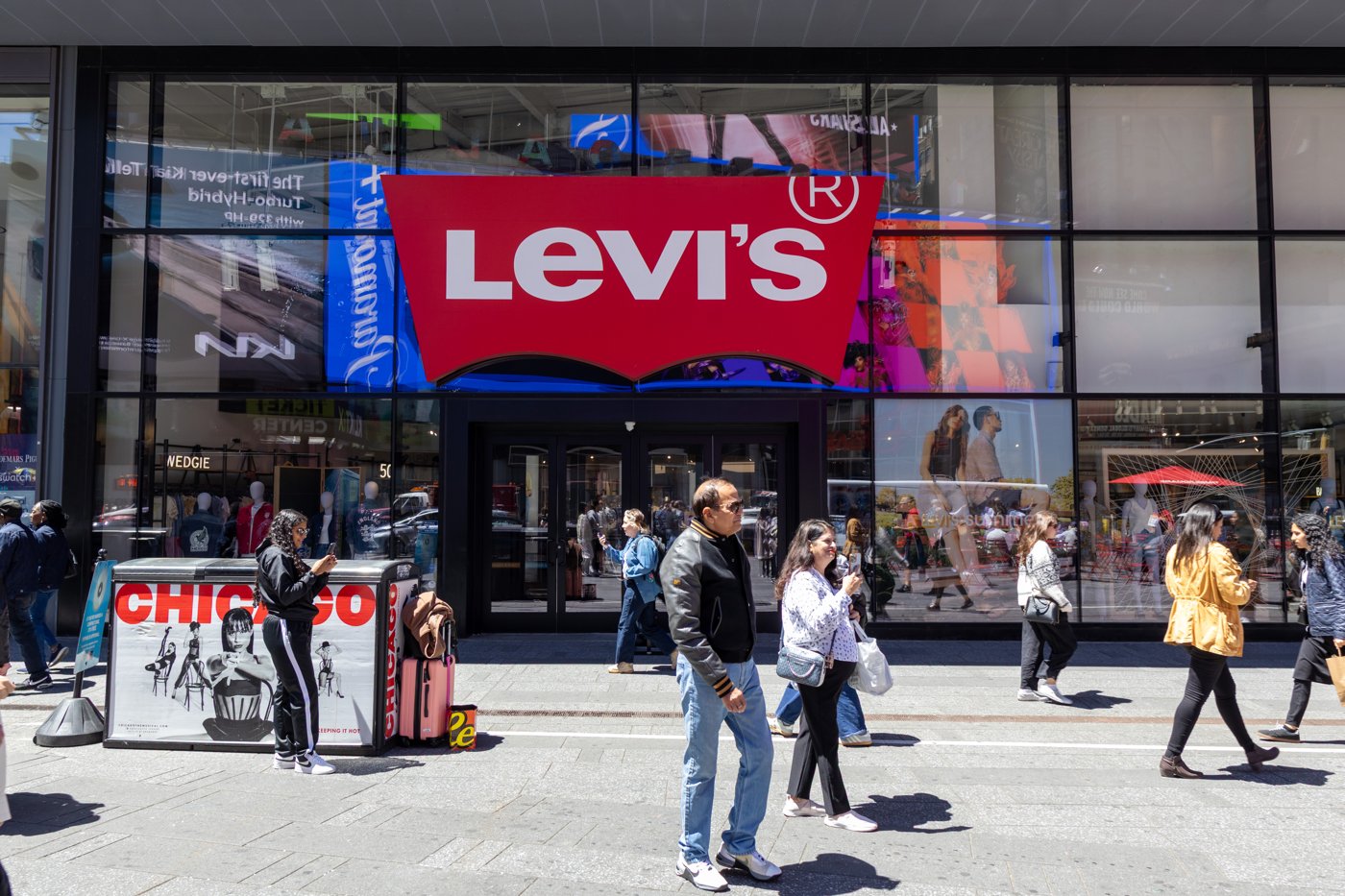
A 170-year-old company that acts like it just opened
Walk into a Levi's store today and the oldest brand in your closet is behaving like the newest. There is a tailor station stitching custom chain-stitch lettering onto a trucker jacket. There is a rack of secondhand 501s the company bought back and resold. There is a screen pushing you toward the app. The jeans on the wall are the same shape they were when your grandparents wore them, and that is exactly the point - and exactly the problem.
Levi Strauss & Co. sells denim in more than 110 countries under Levi's, Dockers, Beyond Yoga and Denizen. It did roughly $6.3 billion in revenue in its last full fiscal year, and its first quarter of FY2026 came in 14% higher than the year before. For a company that has been around since the Gold Rush, that is an unusual sentence to write.
The most recognizable jeans on earth are also the easiest to take for granted. Levi's spends a lot of energy making sure you don't.
- The central tension, in one lineInventing a category is great. Owning it forever is the hard part.
Here is the awkward truth about being the company that invented something: everyone copies you, and eventually the thing you invented becomes a commodity. Blue jeans are now made by fast-fashion chains, luxury houses, and a vending machine's worth of brands in between. The word "jeans" belongs to no one. The challenge for Levi's has never been making denim. It has been staying the denim people actually choose to buy.
For decades the company solved that by being everywhere - stacked on tables in department stores, sold through thousands of wholesale doors, its margins quietly handed to whoever stood between Levi's and the shopper. It worked, in the way that being everywhere usually works: profitably, and a little anonymously.
When you sell through everyone else's store, you learn what sold. You never learn who bought it, or why.
- The case for going directThat anonymity became the problem to solve. A heritage brand that doesn't know its own customer is a brand renting its future to a middleman.
A $68 patent fee and a very good rivet
The original bet was small and slightly accidental. Levi Strauss, a Bavarian immigrant, came to San Francisco in 1853 to sell dry goods to Gold Rush miners. Twenty years later a Reno tailor named Jacob Davis wrote to him with an idea: reinforce the stress points of work pants with copper rivets. Davis had the idea but not the $68 he needed to file a patent. Strauss had the $68. They split the patent, filed it in 1873, and quietly invented the blue jean.
The Origin, Unromanticized
- Strauss didn't invent the rivet idea - Jacob Davis did, and needed a backer with cash.
- The first product was called "waist overalls." The word "jeans" didn't stick until the 1960s.
- U.S. Patent No. 139,121, granted May 20, 1873, is the legal birthday of the blue jean.
- The company has run on four words since 1853: empathy, originality, integrity, courage.
The modern bet is much larger. Under CEO Michelle Gass - who arrived in 2023 and took the top job in 2024 - Levi's is pivoting from a wholesale supplier into a direct-to-consumer "denim lifestyle brand." Translation: sell more of it yourself, in your own stores and on your own app, to a customer you actually know. Gass has been blunt about the destination. She wants to build the company past $10 billion in revenue without sanding off the thing that made it iconic.
We are evolving into a DTC-first denim lifestyle brand, which lets us capture a much larger addressable market.
- Michelle Gass, President & CEO, Levi Strauss & Co.The Long Inseam
San Francisco. Levi Strauss opens a wholesale dry-goods business during the Gold Rush.
The patent. Strauss and Jacob Davis patent riveted "waist overalls." The 501 lineage begins.
The Red Tab. The little red flag is sewn onto a back pocket to fight knockoffs - a trademark that still works.
The Batwing. The red housemark logo debuts, shaped from the brand's own back-pocket arc.
Dockers. Levi's launches khakis and quietly helps invent business casual.
Water<Less. The company rolls out finishing techniques that slash water use in denim production.
Back to Wall Street. Levi Strauss & Co. returns to public markets on the NYSE as LEVI.
New driver. Michelle Gass becomes CEO and accelerates the direct-to-consumer strategy.
One jean, endlessly re-cut
The 501 is the spine of everything. Introduced in the 19th century, it is widely cited as the best-selling pair of jeans in history, and the company has spent a century resisting the urge to fix what isn't broken. Around it sits the rest of the wardrobe: trucker jackets, the women's business that Gass has made a growth priority, Dockers khakis, Beyond Yoga activewear (acquired in 2021), and Denizen for value shoppers and emerging markets.
Then there is the part that complicates the story. A single pair of jeans can consume thousands of liters of water across its life - growing the cotton, dyeing the indigo, finishing the fabric. For a company whose entire business is denim, that is not a footnote. It is a liability with a deadline.
You cannot sell billions of liters of water as a side effect and call yourself a heritage brand worth keeping.
- Why Water<Less isn't marketing garnishSo in 2011 Levi's built more than 20 finishing techniques under the Water<Less banner, cutting the water used to give jeans their worn-in look. Add the SecondHand resale program, which buys back and resells used Levi's, and the product strategy starts to read less like "make more jeans" and more like "make the jean last, then sell it twice."
The numbers behind the swagger
Heritage is a story. Revenue is a fact. Levi's has been turning the first into the second for a while, and the recent direct-to-consumer push is showing up in the financials, not just the press releases.
Quarterly momentum: FY2026 came out swinging
The double-digit print is the kind of number a 170-year-old company is not supposed to put up. Levi's keeps forgetting it's supposed to be old.
The proof isn't only financial. Levi's keeps renting space in the culture - the Beyoncé "LEVII'S JEANS" partnership, sneaker collaborations, and a back-pocket logo that turns up on people who have never thought about the company once. That cultural rent is the quiet asset competitors can't buy.
Most brands chase relevance. Levi's mostly has to avoid losing it - a much harder job, and a much better problem.
- On the economics of being iconicClothes as a force for good, allegedly and actually
Plenty of companies discovered values around the time it became fashionable. Levi's has the receipts to claim it earlier - desegregating factories ahead of the law, building the Levi Strauss Foundation, funding worker-wellbeing and social-justice work for decades. The mission today bundles that history with sustainability: reduce water, extend garment life, and treat the supply chain as something the company is accountable for, not something it merely buys from.
It is fair to be skeptical of any apparel giant talking about the planet. It is also fair to notice that Water<Less and SecondHand are operational programs with numbers attached, not slogans on a hangtag. The mission only counts if it survives a spreadsheet, and so far this one keeps showing up in the manufacturing line.
Things That Amuse & Inform
- The company archive holds the oldest known pair of 501s, dating to around 1879.
- The Red Tab exists because of counterfeiters - it was added in 1936 purely to spot fakes from across a store.
- "Waist overalls" was the official name for more than half a century before "jeans" won.
- The batwing logo's outline is literally traced from the stitching on a 501 back pocket.
The bet that an old brand can grow up without selling out
The direct-to-consumer pivot is the whole game. If it works, Levi's becomes a brand that knows its customer, keeps more of the margin, and funds the sustainability work out of strength instead of guilt. If it stalls, the company drifts back toward being a very famous logo sold mostly by other people's stores - profitable, anonymous, and slowly commoditized by everyone it taught to make jeans.
For shoppers, the practical upshot is simple. You can still buy a 501 that will outlast your phone, your car, and possibly your lease. You can now buy it directly, get it tailored, sell it back, or buy someone else's used pair. The jean stayed the same. The relationship around it is being rebuilt.
The oldest brand in the closet is trying to become the one you talk to directly. That's the entire plan.
- The closing argumentSo return to that store. The tailor is still stitching. The secondhand rack is still full. The 501s on the wall are still the same shape they were in 1873 - but the company behind them is no longer content to let a middleman decide who wears them. After 170 years, Levi Strauss & Co. has decided the most radical thing it can do is meet its customer face to face.