The first thing to understand about Mike Huang's career is that its apparent zigzags are the point. He moved from business intelligence to commerce software, from enterprise product management to social experiments, from an acquisition into Google to a startup of his own. The categories kept changing. The underlying question did not: how do you persuade a person to place a small piece of trust in a piece of software, then return tomorrow and do it again?
That is less romantic than the usual founder mythology. There is no garage in the tale, no lightning bolt, no insistence that history had been waiting for precisely this application. There is instead a product manager's education: ship, measure, notice, revise. Huang earned a bachelor's degree in mathematics at the University of Georgia and a master's in operations research and applied statistics at North Carolina State University. The formal training supplied models. His jobs supplied humans, who have always regarded models as polite suggestions.
He began in product management at MicroStrategy in 1997, then moved to Blue Martini Software. At Oracle, where he became a group product manager, the work involved the disciplined, sometimes unglamorous craft of examining how customers used a product and turning that evidence into improvements. A public executive profile credits him with lifting adoption by 75 percent. The figure matters less as decoration than as a clue: Huang was learning to look for behavior after the sales pitch was over.
The social laboratory
Slide was where the tidy world of enterprise software gave way to the unruly theatre of consumer attention. Huang joined in 2005 and eventually served as executive vice president of Slide Asia and vice president of product. The company built social applications at a time when the Facebook platform looked like fresh territory and every notification carried the faint promise of a new habit.
Two experiments from that period are especially instructive. Disco was a group messaging product. Prizes.org was a web and mobile marketplace for ideas. One executive biography reports that Disco grew faster than Slide's other products and that Prizes.org maintained retention above 40 percent. Both products have since become period pieces, but the mechanics survive everywhere: a reason to return, a group to return to, and enough feedback to make participation feel consequential.
When Google acquired Slide in 2010, Huang became a director of product management there. Acquisitions are often narrated as endings, though for operators they are also field trips into scale. A product that once lived by the instincts of a compact team enters an organization with vast distribution, deeper infrastructure, and many more ways to say no. Huang stayed until late 2012. Then he chose the small room again.
The product before the business model
Huang co-founded Glow with Max Levchin and a group that included Kevin Ho, Ryan Ye, and Christopher Martinez. Levchin, known for PayPal and Slide, served as executive chairman. Huang ran the company. At launch in August 2013, Glow had roughly ten full-time employees divided between San Francisco and Shanghai. The arrangement was a compact statement of the company's operating logic: customers and capital in one city, a substantial engineering presence in another, and product management as the connective tissue.
The origin story has an agreeably analog prop. Huang once described himself writing important information on paper, then looking at the page with the professional disbelief of someone who had spent years replacing manual processes with software. The anecdote works because it captures a recognizable product instinct. Friction becomes interesting when a builder experiences it personally, but it becomes a company only when the builder discovers that the friction is shared.
Glow's first product was narrow and mobile. Over time, the company expanded into a portfolio of apps with personalization, logging, content, and community at their center. Those elements were not random features collected by committee. They reflected the lessons of Huang's earlier work. Logging creates useful data. Personalized feedback rewards the logging. Community gives people reasons to return even when the software has nothing novel to say. The loop was the product.
The business arrived with serious backing. Founders Fund and Andreessen Horowitz participated in an initial $6 million round. In 2014, Formation 8 joined existing investors in a $17 million Series B. The same year, Glow won a Webby in the mobile apps category. Awards and funding can make a young company appear inevitable after the fact. Huang's public comments at the time suggest he regarded the sequence more carefully.
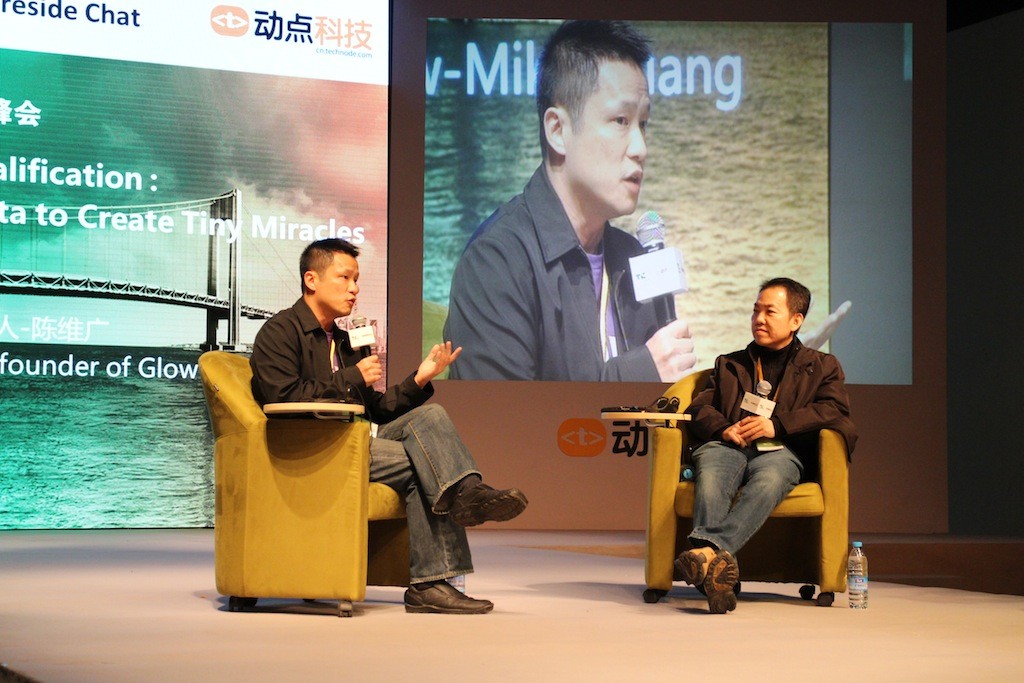
At a 2013 appearance in Shanghai, he said the company was not in a hurry to make money and that its first priority was making a fantastic product for customers. Monetization was welcome, but not if it damaged the experience that gave the company a reason to exist. It is an unfashionably patient principle, especially in consumer software, where the temptation to insert a tollbooth appears approximately five minutes after the first user arrives.
Sequence matters. First create a behavior worth repeating. Then find a business model that preserves the reason people repeat it.
Two cities, one product language
Huang's remarks in Shanghai also reveal a less celebrated part of his work. He argued that Chinese technical talent compared well with its Silicon Valley peers, while greater exposure to Silicon Valley's product thinking could help it flourish. The interesting word there is exposure. He was not proposing that one office imitate the other. He was describing the circulation of context.
Distributed companies now possess elaborate rituals for this problem: written updates, recorded demonstrations, virtual whiteboards, asynchronous decisions. Glow's early team had the same underlying task before remote work acquired a management industry. Code can travel instantly. Assumptions travel coach. A leader working across offices has to make invisible things visible: who the customer is, what problem deserves priority, why a rough edge matters, and when speed is merely hurry wearing a lanyard.
Huang's résumé made him unusually suited to the translation. Enterprise software had taught him to listen for explicit requirements. Consumer software had taught him that people often reveal their requirements only through behavior. Slide had taught experimentation. Google had demonstrated scale. His quantitative education gave him comfort with data, while years in product gave him reasons to distrust any chart that claimed to explain a person completely.
The quieter kind of ambition
Huang is not a founder who has spent years turning himself into a public character. His available interviews cluster around company launches, partnerships, product changes, and data. The absence of theatrical autobiography makes the operating philosophy easier to see. He talks about the product, the customer, the team, and the evidence. Even his bolder claims tend to arrive attached to a metric.
This can be mistaken for modest ambition. It is better understood as ambition directed outward. Huang helped take Glow from one iPhone application to a family of products, from a roughly ten-person launch team to a company with teams on both sides of the Pacific, and from $6 million in initial financing to $23 million across its first two announced rounds. The aim grew; the public persona did not need to grow in equal proportion.
There is a useful founder lesson in that restraint. Visibility and clarity are different resources. A leader may accumulate the first while losing the second. Huang's career suggests another route: keep studying behavior, keep the product legible, and be slow to confuse attention with evidence. The world is already generous with opinions. A returning user is harder to counterfeit.
The line from mathematics to Glow is therefore neither straight nor accidental. It runs through systems built for companies, experiments built for social networks, a large technology platform, and finally a consumer company built around recurring personal routines. Each stop added a different answer to the same question about trust. Software asks for it with every tap. Good product managers remember that the person tapping owes them nothing.
Huang's most durable achievement may be the coherence hidden inside those career changes. Categories age. Interfaces date themselves with astonishing speed. The habit of observing carefully survives. It is not glamorous work, which is fortunate: glamour attracts crowds, and someone still has to notice what the customer is doing.