In 2009, a mortgage company looking for a bank had good reason to expect a closed door. The financial crisis had made mortgage lending an uncomfortable subject, and big lenders were retreating. Merchants Bank went looking for business in the space they left behind. Mike Dunlap joined that August as senior vice president of mortgage banking. His assignment would put him close to the plumbing of American home finance, where a reliable supply of money matters rather more than a handsome branch lobby.
Years later, explaining that decision, he put it simply: “When all of the big banks got out, we got in.” There is a whole business biography inside that sentence. It contains an opening in a market, the confidence to enter it, and the practical task of keeping customers once larger competitors return. Dunlap helped establish the bank’s warehouse lending platform. Showing up was the beginning. Making the arrangement work was the job.
An accountant enters the mortgage business
Dunlap’s route to the chief executive’s office began with accounting. He studied at Indiana University’s Kelley School of Business and started his career as a certified public accountant at KPMG. The early professional vocabulary was numbers, controls and financial statements. Before Merchants, he held finance positions at Waterfield Mortgage and Bank One, then served as chief financial officer of National City Mortgage.
Those names also trace a period of consolidation in American finance. Waterfield was acquired by Huntington; Bank One became part of JPMorgan Chase; National City became part of PNC. Dunlap’s experience came from inside mortgage businesses that needed to keep operating while the names above the door changed. A balance sheet has little interest in a new corporate logo. Its obligations survive the stationery.
That background helps explain the work he took on at Merchants. Building a lending operation requires decisions about funding, process and people long before it produces a memorable advertisement. His public career follows that sequence: technical finance roles, responsibility for a business line, then broader operating authority. The accountant did not disappear when the job titles became longer.
The warehouse with no loading dock
Warehouse lending has an unfortunate name for anyone trying to picture a bank at work. It suggests forklifts. In mortgage banking, it concerns the financing that lets mortgage lenders fund loans before selling them onward. The customer is another lender. The machinery sits behind a household transaction that is much more familiar: somebody buying or refinancing a home.
Merchants’ warehouse business serves mortgage bankers nationally, offering lines of credit and loan participations for single-family and multifamily lending. That is a different route to a national presence from putting a branch on every busy corner. Relationships with other mortgage businesses carry the bank’s reach beyond its home state.
Dunlap was also primarily responsible for establishing Merchants Mortgage, the bank’s single-family mortgage origination and servicing division. The two activities put Merchants at different points in the same financial system. One supports mortgage companies; the other originates and services loans. They require related knowledge, with different customers and operating demands. His contribution was to help turn that knowledge into functioning businesses.
- Bank fundingWarehouse credit
- Mortgage lenderFunds a home loan
- Loan saleInvestor purchases loan
A simplified financing sequence, rather than a measure of Merchants’ loan volumes.
Four dates, widening responsibility
His promotion record is unusually legible. After arriving in 2009, Dunlap became a director of Merchants Bancorp in May 2014. He also became president and co-chief operating officer of Merchants Bank that year. In January 2018, he moved into the president and chief operating officer roles at the holding company, succeeding co-founder Randall Rogers in those positions.
Then, in January 2020, Dunlap became chief executive of Merchants Bank and chairman of Merchants Capital. Michael Petrie retained leadership of the parent company and his chairmanship of the bank. Michael Dury became CEO of Merchants Capital. The names are easy to tangle; the division of responsibility matters. Dunlap’s bank CEO title does not make him CEO of every business carrying the Merchants name.
The changes formalized a succession from founders to executives who had already spent years inside the organization. They also left Dunlap working across three layers: the bank, its parent and the multifamily finance business. His career became an exercise in connecting operations that share capital and relationships while doing distinct kinds of work.
The people rule, before the poster
For all that institutional complexity, Dunlap has a strikingly uncomplicated hiring rule. In February 2026, he described it this way: “Our number one rule is you cannot be a jerk and work here.” He said the expectation is made clear during interviews. It extends to customers, too: employees should be treated respectfully, and a customer who crosses that line can be asked to take their business elsewhere.
The idea has a longer history than the memorable phrasing. Back in 2019, as Merchants prepared for a headquarters move in Carmel, Dunlap credited Petrie and Rogers with giving employees autonomy and respect. He was specific about avoiding micromanagement. His description of the founders emphasized confidence in the people doing the work.
“When people feel trusted and respected at work, they do amazing things.”
Mike Dunlap, 2019
There is an operational question underneath this language: how much judgment can an organization entrust to its staff? Dunlap’s answer gives employees room to use their talent. That makes the hiring standard consequential. A rule about everyday conduct becomes part of deciding who gets responsibility in the first place.
A speech with the steel still showing
In June 2024, Dunlap spoke at a topping-off ceremony for a new Merchants Capital building in Carmel. Petrie and Dury spoke as well. A topping-off marks the placement of a building’s highest structural element, so the occasion supplied a rather literal picture of an expanding organization: executives at a construction site, celebrating work that was still visibly unfinished.
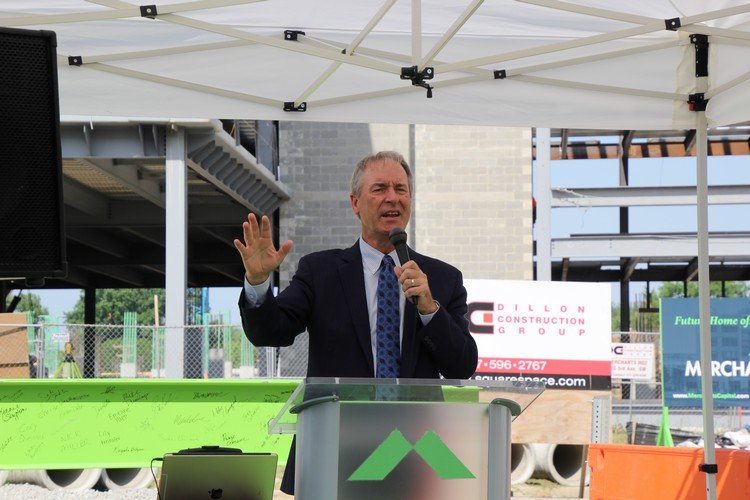
The plans included a bridge between the bank’s HQ1 and the Capital building. As corporate metaphors go, this one had the advantage of requiring an actual contractor. The connection would join workplaces occupied by related businesses whose leaders had grown up professionally alongside one another.
The workplace story continued in July 2026. Merchants reported a fifth-place finish among large companies on the Central Indiana Top Workplaces list and an eighteenth-place national finish among employers with 500 to 999 employees. The assessments used anonymous employee feedback, and the local recognition included work and personal-life flexibility. Those are company workplace awards, rather than individual prizes for Dunlap, but they concern the environment he helps run.
The CEO and the frog
Accounting and mortgage finance are one preparation for public life. Appearing alongside a frog mascot is another. Dunlap has done both. Merchants’ advertising paired its CEO with Hopper in a campaign promoting deposit accounts, using television, digital media, print and social channels.
In 2024, the American Bankers Association recognized the campaign in its integrated marketing category. The reported results included 4,242 money market and certificate-of-deposit accounts opened and $272 million deposited in its first five months. Website traffic increased 61%. These were campaign results, not a personal scorecard for the executive in the commercials. Still, his participation made the person running the bank part of its public introduction.
The association between Dunlap and Hopper adds a welcome absurdity to a career otherwise full of committee names. A chief executive can discuss mortgage funding at work and share the screen with a mascot afterward. Both activities ask an audience to place some confidence in the bank, although only one requires a frog.
A bigger stage in Bloomington
Indiana University brought another audience. In August 2025, Merchants committed $50 million over 20 years to an athletics partnership that renamed the playing surface at Memorial Stadium Merchants Bank Field. The agreement also included financial education for student-athletes. For Dunlap, a Kelley graduate, the university was already part of his own history.
By September 2026, he was appearing in a commercial filmed on that field with head coach Curt Cignetti and members of the football team. The premise played on the coach’s habit of writing on note cards during games. Hopper appeared; Petrie made cameos. The bank’s executives were putting themselves inside the same Indiana story they were paying to support.
On October 15, 2026, IU announced a further five-year agreement making Merchants the jersey patch partner across all 24 varsity sports programs. The field sponsorship and the patch agreement are separate commitments. Together, they show how much more visible the institution had become since the days when Dunlap was helping build its mortgage operations.
Housing, at the other end of the paperwork
There is a smaller dollar figure worth keeping beside the stadium agreement. In June 2025, Merchants announced that it had helped secure $200,000 in Federal Home Loan Bank of Indianapolis grants for three local nonprofits: RDOOR Housing Corporation, Coburn Place and Hamilton County Area Neighborhood Development. The funding supported affordable housing and related community work in the Indianapolis area.
Dunlap welcomed the awards and emphasized the organizations’ importance to his team. The work sits close to the subject that has followed him through finance jobs, lending platforms and executive promotions: housing. A national mortgage business and a local housing nonprofit operate at different scales. Each still depends on money reaching a useful destination.
That is the thread through Dunlap’s career. He has worked on the financial arrangements, taken responsibility for larger operations and become a recognizable face in the advertisements. The most revealing part remains the work between those moments: financing a lender, trusting an employee, maintaining a relationship. Showing up starts the story. There is considerably more paperwork after that.
Follow the story
- Mike Dunlap on LinkedIn
- Official biography
- Merchants Bank
- The 2009 mortgage-market decision
- The 2024 campaign
- Watch the IU commercial
- The October 2026 IU agreement
- Dunlap on workplace conduct
- Trust and the Carmel headquarters
- The HQ2 ceremony
- Housing grants in Indianapolis
- The 2026 workplace recognition
- The leadership appointments
- Career details in company filings
- Merchants on Instagram
- Merchants on X
- Merchants on Facebook
- Merchants on YouTube