At Binance, some people trying to open an account kept failing an identity check. They tried again. They failed again. According to Microblink’s account of the project, the trouble began with the photographs: inconsistent images sent legitimate customers into a rejection loop. The customer could be perfectly real and still look, to the software, like a problem.
- Microblink turns cameras into document and payment-card readers.
- Its software also checks authenticity and connects fraud signals.
- The useful lesson: fix the capture before multiplying the checks.
The photograph failed first
That is a wonderfully ordinary place to find an AI company. A finger covers a corner. A lamp throws a reflection across the plastic. An image blurs. Somewhere farther along, a verification system must judge evidence that was compromised before it arrived. The apparent security problem has a customer-experience problem sitting underneath it.
Binance integrated BlinkID to improve that first encounter. The software detected blur, reflections and finger obstructions, supplied live guidance, and met the exchange’s restrictions on SDK size. Microblink’s case study reports a 40% increase in user conversions. That is a relative improvement, not a published increase of 40 percentage points. It is also a vendor-reported customer result, rather than a promise about the next integration.
user conversions at BinanceReported in Microblink’s customer case study. Relative increase.
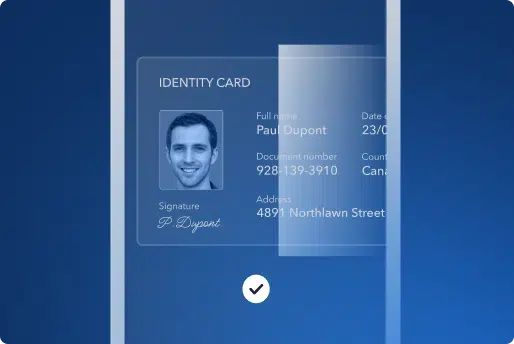
The interesting part is the sequence. First, improve the evidence. Then ask the difficult questions about it. A product manager could borrow that sequence tomorrow: examine failed images and repeated attempts before adding another demand to the signup form.
Seven years before the check
Microblink’s roots are in Croatia, where an earlier project, PhotoPay, helped people scan payment slips and invoices. A pilot with Erste Bank dates to 2011. Microblink gives its founding year as 2013; its Croatian founders include Damir Sabol, Izet Ždralović and Jurica Cerovec. There was a practical ambition underneath the computer vision: make a phone read information that a person would otherwise type.
By December 2020, the business was profitable and had been bootstrapped, according to its investment announcement. Silversmith Capital Partners led a $60 million minority investment. The money was intended for products, sales expansion and hiring. Longtime American partner BlinkReceipt combined with the business during the transaction, and Darren Bassman became CEO. Today, Hartley Thompson leads the company.

The company’s careers page supplies a small clue to its engineering culture. “Technical people make technical decisions,” says staff engineer Krešimir Jelić. That is an employee testimonial selected by the employer, but a revealing statement of intent. The same page describes learning from setbacks and sharing responsibility. Computer vision still needs people willing to inspect what went wrong.
Reading is only the first job
The products make more sense once their jobs are separated. BlinkID captures documents and extracts information. BlinkID Verify checks document authenticity and fraud indicators. BlinkCard reads payment-card details and adds signals about how the card is presented. A merchant can reduce typing at checkout; a bank can collect identity evidence; a hotel can speed up guest registration.
Those distinctions matter. Reading a genuine-looking card number does not prove that the person presenting it owns the card. BlinkCard’s checks for screen images and photocopies address another part of that problem. Identity workflows can bring in face matching, liveness, watchlist checks and other signals. Each answers a different question.
Microblink sells this machinery to businesses through SDKs, APIs and its broader platform. Its published licensing terms describe quote-based annual fees and usage tiers. Buyers also need to budget for integration, testing and exception handling. The economic test is whether software and operating costs are justified by fewer abandoned applications, fewer manual interventions and better fraud decisions.
This puts Microblink between document-reading software and full identity platforms. Jumio and Entrust, whose verification offering was formerly Onfido, sell overlapping capabilities. Microblink’s distinctive combination is its capture engineering, payment-card technology and fraud research. The sensible comparison is a trial on the buyer’s documents and devices, with acceptable rejection and fraud rates defined beforehand.
Deployment deserves the same care. The privacy notice for Microblink’s demonstration app distinguishes Capture and Extract, which process on the device, from Verify, which sends evidence to its cloud infrastructure. A buyer should map that boundary for the actual configuration being purchased. “On-device” describes particular processing steps; it should never become an assumption about the entire verification journey.
A laboratory for the next forgery
A readable document can still be a fake. Microblink’s Fraud Lab generates synthetic document variations and attacks to train and test detection models. Its February 2026 award announcement describes more than 100,000 synthetic IDs generated monthly. Making the bad examples is part of teaching the system what to distrust.
“No solution can catch 100% of fraud while also accepting 100% of good users.”Microblink’s developer overview on GitHub
That admission is more useful than a slogan about perfect security. Thresholds determine who gets rejected and who gets through. Microblink lets customers adjust checks, but the customer still has to choose the tradeoff. Camera conditions, supported documents and the population being served all matter. A laboratory score cannot settle every production decision.
Who gave the agent permission?
On October 8, 2026, Microblink announced a Q4 expansion of its Identity Intelligence OS, covering biometrics, generated-image detection, document intelligence and conversion analytics. It also outlined work toward “Know Your Actor”: connecting a verified person to an agent, its permissions and its actions. The release was expected to begin rolling out during Q4; agent-oriented services were described as roadmap work.
The question is concrete. If software books a hotel room for you, the hotel may need to know who you are and what you authorized. That extends well beyond reading your passport. Microblink’s ambition has grown, but its most transferable lesson remains close to the camera: find the exact point where a legitimate person gets stuck. Then make that moment work.