Michal Klaus had a peculiar problem when Ataccama was taking shape: he was worried about the people leaving his team, and he was the person taking them. As a leader at the data consultancy Adastra, he knew the value of those ten colleagues. As the incoming head of a software spin-off, he needed them. Starting a company is often described as a leap. Klaus had the additional pleasure of watching it from both sides of the gap.
“It was me on both sides,” he later recalled. The arrangement initially sounded tidy. Ataccama would build the software; Adastra would handle sales and marketing. Reality requested an amendment. The new business developed its own commercial operation, too. A tool could leave the parent company. A working business required rather more luggage.
An uncomfortable seat on both sides
The opportunity came from work the team already understood. Data integration projects exposed the same difficulty repeatedly: information arrived incomplete, inconsistent or otherwise unfit for the job ahead. An internal tool for improving that information suggested a product that other organisations might buy.
The spin-off dates to 2007; Klaus described operations getting under way in 2008. That put the young business into an awkward economic moment. Yet he remembered the downturn opening doors. Customers looking more closely at software bills had a reason to consider an alternative to established suppliers. Scrutiny could be useful to a newcomer prepared to withstand it.
Early banking customers gave the company a foothold. Bank of Montreal came before Lloyds Banking Group, which arrived in 2011. The problem Ataccama addressed travelled well: large organisations needed information they could use with confidence. Geography offered no exemption from an untidy database.
The programmer learns to sell
Klaus’s route to that opportunity crossed several kinds of work. His professional history starts with programming consulting at HTP/Metis between 1991 and 1994. He then spent six years as a partner and managing director at Integia. He had already run a business before Ataccama became his long assignment.
Adastra followed in 2000. There, his roles moved through project management, business development for the Czech Republic and Slovakia, and leadership of a master data management competency centre. The sequence helps explain why he could recognise both the engineering opportunity and the commercial inconvenience of separating it from its original home.
A former manager, Tom Jones, remembered a technically capable colleague who could also be trusted in front of clients. Those two abilities belong together in this story. Someone has to understand how a system works. Someone also has to hear what a customer means when saying that it does not.
Sixty-five people, rather large customers
By October 2015, Ataccama described a business with about 65 employees and $15 million in revenue for the preceding fiscal year. Its customers included American Airlines, GE Capital and Canadian Tire. For a relatively small team, these were substantial names to have on the other end of the telephone.
“We want to grow faster,” Klaus said. The company had become profitable after three years, and expansion after the initial Adastra backing was funded through the business. That history gives the later investment announcement some perspective. Years of selling, delivering and hiring preceded the large cheque.
The product was changing alongside the organisation. In 2015, Klaus discussed moving modules to the cloud and shortening the innovation cycle. A software company cannot simply preserve the version that first worked. Customers change their infrastructure, purchasing habits and expectations. The successful early product eventually acquires the slightly inconvenient status of something that must be rebuilt.
operations begin
$15m prior-year revenue
growth investment
board advisory role
A car that knows where the data lives
Klaus found an accessible image for the next stage of the software: a self-driving car. A user would specify the destination, and the system would handle more of the journey. Applied to data, the ambition was to find, analyse and prepare information without requiring every user to become a technical specialist.
The analogy makes a fairly dry enterprise purchase sound almost leisurely. Underneath it sat demanding engineering. Ataccama ONE’s second generation expanded the use of artificial intelligence and machine learning to automate routine work. The intention was to reduce the effort between wanting an answer and having suitable information with which to pursue it.
Klaus also argued that this kind of development could attract technical people. The company offered difficult problems, international customers and work on data and AI from a Czech base. His recruitment pitch rested on the substance of the task. There was plenty to do before the metaphorical passenger could settle into the back seat.
By late 2022, he was describing another consequence of competing internationally: a developer in Prague cost roughly as much as one in Toronto. The Czech base offered no permanent escape from global competition for people. He had noticed Czech startups advertising in the metro and on the streets to attract developers. For someone whose product worked largely out of public sight, becoming more visible had acquired a practical purpose. The next recruit had to know the company existed before deciding whether its work was interesting.
The ambition, and the edit
In 2021, Klaus remembered the founders having “a secret dream” of building a global company. The phrase is pleasingly modest for an ambition involving offices, enterprise customers and people working across countries. Daily work can conceal the scale of what has accumulated.
His account of bringing Gen2 to general availability was considerably less dreamy. The team delayed the release by a month and deferred some intended features. Hiring then accelerated, with 100 people joining between late September and late January. He was surprised by how quickly new colleagues became productive.
Here was a founder discussing both the plan and its revisions. A release has a date; features have varying states of readiness; people require time to find their feet. Keeping those facts in the same conversation makes growth sound like an operating responsibility. It also makes the finished product easier to understand: somebody had to decide what could wait.
A question with 54 answers
Another episode makes Klaus’s leadership tangible. At noon on February 24, 2022, he asked colleagues how they could help Ukraine. Within hours, the Slack thread had 54 responses. Seven initiatives emerged over the following hours and days, and employees were working on assistance over the weekend.
On February 28, the company held an online meeting about the invasion and its response. For an international organisation, understanding what colleagues were experiencing required deliberate communication. A short internal question had opened a route for people to act.
There is a smaller, everyday counterpart to that episode. Michal Baumgartner, a colleague working on Data Stories, described Klaus talking to the whole company with the openness of a friend. Employees heard about finances and about things going badly as well as well. That is a specific habit, and a more revealing one than the usual collection of workplace adjectives.
“We want to grow faster.”
Michal Klaus, 2015
A cheque with work attached
On June 22, 2022, Ataccama announced a $150 million minority investment from Bain Capital Tech Opportunities. The company reported that annual recurring revenue had doubled in 2021. It had more than 450 employees and ten offices. Klaus was now leading an organisation far removed in scale from the original team.
The proposed uses of the money were practical: strengthen sales and marketing, develop the product and expand internationally. The underlying customer problem remained recognisable. More people wanted access to data, while organisations still needed control over its quality, security and use. Making those aims coexist was part of the product’s purpose.
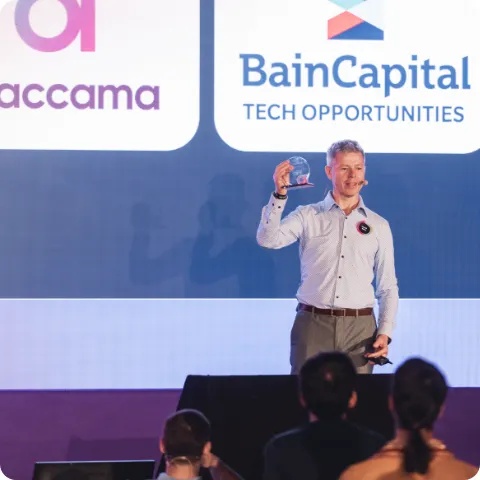
The company’s Allstaff gathering put a human scene around the announcement. Colleagues met in Prague for work and activities, and the employee band, Ataccama Rocks, played an evening set. A business built around reliable records could still accommodate guitars. The investment was part of the celebrations; the next stage would require people to work together after the music stopped.
Klaus’s explanation of the funding decision was straightforward: expansion financed from cash flow had worked, but the pace was insufficient for the company’s ambitions. He also treated a possible public listing as a process requiring preparation. Product, performance, internal management and company scale would all matter. A stock-market destination did not remove the intervening jobs.
For Klaus, the aspirations also extended beyond a valuation milestone. He spoke about software and data contributing to improvements in the world, and about the satisfaction of employees doing work they found meaningful while earning internationally competitive pay. These were his stated motivations alongside the expansion plans. They bring the discussion back from a possible listing to the people doing the work: the programmers, customer teams and new colleagues whose decisions would determine whether the larger organisation remained a place they wanted to help build.
The four-hour handover
Before Mike McKee took over as CEO, he met Klaus for dinner. McKee wanted to understand why the founder was leaving the executive role. The meeting was expected to take an hour. It lasted four. Somewhere in that extra time sits a useful image of succession: two people discussing a business that one had spent years building and the other was considering leading.
The formal transition followed on October 1, 2023. Klaus became a strategic board advisor, with product and customer success identified as areas for his continued contribution. His public professional profile also lists independent investing from September 2024.
Ataccama had given him a long education in turning technical work into an organisation. The story began with the discomfort of taking valued colleagues into an uncertain venture. It arrived at another change of seats, this time with a successor across the table. Four hours seems a reasonable allowance. There was quite a lot to explain.
Continue the conversation
Interviews, company milestones and places to follow his work.
- Ataccama
- Michal Klaus on LinkedIn
- Michal Klaus on Medium
- The 2023 CEO transition
- His 2023 interview (Czech)
- Na vlně podnikání podcast (Czech)
- Watch: Ataccama ONE Gen2 (YouTube)
- The 2022 Allstaff gathering
- The spin-off and early customers
- The 2022 investment
- The dinner with Mike McKee (Czech)
- The Ukraine response (Czech)