A startup can get an introduction and still have nowhere to go. The meeting happens. The presentation is polished. Everybody agrees that innovation matters, a proposition sufficiently agreeable to survive almost any meeting. Then comes the more awkward question: who will actually work with this young company? Michał Bańka’s career circles that question, through public finance, an accelerator he co-founded, and research into the relationship between businesses of very different sizes.
There is a particular pleasure in his choice of subject. Startup culture likes a dramatic beginning: a founder, an idea, an audience suddenly paying attention. Bańka has spent much of his working life on the arrangements that make a beginning useful. Funding instruments, corporate partnerships and programs for entrepreneurs are less photogenic than a product launch. They also determine whether a promising conversation has a second chapter.
Today, Accelpoint lists him as founding partner and advisor. He is also an academic at Warsaw University of Technology. Those roles put him on both sides of an interesting professional habit: building arrangements for cooperation, then examining how cooperation behaves. The same practical problem can become a program, a business relationship or a research question, depending on which desk he is sitting at.
Before the pitch came the paperwork
His early credentials belong to the world of institutions. A doctorate in economic sciences, specializing in management, followed at Warsaw University of Technology in 2008. His work with European funds dates to 2004. At the Polish Agency for Enterprise Development, known as PARP, he became deputy director and later director of the department supporting business environment institutions.
That department’s remit ran through the machinery surrounding young companies: seed funds, incubators, business angel networks and support for access to capital markets. The agency biography also records his work on an innovation loan fund for businesses with outside equity investors. The underlying problem was practical. A young company might need financing before its commercial record could do much of the persuading.
Accelpoint’s account credits him with creating Starter, BizNest and an innovation loan fund, and with authoring and managing ScaleUp, which connected startups with large enterprises. These names belong to different mechanisms, but the continuity is useful: Bańka worked on the circumstances in which entrepreneurship could happen. Somebody still had to build the company. His work concerned the doors it might be able to open.
It is an instructive background for an accelerator founder. Public institutions have rules, eligibility requirements and obligations. Founders have plans that may change between breakfast and lunch. A career spent around both makes the gap between them a concrete management problem. A good intention needs a mechanism; a mechanism needs people who can use it.
An accelerator with destinations
In 2018, Bańka and Hubert Anyżewski founded Accelpoint. Its early work included AccelUp, bringing more developed startups into cooperation with corporate partners in finance, insurance and telecommunications. Santander, AXA Partners and Orange appeared among its partners. An accelerator with named technology recipients offers a fairly direct proposition: there is an organization here with which a young business might test its usefulness.
Bańka’s account of the company’s 2020 activity described an international strategy directed toward Britain, Singapore and Israel. The emphasis was on relationships between Central and Eastern Europe and those markets. A partnership with the British Embassy in Warsaw brought embassy representatives onto AccelUp demo-day juries. RevDeBug and Alphamoon were selected for planned business visits to Britain.
Those details give international ambition a shape. A destination, a partner and a prospective customer are easier to act on than the instruction to think globally. Bańka wrote about the Singapore Fintech Festival relationship, too. His account treated access to another market as work to be organized: relationships, selection, introductions and follow-through. Geography becomes useful when someone on the other side has a reason to take the call.
The leadership changed in 2021. Maciej Majewski, previously head of acceleration, became CEO; Jakub Jankowski joined the board. Accelpoint announced that Bańka and Anyżewski would remain shareholders and strategic advisors while pursuing new projects. The distinction matters to his present story. His connection to the company continued through ownership and advice, with daily executive leadership passing to others.
A warning against imported answers
In January 2020, Bańka offered a pointed assessment of Poland’s startup environment. He acknowledged the growth of support institutions and the skills of founders, while questioning the balance between public and private capital. He also saw insufficient support for companies moving beyond their earliest stages. A country could become better at helping companies begin and still leave them struggling with the next part.
His warning about copying Western solutions was equally specific. Education, commercialization of research and a path suited to Poland mattered more to him than adopting an overseas model wholesale. He pointed toward Scandinavia as a closer reference. The argument allows room for borrowing, but requires attention to the environment in which a borrowed mechanism must operate.
Read alongside Accelpoint’s overseas partnerships, that position has a useful consistency. International relationships can expand a founder’s options without supplying a ready-made national strategy. Britain and Singapore can be places to meet customers. They do not settle every question about how a Polish company should be financed, or how Polish institutions should support it. The lesson is about selecting what travels well.
“Przestańmy na siłę kopiować zachodnie rozwiązania, które nie zawsze mogą przyjąć się w nowym środowisku.”
Michał Bańka · January 2020He urged Poland to stop forcing Western solutions into environments where they might not take hold.
He went back to examine the handshake
In 2025, Bańka published Open Innovation and Startups with Routledge. The book examines how corporations and startups work together through acceleration programs, including their motivations, barriers and different forms of cooperation. Its subject sits very close to his operating career. The relationships that an accelerator helps create become something to investigate with more patience than a demo day allows.
Open innovation gives that investigation its framework: companies can seek ideas and technologies beyond their own research departments. The proposition sounds straightforward until two organizations must agree how to proceed. A startup’s invention and a corporation’s resources do not automatically produce a workable relationship. Bańka’s book considers how acceleration can be prepared and conducted, placing the organization of collaboration alongside the technology itself.
A 2025 paper he co-authored examined 25 international firms participating in 10 acceleration programs in Poland during 2019-2021. The research asked what corporations wanted and how far the anticipated benefits were achieved. Its collaborators included Magdalena Marczewska, Roberta Dutra De Andrade, Arkadiusz Kowalski, Piotr Boulangé, Katarzyna Sedkiewicz and Jakub Murawski. Cooperation was both the subject and the method.
The corporate goals included lower operating costs, specialized technologies and improvements to internal processes. Reported outcomes also included the development of products, services, processes or sales channels, and a more modern corporate image. That last item is a small reminder that participants can value different things about the same arrangement. A partnership may improve a business process and its presentation to the outside world.
The study also considered collaboration time and prior experience. Those are revealing variables for someone whose work has involved assembling partnerships. They shift attention toward what people learn through working together. An introduction is a moment. A useful relationship has a duration, a history and objectives that somebody can revisit. The research gives those less theatrical aspects of innovation their turn on the page.
A seat at several tables
Bańka’s work extends beyond Accelpoint’s advisory role. At the November 2023 venture capital conference at SGH Warsaw School of Economics, he moderated sessions on startup financing and the challenges facing the VC market. The agenda placed him between investors and academics, a familiar position in a career that repeatedly brings those groups into conversation.
In December 2024, he appeared among the mentors announced for StartupGrowthHub, organized by SGH with partners including Accelpoint. Mentoring brings the scale of the work back down to an individual team and its decisions. After the architecture of a funding program or the comparisons in a research paper, there is still a founder deciding what to do next.
There is a teaching role alongside these public appearances. The university’s description of his book places it within management and quality sciences, while explaining its practical relevance to acceleration. That combination gives his work two audiences: people studying organizations and people trying to make organizations cooperate. Each audience can ask a question the other might overlook. Does a useful theory describe what happens when a partnership begins? Can an operating experience teach anything beyond one particular program? His movement between the accelerator and the university keeps both questions close to the work.
His international academic work includes a 2022 visiting-scholar stay at Stanford’s School of Engineering. He also helped establish Pitch Me Baby, the pitching initiative, in 2022. These are different settings for a recurring activity: creating contact between people with an idea and people with resources, knowledge or a possible use for it. The setting changes from university to event to corporate relationship.
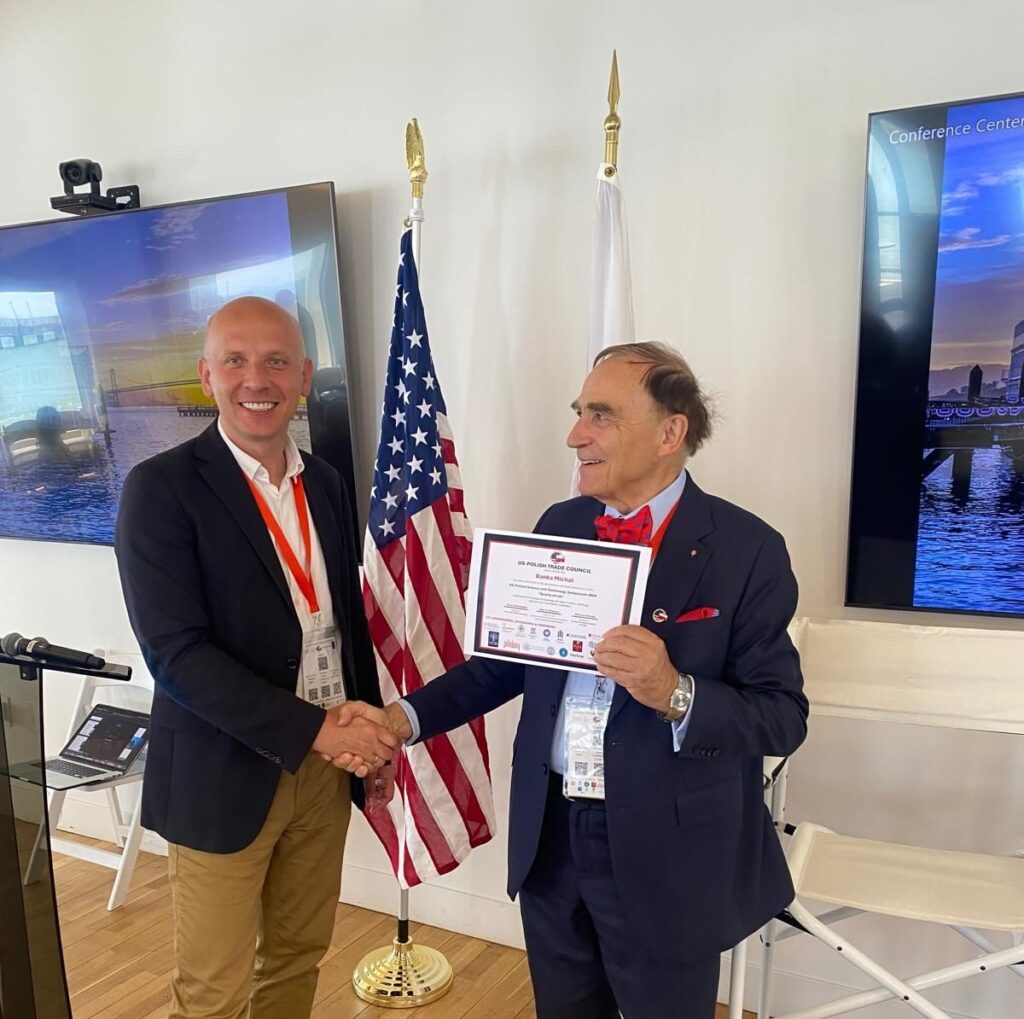
A photograph from the US-Poland Science and Technology Symposium in 2024 captures him smiling during a handshake beside the American and Polish flags. It could pass for the conventional image of international business. In the context of his career, it also makes a good place to pause. Handshakes are easy to photograph. The arrangements behind them are considerably harder to fit in the frame.
More recently, the GreenTech Polska 2025 report, issued in 2026, lists him among its authors. Climate technology brings another set of founders, financing questions and commercialization problems into view. Across these activities, the question remains concrete enough to keep asking: once the people have met, what will let them work together? Bańka has made a career of staying for that part.