A pair of jeans has a deadline. It may look perfectly content on a shelf, folded into a tidy blue rectangle, but the season is moving, the customer is changing, and somewhere a finance team is calculating how long that rectangle can remain there before somebody has to lower its price. Michael Mathias has spent much of his working life on the business side of that predicament.
His American Eagle story has an unusual shape. He arrived in 1998, built a career across its operations, went elsewhere for a spell, and came back. By April 2020 he was chief financial officer. In August 2026 he became strategic advisor to chairman and CEO Jay Schottenstein. The sequence offers a useful way to think about a long career: leaving can be part of belonging, and a change of title can preserve a relationship rather than end it.
For a retailer selling youth and novelty, experience might seem an unfashionable asset. Fashion prefers a new arrival. Finance has reason to appreciate someone who remembers what happened the last time.
A return ticket to Pittsburgh
Mathias began his career at the May Company. His education also connects him to Pittsburgh: a Bachelor of Science from Carnegie Mellon University and an MBA from the University of Pittsburgh. The latter came in 2003. His professional geography makes a compact triangle of stores, business schools, and a city that has supplied much of his working life.
At AEO, his early job was manager of finance for stores and operations. Later responsibilities included e-commerce, store finance, Aerie planning, strategy, and business development. Those assignments put the numbers alongside the merchandise and the places where people actually bought it. A forecast in that setting has to survive contact with a fitting room.
He spent 2016 to 2017 at General Nutrition Centers as vice president of financial planning and analysis. Returning to AEO in 2017, he became senior vice president of financial planning and analysis. In 2020, the CFO appointment gave him oversight of accounting, tax, internal audit, treasury, financial planning, and merchandise planning. It was a broad brief for someone already acquainted with several corners of the company.
The shelf is part of the balance sheet
The connection between a finance office and a shop floor becomes especially clear when Mathias discusses inventory. In a 2022 interview, he described reducing the number of product choices, moving inventory closer to customers, and replenishing stores faster. The subjects were ordinary enough: stock, packages, days. Together, they explained a great deal about profit.
He said choice counts had fallen by 30 to 40 percent, particularly at American Eagle. Inventory trapped in stores and liable to markdowns had been reduced by 40 percent. Replenishment could take one or two days instead of as much as a week. These were his descriptions of improvements at the time, rather than permanent promises about every shipment.
There is an almost domestic logic to the explanation. Fewer things stuck in the wrong cupboard. Less money spent sending separate parcels to the same address. More chance of getting the right item to the person who wants it. The scale is corporate; the underlying irritation is familiar to anyone who has waited for the second half of an order.
“Those are structural improvements we are intent on hanging onto.”Michael Mathias, 2022
That phrase catches the ambition in his account. A good quarter passes. A better way of moving stock might help the next quarter too. For a finance executive, the attraction is easy to understand: repeatable improvements offer something firmer to work with than a single popular collection.
Store replenishment as Mathias described it in 2022
A historical operational comparison, not a current delivery guarantee.
A growth plan meets the next season
By March 2024, AEO had introduced a three-year plan called Powering Profitable Growth. Its three priorities joined brand expansion, financial discipline, and better operations. The combination matters to Mathias’s story because it describes the territory a retail CFO has to cover. Selling more clothes and making more money from those sales are related ambitions, but the second requires its own work.
The plan set out annual revenue growth of 3 to 5 percent and operating-income growth in the mid-to-high teens, with an approximate 10 percent operating-margin goal. These were targets. Their usefulness lay in making the intended relationship explicit: profits were supposed to grow faster than sales.
Fiscal 2024 provided a substantial result during his tenure. AEO reported $5.3 billion in revenue, $427 million in GAAP operating income, and $445 million in adjusted operating income. The adjusted figure rose 19 percent. Company results belong to the people across a business; they also provide the practical setting in which a CFO’s work is judged.
The next season complicated the picture. In May 2025, AEO announced a roughly $75 million write-down of spring and summer inventory and withdrew its full-year guidance. Schottenstein acknowledged merchandising execution that had fallen short, higher promotions, and excess stock. A shelf full of goods can change from an opportunity to a problem with uncomfortable speed.
Fiscal 2025 ultimately brought $328 million in adjusted operating income, down 26 percent, and $226 million in GAAP operating income, down 47 percent. Those figures belong alongside the earlier gains. Retail does not award lifetime immunity for a successful year. Every new assortment asks the business to make its case again.
This is what gives the inventory discussion its weight. The subject can sound dry until a missed forecast acquires a dollar value. Mathias’s career sits inside that recurring calculation: how much to commit, how much room to leave, and how quickly to respond when shoppers cast a different vote.
The CFO watching the same show as his customers
A less formal glimpse came at a June 2024 consumer conference. Asked about what he was watching, Mathias brought up Outer Banks. His children, then in the 18-to-22 range, had encouraged him to watch it. He also acknowledged American Eagle’s collaboration with the show. Even the television recommendation had a merchandising footnote.
He spoke about years coaching youth sports, especially basketball and soccer, and about becoming a fan of the English Premier League. He was watching Welcome to Wrexham, the series following Ryan Reynolds and Rob McElhenney’s Welsh football club. These are small details, but they put a recognisable person beside the executive title.
The same conference placed him in conversation with Jennifer Foyle, AEO’s president and executive creative director for American Eagle and Aerie. Their appearances together show the working proximity of creative and financial leadership. One side develops reasons for customers to care; the other helps work out what the business can support. Both have to keep listening.
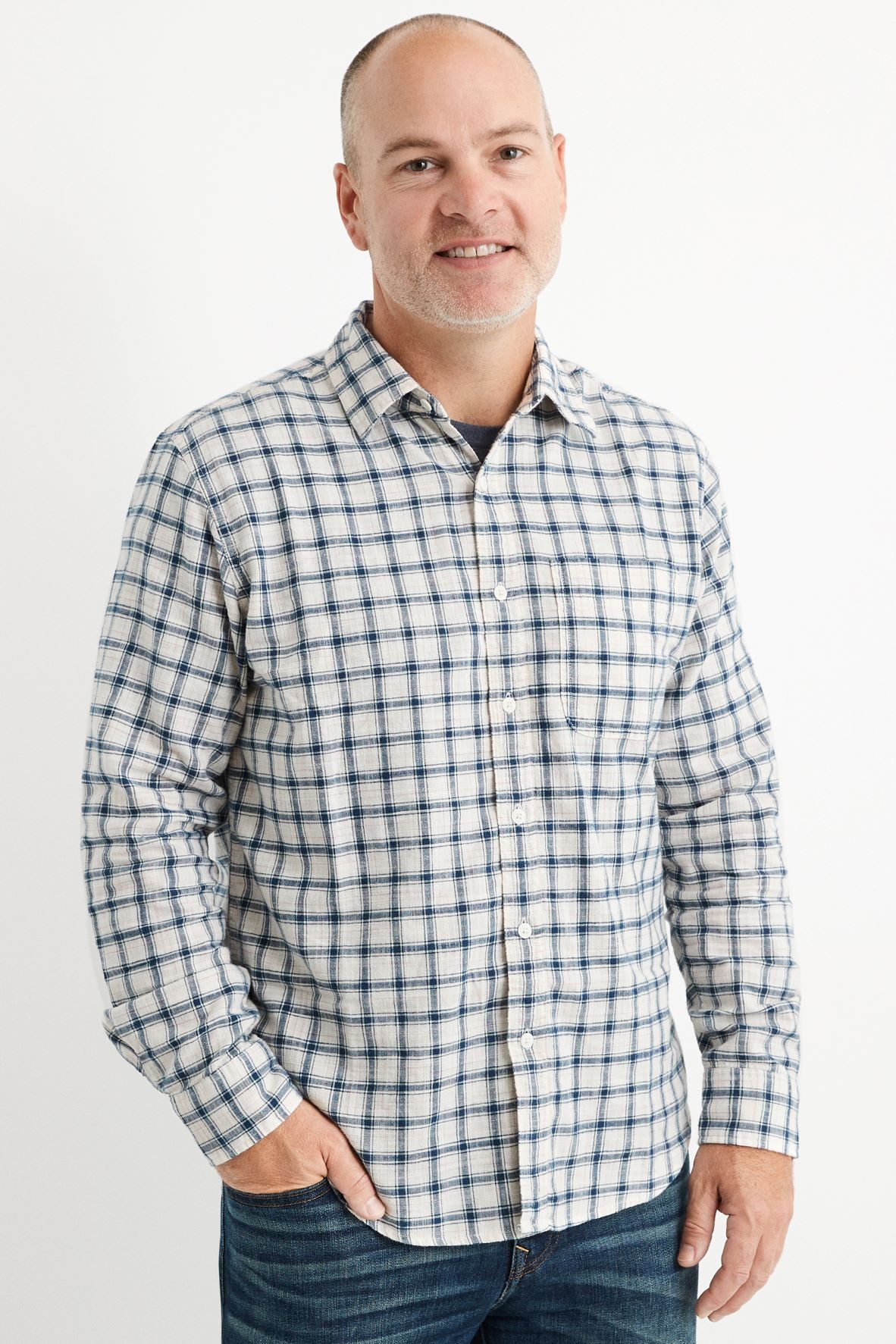
Two Pittsburgh institutions, one familiar face
In March 2025, Mathias accepted Pitt Business’s Corporate Appreciation Award on behalf of American Eagle. The ceremony took place at Alumni Hall. The university identified him as an MBA alumnus from the class of 2003. It was a small, concrete meeting of two institutions that recur in his biography.
The distinction was for the company, and he represented it. That is a revealing kind of public appearance for a finance chief: away from the earnings discussion, still carrying the organisation’s name. His LinkedIn profile also lists membership of the NACD Three Rivers Chapter board beginning in 2025, extending his professional connections into corporate governance.
There is no need to make these affiliations into a grand theory of Pittsburgh. They are useful at their actual size. A university education, an employer with deep local roots, and a regional directors’ organisation make a visible network of work and relationships.
The handover has its own work
AEO announced the CFO transition on July 1, 2026, with Ravi Thanawala succeeding Mathias on August 3. Mathias moved to a full-time, non-executive strategic advisory role. The arrangement called for close collaboration with Thanawala through the rest of the 2026 fiscal year and support for Schottenstein through July 30, 2027.
The dates give the change a deliberate overlap. A business can transfer responsibility on a specified Monday. Transferring the accumulated context behind that responsibility takes conversation. A new finance chief inherits accounts and forecasts; an experienced colleague can help explain the decisions that shaped them.
For Mathias, the move keeps him connected to a company he first joined nearly three decades earlier. The first chapter concerned stores and operations. The latest concerns continuity. Between them sit a departure, a return, six years as CFO, strong results, and difficult merchandise calls.
Fashion has a perfectly good reason to celebrate the next thing. Michael Mathias’s story leaves room for another commercial asset: someone who has been around long enough to remember the previous thing, and is still there to explain it.