The trouble with RFPIO was not that the name was wrong. It was almost comically right. The company began by helping teams answer requests for proposals, and its name compressed that assignment into five useful characters: RFP in, response out. Then the customers misbehaved in the way good customers often do. They used the software for security questionnaires, due-diligence requests, vendor assessments, RFIs, RFQs and the recurring blizzard of questions exchanged whenever one business considers trusting another.
By the time Michael Londgren joined as chief marketing officer in December 2022, the name described the first room in a house that had acquired several wings. He had seen this architectural problem before. At DocuSign, he helped a company known for electronic signatures frame a larger field called Digital Transaction Management. At Seismic, he led marketing in the developing sales-enablement category. The product begins somewhere precise; the customer reveals that the value lives somewhere larger.
Londgren’s work sits in that gap. He is a translator between what software does today and what a business might credibly become tomorrow. The translation cannot be airy. Salespeople have to sell it, product teams have to build it, customers have to recognize it, and employees must be able to repeat it without glancing at a laminated card. A category is corporate strategy wearing public clothes.
The dangerous luxury of an accurate acronym
The rebrand began with an admission among Responsive’s executives: they had outgrown RFPIO. That sounds obvious after the fact, which is the preferred appearance of difficult decisions. A strong existing name has search equity, customer memory, internal habits and invoices attached to it. Londgren has said he generally would not recommend renaming a company with a commanding market presence. In this case, the cost of accuracy had become constraint.
Working with the agency Barrett Hofherr, the team revisited the company’s vision, mission and value proposition. They looked for a name that was authentic, simple, memorable, available and legible across countries, industries and use cases. They even built a weighted model to compare candidates. Branding is often portrayed as a lightning bolt striking a sketchbook. Here it also involved a spreadsheet, as consequential choices frequently do.
“Responsive” survived the model and the human test. It described what the platform helped customers do. It also described how the company wanted its employees to behave. When leaders revealed the proposal at an all-hands meeting, Londgren recalled watching positive reactions multiply in the Zoom chat. The name had found the rare overlap between market ambition and ordinary English.
To be responsive means to be empathetic, truly understand needs and respond accordingly.Michael Londgren, on the meaning of the new name
The name change arrived publicly in July 2023. The accompanying category, Strategic Response Management, widened the lens from documents to decisions. A proposal team was not merely formatting answers against a deadline. It was coordinating knowledge, judging which opportunities deserved attention, protecting compliance and shaping how the company presented itself at a moment of commercial consequence.
A career in making the frame wider
Londgren did not begin with a conventional marketing degree. He studied international relations at Stanford, graduating with honors, then earned an MBA from Harvard Business School. His first technology marketing assignment was at Apple, leading marketing for its developer-tools business. The work placed him between builders and buyers early: take something technically exacting and make its importance understandable without sanding away the truth.
There were roles at Blue Martini Software, Encover, BoardVantage and Adobe, where he was director of product marketing for Adobe Connect. At DocuSign he built the product-marketing organization and later led customer enablement. Company accounts credit him with helping the staff grow from roughly 180 people to 2,500. At Google Cloud, he led product marketing for G Suite during a year when paid customers grew from four million to more than five million.
Seismic hired him as CMO in 2019 to lead worldwide marketing. Two years later, when he stepped away, Londgren pointed to a company that had passed a $200 million annual revenue run rate, completed three acquisitions and expanded in Europe. Yet the part of his farewell he emphasized most was cross-functional partnership. He handed off leadership, stayed on as an adviser and took time for family, friends, travel, skiing, cycling, reading and writing. It was a deliberate interval in a career fond of acceleration.
There is another, quieter line through the biography. Londgren served on the board of The Stanford Daily from 1995 through 2015, including ten years as chairman. A former colleague described him encouraging the student newspaper to invent new revenue streams and recruiting forward-looking journalists to its board. She also recalled his personal mentorship, from choosing a role to practicing negotiation. The category builder, in other words, has spent a long time around both business models and storytellers.
Customers are the story, not the footnote
Ask Londgren about effective campaigns and he returns to customer voices. He has said some of his best work showcased the practices of visionary leaders because people want to understand what other capable people actually did. This is less glamorous than declaring a brand revolutionary, and much more useful. Buyers can admire a promise; they can interrogate proof.
His newer formulation is sharper: “The future of marketing is customer success.” Prospective buyers now arrive after reading reviews, comparing alternatives and testing a vendor’s claims through their networks. Marketing may earn attention and sales may earn a meeting, but existing customers supply the evidence. The voice once placed in a testimonial box at the end of the journey increasingly determines whether the journey begins.
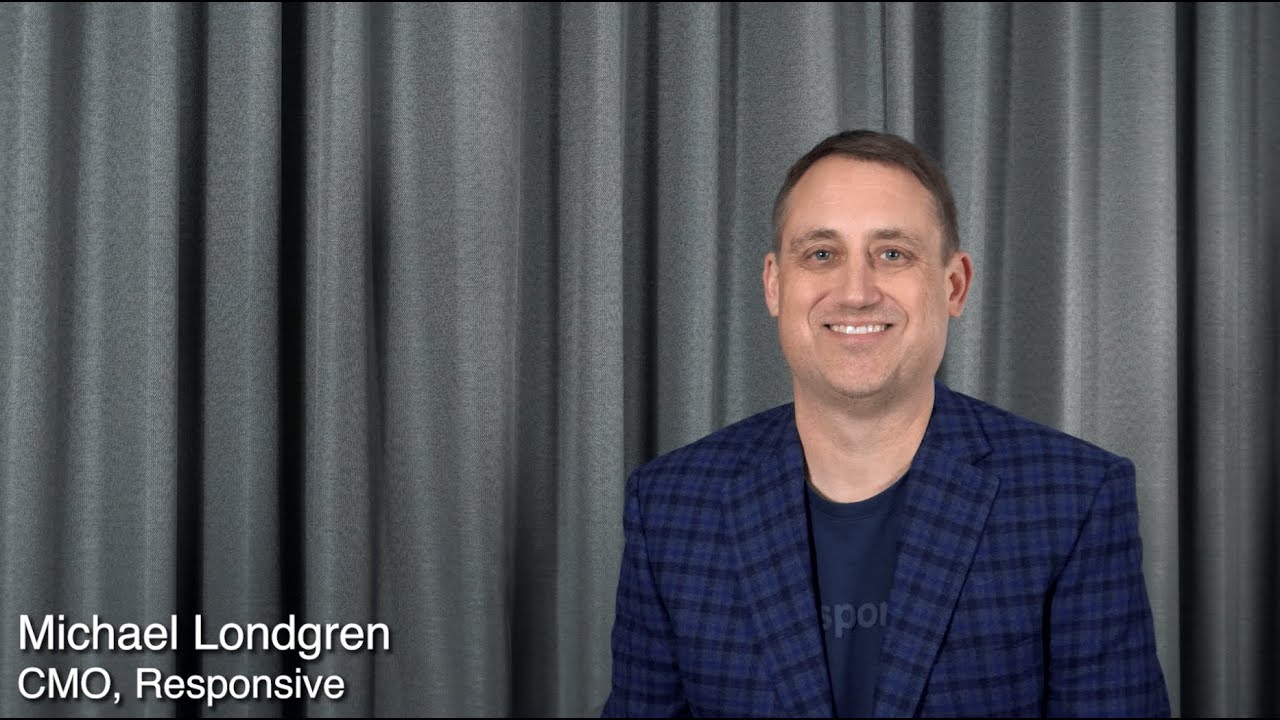
That belief changes where a CMO spends time. In a 2023 interview, Londgren argued that marketing leaders should help shape the company’s vision, mission, value proposition and differentiation. He also rejected the old treaty in which sales owned revenue while marketing owned marketing-qualified leads. Marketing should share responsibility for bookings, pipeline and movement through it. The work belongs in the trench with sales, and at the planning table with product and customer success.
AI can draft. Humans decide.
The arrival of generative AI makes Responsive’s territory more valuable and more treacherous. A machine can draft an answer quickly. It can also produce a polished paragraph that is ungrounded, interchangeable or faintly insulting in its failure to notice the reader. Londgren’s public position is neither abstinence nor automation theater. Use AI to assess fit, prepare first drafts, find relevant knowledge, check compliance and improve quality. Keep people responsible for win themes, customer understanding, competitive judgment and the final voice.
Received something obviously written by AI?
Did it actually resonate?
Informal show-of-hands poll of 100+ revenue leaders, London, 2026
At a 2026 gathering in London, he offered a wonderfully brutal demonstration. More than 100 revenue leaders were asked whether they had received an email or document that was obviously written by AI. Every hand went up. Asked how many of those messages resonated, the room supplied zero hands. The numbers were informal, but the embarrassment was precise. Cheap fluency is not the same as consideration.
His analogy for a better approach comes from an unlikely place: Netflix’s Formula 1: Drive to Survive. Londgren, who follows McLaren and Lando Norris, argues that the series expanded an audience by finding characters, tension and human stakes inside a technical sport. The cars remained essential, but the machinery alone was not the story. B2B companies make the same mistake when they confuse a product demonstration with a reason to care.
In his telling, a company needs a brand story, a product story and a customer story. They can reinforce one another, but they are not substitutes. The launch is also not the whole plot. An audience grows over a season, through recognizable people and accumulated consequence. Londgren’s advice to optimize for serendipity rather than control is unusually loose for an executive who once scored company names with a model. It reveals the balance he is after: discipline around the frame, freedom for real people inside it.
The future of marketing is customer success.Michael Londgren, on where buyers now find credible proof
The long game of being responsive
Londgren now describes proposal professionals as moving beyond service work toward strategic influence. They help companies decide which opportunities fit, surface what customers keep asking, contribute to product road maps and give sellers access to trusted knowledge. The title “response strategist” is not cosmetic if the team is trusted with better questions as well as faster answers.
That is also the larger argument embedded in the rebrand. Responsiveness is speed with attention attached. Without attention, speed merely delivers the wrong thing sooner. The useful promise of enterprise AI is not an infinite warehouse of competent sentences. It is the chance to return time to the people who can notice context, make a choice and write the sentence that belongs only here.
A quarter-century after marketing developer tools at Apple, Londgren is still translating between technical possibility and human consequence. The acronyms have changed. The recurring assignment has not: find the larger story already present in the customer’s behavior, give it a name the company can live up to, and remember that a response is valuable because someone is waiting for it.