Michael Fenchel went to an educator training and began writing in his journal. Ilana Nankin, who had invited him, recognized the habit. When he was inspired, he wrote poetry. She asked him to read what he had written to the teachers in the room. A few days later, he returned with a proposal to make a business of the work. The notebook had done its part. Now came the organization.
The partnership became Breathe for Change in 2015. Today, Fenchel is its co-founder and co-CEO alongside Nankin. The poem is a useful place to begin his story because it puts several of his interests on the same page: making something, sharing it with a group, and then asking how that moment might become a continuing enterprise.
His career has accommodated a traveling creative studio, a coworking community, music software, and programs for entrepreneurial leaders. The settings vary considerably. Some of the early ones had wheels. Across them runs a question that makes the detours easier to follow: what can people do when they have somewhere to create together?
A studio with a steering wheel
In 2011, Fenchel and childhood friends Alex Connelly and Sam Lundsten set out with 7Cees, a mobile creative studio. Their vehicle was a school bus topped with two Volkswagen pop-top buses. Its name was F.F. Sloth. A conventional office lease would have required considerably less explanation.
Fenchel had graduated from the University of Michigan and tried a software startup that did not work out. At Madison’s Sector67 makerspace, he encountered a community organized around making things. Visiting creative spaces in other cities prompted a different possibility: take a workspace from place to place and invite people into it.
He found the vehicle on eBay. The friends converted it into a studio with music and art equipment, drawing on Sector67 members for practical help. Connelly brought design experience; Lundsten brought sculpture and painting. Fenchel helped establish the nonprofit and drove the bus. Their plan was a year of travel, with projects taking shape through the people they met.
“Why not put it on wheels?”
Michael Fenchel, on the traveling studio, 2011
What leaving Madison made visible
A month into the journey, Fenchel wrote about the city he had left. Distance had made him notice something he had taken for granted: Madison’s mix of ability and informality. He admired people who could do accomplished work without insisting that everyone recognize them as accomplished people.
His account lingered on ordinary encounters. A quick response from someone working at a coffee shop could keep a person thinking. A friendly exchange could make an unfamiliar idea easier to share. The city’s appeal, in his telling, involved the combination of intelligence, openness, and the willingness to participate.
He also described practical advantages for starting projects: accessible resources, a network of people, and a community small enough for new work to become visible. The affection was personal. He had spent most of his life there. Away from home, he was noticing how much of his own work depended on the people who had helped him begin.
The caboose gets crowded
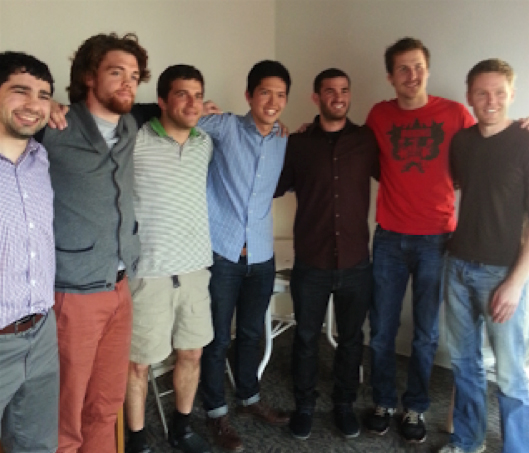
Another of Fenchel’s experiments with shared space began in an old caboose at a former railroad depot on West Washington Avenue. He and fellow entrepreneurs worked on projects, traded ideas, and took on civic work. More people wanted to join. Eventually, the railway car ran out of room.
The group moved into an office at 100 State Street, which gave 100state its name. Further growth brought another move to the Capitol Square. By summer 2015, the coworking community had nearly 200 members. Fenchel described a mix of entrepreneurs, freelancers, and professionals, including people working well beyond the technology industry.
Membership involved an interview. The point was to find people willing to contribute advice and expertise, as well as benefit from what others knew. A shared workplace can be a collection of separate businesses occupying adjacent desks. Here, Fenchel wanted collaboration to become part of the way people used the room.
“Our philosophy is that collaboration is a positive feature of work.”
Michael Fenchel, summer 2015
A room that made things for its city
In August 2013, 100state already had more than 50 members, with shared space starting at $50 a month under the membership model then being reviewed. Fenchel was its executive director. Members worked on their own projects and on work for the surrounding community.
One example was software for Make Music Madison. The group provided it to the local celebration, then licensed it to eight other cities, including New York and Denver. It was a modestly complicated answer to an interesting business question: could doing something useful for home also produce work that traveled?
George McLaughlin, who watched the community develop, remembered the variety of people occupying the space: a photographer, a doctoral student, developers working on live music scheduling, and other founders. Their proximity created introductions and shared projects. That account gives the coworking idea some texture. The value of the room appeared in what its occupants could make happen together.
Madison remembers the microphone
The city recognized Fenchel’s work in 2013 with the Dane and Beyond award at the Isthmus Independent Business Awards. The occasion brought together local businesses being recognized for contributions to their community. Fenchel thanked his mother for raising him in Madison.
It is a small, memorable detail in a career full of organizations. Accepting recognition for building something new, he acknowledged the place and person that preceded the building. His traveling studio had already given him occasion to write about that debt to home. On awards night, he expressed it more directly.
Other memories are louder. Ibrahim Harun, a 100state member since 2013, recalled Fenchel and Andrew Conley singing a thank-you song at the first 100Thanks event in 2014. He also remembered Fenchel rapping at parties. A founder can arrange the gathering and then take his turn at the microphone. In this community, apparently, both counted as participation.
- 2011A moving studio7Cees takes creative work on the road.
- 2013A shared workspace100state develops its Madison community.
- 2015An education partnershipFenchel and Nankin build Breathe for Change.
Partners, pages, and practical work
At Breathe for Change, Nankin brought experience in classrooms and teacher education. Fenchel brought experience helping ventures take shape. Their partnership extended into the work behind her doctorate: in her 2016 dissertation acknowledgments, Nankin thanked him for his direction, conversations, editing, and creative writing sessions.
Those acknowledgments offer a closer view of collaboration than a list of titles. There were pages to work through and ideas to discuss. Fenchel’s contribution included helping her make the writing reflect teachers’ experiences and perspectives. The work that followed the poem involved attention to other people’s words.
The distinction matters to his story. A public founding moment makes a good anecdote; an editing session shows how a partnership continues after the anecdote ends. One requires an audience. The other requires staying with the material. Both belong in an account of how an educator and an entrepreneur began building together.
Learning to share the work
Fenchel’s career also crossed into live music software at Prism.fm and product work at BlueTree Network. In a conversation about running several companies, he described finding people in his network who could assume leadership responsibilities as ventures developed.
That is a consequential part of a founder’s job. Getting a project started and making room for someone else to lead it ask for different decisions. A useful idea needs people who can keep working on it. The founder’s network becomes part of the organization’s ability to continue.
His education remains an interesting companion to these pursuits. Breathe for Change’s current biography describes his University of Michigan studies in math and physics, alongside his enthusiasm for creative expression. It also identifies freestyle rap as a continuing interest. Equations and improvisation make an unusual pairing on a biography, but both have a place in the work he describes.
The founder as a participant
With Adriana Robertson, Fenchel co-founded PRDX, which works with entrepreneurial leaders on connection and collaboration. Their respective biographies give the partnership different starting points: his experience building ventures and her experience in leadership training and facilitation.
Fenchel’s own account emphasizes that he wanted the community and accountability the program offers its participants. He writes about developing the work with other leaders and allowing their experiences to inform it. The founder appears inside the project, learning with the people it serves.
In March 2023, a conversation with Raj Jana returned to introspection and the changing seasons of life. It adds another pause to a career often described through its startups. There is activity, and there is time spent considering what that activity is for. Fenchel has made both part of his public account of leadership.
A classroom question for the AI age
In 2026, Fenchel and Nankin brought their shared work into conversations about human intelligence in education. Their January founders’ letter described an evolving organization and a renewed emphasis on the human capacities involved in learning.
A March conversation took up agency, focus, critical thinking, and collaboration as AI becomes more common in education. It framed the technology as a potential partner in thinking. The interest was in what educators and students could bring to the exchange themselves.
By July, Fenchel’s physics background was appearing in his discussion of how one person’s actions affect others. His classroom framing connected that interest to wonder, trust, integrity, gratitude, and purpose. These are the capacities he and Nankin have been discussing with educators.
The projects have changed size, setting, and audience since the bus. Fenchel’s work still gives people a place to meet, learn, and contribute. Sometimes that place is a studio, sometimes a shared office, sometimes an educator training. And sometimes, before the plans are drawn up, someone opens a notebook.