The celebratory photographs arrived in April 2021: blue screens, black masks, raised hands, Nasdaq's white podium. Michael Favet stood near the middle of the NeuroPace team as the medical-device company marked its public listing. It was the sort of scene that makes a career look inevitable after the fact. An engineer moves into management, joins a board, becomes chief executive, and rings the bell. Cue the applause. Roll credits.
Favet's next act spoiled that tidy ending. Less than three years later, he accepted the chief executive job at Revamp Medical, a small clinical-stage company founded in Israel in 2016. He traded the cadence of quarterly calls for the longer rhythm of feasibility studies, regulatory work and pivotal-stage preparation. The move brought him back to a familiar place: a promising mechanism surrounded by all the difficult work required to make it useful at scale.
This is the thread that gives his résumé its shape. For more than two decades, Favet has kept changing seats while staying at the same table. Research and development. Operations. Investing. Governance. Commercialization. Public-company leadership. Each role taught him a different way a medical technology can fail, and a different way a team can carry one forward.
An engineer learns the other languages
Favet's first formal language was mechanical engineering, studied at the University of Illinois Urbana-Champaign. He later added an MBA from the University of Minnesota's Carlson School of Management, completed in 1995. The combination is almost suspiciously neat for medical devices: understand the thing, then understand the organization that must build, fund and sell the thing.
His operating education sprawled across several corners of the industry. His public biography includes Guidant and Boston Scientific, followed by leadership work at Ventus Medical, Sonitus Medical and Advanced Cardiac Therapeutics. The products and clinical settings changed. The underlying discipline remained severe. A medical device must survive engineering review, clinical scrutiny, manufacturing constraints, regulatory examination and the plain old question of whether a busy professional will adopt it.
At Sonitus Medical, Favet served as chief operating officer from 2012 to 2015. He held the same title at Advanced Cardiac Therapeutics from 2015 into early 2017. Operations is where a clever prototype meets calendars, budgets, quality systems and the stubbornness of physical matter. It is a useful antidote to the executive temptation to believe that announcing a priority causes it to happen.
The operating apprenticeship
Then came a change of vantage. In 2016, Favet became a managing director at KCK's medtech group. The investor's chair demands comparison. An operator can spend years learning every contour of one company; an investor must decide which assumptions matter across many. Favet was responsible for strategic investments and advising portfolio companies. He was still close to the machinery, only now he could see how capital judged it.
That same year, he joined the board of NeuroPace. The company had been working since 1997 on responsive neurostimulation. Its technology listened for specific electrical patterns and responded in real time. By the time Favet arrived, the scientific achievement was established. The larger assignment involved expanding commercial use and helping more eligible people reach a therapy that required a specialized pathway.
From the boardroom into the engine room
Favet did not parachute directly from director to CEO. In October 2018, he stepped into the acting chief commercial officer role. In July 2019, NeuroPace named him chief executive, succeeding longtime leader Frank Fischer, who became chairman. The sequence matters. He had observed the company as a director, worked inside its commercial problem, and only then assumed responsibility for the whole enterprise.
In a 2019 Medtech Talk conversation, the newly appointed CEO discussed what had persuaded him to take the job and where he wanted NeuroPace to go. His later public appearances returned to a practical obstacle: creating awareness, opening implanting centers and helping clinical teams identify appropriate candidates. Medical-device markets are rarely waiting fully formed. They have to be assembled through evidence, training, referral patterns and trust.
“It's always a pleasure to connect and discuss our progress and what we're still focused on - to help even more patients.”Michael Favet, responding after a 2023 DeviceTalks interview
The pandemic made that work stranger and harder. In earnings calls, Favet described hospital staffing limitations and the slow recovery of specialized monitoring units. He spoke in pipelines and time lags: a person entering evaluation could take roughly six months to reach an implant. That is the less cinematic side of commercialization. Demand does not travel in a straight line. It moves through institutions, schedules and teams of people who all need enough capacity to do their part.
NeuroPace entered the public market in April 2021 at $17 a share. After the underwriters exercised their option, the completed offering comprised 6.9 million shares and produced about $117.3 million in gross proceeds. On April 27, Favet rang Nasdaq's closing bell. The picture captured an arrival. The operating story continued the next morning.
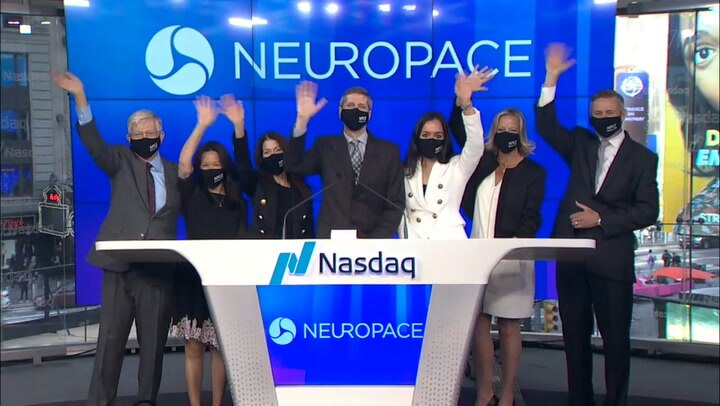
Favet stepped down as NeuroPace's president, CEO and director in July 2023, remaining available as a consultant during the transition. Four years at the top had included commercial expansion, a global disruption and a public listing. His résumé could now carry the pleasantly polished phrase “former public-company CEO,” a phrase that opens many doors and closes very few.
Back to the workbench
The door he chose led to Revamp Medical. The company appointed him CEO and a director in March 2024. Its central project, Doraya, is an investigational catheter designed for temporary placement below the renal veins. The technical idea is to modulate venous flow for a limited period. It is adjusted, monitored and removed. Elegance in concept, of course, does not waive the usual medtech tolls.
Revamp hired Favet at a hinge point. Early clinical work existed. A U.S. feasibility study was underway. Ahead lay the tasks of completing that evidence, designing the next study, engaging regulators and preparing an organization for a larger trial. Board director Mike Berman pointed specifically to Favet's experience leading innovation and developing new therapies. Favet described the mandate more simply.
“I look forward to further building the clinical evidence and bringing Doraya to the market.”Michael Favet, on joining Revamp Medical in March 2024
The sentence is worth pausing over because the two halves are inseparable. Build evidence. Bring to market. In ordinary consumer technology, a launch can begin the experiment. In medical devices, evidence is part of the product and the prerequisite for nearly everything that follows. The trial is not a decorative appendix to the business plan. It is one of the business's central acts.
By early 2026, Revamp was presenting final results from the U.S. early feasibility study and talking publicly about pivotal-stage preparation. In June, JACC: Heart Failure published a peer-reviewed brief report from the study. The paper's authors were investigators from six U.S. centers, and the study was funded by Revamp. These are company milestones rather than personal trophies, which may be precisely why they belong in Favet's story. The chief executive's job is to make coordinated work possible and let the evidence carry the loudest voice.
The résumé as a toolkit
There is a fashionable idea that careers should tell one clean story. Favet's tells several, braided together. The mechanical engineer learned management. The operator became an investor. The investor sat on a board. The director stepped into commercialization. The CEO learned public markets, then returned to an early clinical-stage company.
Read as a list, it is long. Read as preparation for Revamp, it is compact. A clinical-stage CEO must be able to ask whether the mechanism is persuasive, whether the study can answer the right questions, whether the team can execute it, whether investors understand the sequence, and whether a future market can support the result. Each of Favet's earlier seats offers a different lens on one of those questions.
This does not guarantee an outcome. Nothing honest in clinical-stage medtech does. Doraya remains investigational, and a peer-reviewed feasibility report is a waypoint rather than a finish. The interesting fact is that Favet has voluntarily returned to the terrain where progress is least theatrical. The work is measured in completed enrollment, interpretable data, regulator feedback and the quality of the next decision.
The Nasdaq bell made a clean sound. Company building rarely does. It hums, stalls, clicks, waits and occasionally produces a result that earns the next experiment. Favet's career suggests he likes being close enough to hear all of it.