A clever idea enjoys a glamorous childhood. Everyone admires the sketch. The prototype gets passed around the room. A whiteboard acquires arrows, a patent acquires claims, and for a short, lovely moment the future appears to have excellent handwriting. Then adulthood arrives. The idea needs a company, the company needs capital, and every elegant line on the whiteboard meets an institution with a calendar of its own.
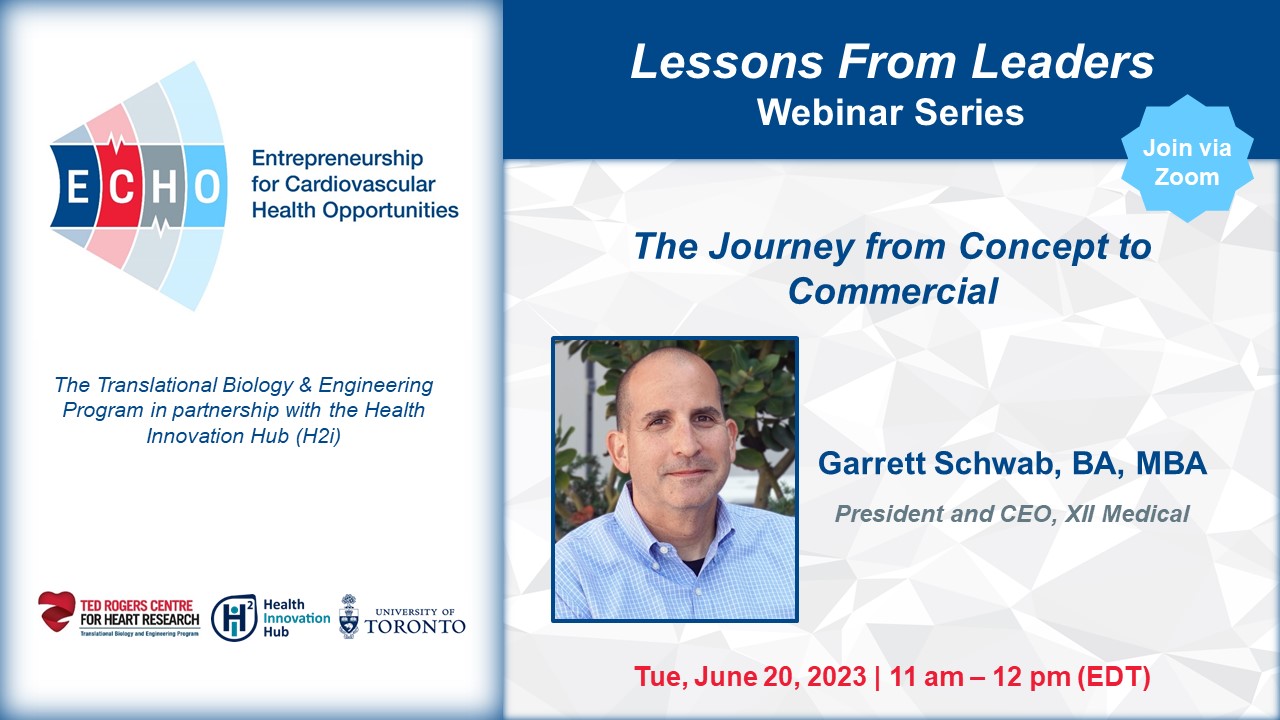
Garrett Schwab has built his career in that less-photographed stretch of the journey. He is the president and CEO of XII Medical, a Union City, California medical-technology company he has led since May 2021. Before that came the long apprenticeship: Devices for Vascular Intervention and Guidant; IsoStent; Radiant Medical; Emphasys Medical; Ardian; Medtronic; then Ziva Medical, which he co-founded and led. The list reads less like job-hopping than a survey course in how complicated products become durable organizations.
Schwab's formal education is revealing. He earned a BA in economics from Vassar College and an MBA from the University of Michigan's Ross School of Business. He is not presented publicly as the lone laboratory genius or the flamboyant promoter. His résumé sits at the interfaces: clinical work, reimbursement, management, boards, patents, financing. In a sector crowded with specialists, his specialty is learning how the specialists depend on one another.
Chapter IThe education of a translator
One entry in Schwab's earlier career deserves more attention than its modest wording invites: global reimbursement. In 2013, a Stanford course syllabus introduced him as a former Medtronic global reimbursement director. Ten years later, the same course listed him as a guest speaker again, now as president and CEO of XII Medical. The title changed. The underlying problem did not. A technology must make sense not only to the people who design it, but also to the systems expected to evaluate and adopt it.
This is the sort of knowledge that rarely appears in founder mythology. Payment is not a cinematic montage. Neither are clinical programs, manufacturing plans, board meetings, or the thousand small decisions by which a young company proves it can be trusted with a larger one. Yet those ordinary disciplines determine whether invention remains a noun or becomes a verb.
Schwab's passage through both large companies and startups gave him two complementary views. Large organizations teach the weight of systems: process, scale, accountability, and the cost of an overlooked dependency. Startups teach the absence of systems: someone must build each one while the clock is running. An operator who has seen both learns when structure is a guardrail and when it is simply furniture.
Chapter IIA founder returns to the long game
From 2013 to 2017, Schwab served as co-founder, president, CEO, and a board member of Ziva Medical. The patent record places him close to the invention process as well as the organization around it. His name appears alongside engineers and other inventors on device patents. That detail complicates any neat division between “business person” and “technical person.” Hard companies are allergic to neat divisions.
A patent, after all, proves that an idea can be described with unusual precision. A company must prove that an idea can survive contact with time. It needs people with different vocabularies to recognize the same destination. It needs a plan credible enough for the next milestone, but flexible enough to acknowledge that the terrain is still being mapped. It needs a CEO willing to make decisions before the evidence is complete, then revise those decisions without rewriting history.
When XII Medical selected Schwab for its top job in 2021, it chose this accumulated range. The company had been founded in 2017 and backed from the beginning by Cleveland Clinic. Its location in Union City puts it in the Bay Area's orbit without placing it in the standard mythology of a garage and an app. Device companies have more literal concerns. Materials must behave. Partners must deliver. Research must be designed. A product can be clever on Monday and still have years of work scheduled for Tuesday.
Chapter IIIThe coalition is part of the product
In August 2024, XII Medical announced a $45 million Series B. Omega Funds led the round, and Intuitive Ventures joined as a new investor. Existing backers included Cleveland Clinic, Ajax Health, Longview Ventures, Aperture Venture Partners, JobsOhio Growth Capital Fund, and an undisclosed strategic investor. On paper, it was a financing. Seen through an operator's eyes, it was a coalition.
Each name represents a different kind of confidence. A hospital-linked institution sees one set of requirements. A specialist fund sees another. Strategic capital brings its own pattern recognition. The CEO's work is not to flatten those perspectives into identical opinions. It is to make them compatible enough to support one plan.
Capital buys time. Leadership decides what the time becomes.
Schwab's public comment on the round was characteristically organizational. He pointed to expanding the team and collaborating with partners. Those are not decorative goals. A large check can create the illusion that a company has acquired certainty; in practice, it has acquired choices. Hiring too soon can be as expensive as hiring too late. Partnerships can multiply capability or multiply meetings. Capital is stored possibility, and a CEO's calendar is where it begins to take a shape.
The useful idea here travels beyond medical technology. Founders often describe their company as a product. Experienced operators understand that the company is also a translation system. Engineers translate a need into a design. Researchers translate a design into evidence. Finance translates a plan into runway. Leaders translate among all three, while preserving enough meaning that nobody arrives at the end having built a different business.
Translation also explains why broad operating experience becomes more valuable as a company grows. Early on, one person may hold the whole argument in mind. Later, knowledge spreads across functions, vendors, board members, and new hires who did not witness the original decisions. The organization needs a memory that is sturdier than any founder's recollection. Priorities must become budgets; assumptions must become tests; lessons must become process without process becoming a religion. Schwab's career has repeatedly occupied those handoff points. Reimbursement connects a product to an economic system. Clinical work connects intention to evidence. A board connects today's choices to the capital and accountability behind them. The CEO connects the lot, usually while everyone is asking for a clearer answer than the facts can yet provide. This is not generalism as a lack of depth. It is a depth of interfaces - knowing which question belongs in which room, who must hear the answer, and what will break if the message loses a crucial word on the way.
Chapter IVProgress without theatre
Schwab is a restrained public figure. There is a LinkedIn profile and a modest trail of company announcements, university appearances, organizational biographies, and patent entries. The record does not supply a catalogue of breakfast routines or adversity anecdotes. It supplies something more relevant: repeated proximity to the hard middle of complex work.
Consider the decade between his two Stanford guest appearances. In 2013 he brought the industry perspective on reimbursement. By 2023 he returned with the broader authority and burden of a CEO. That is an elegant before-and-after, though real careers refuse such tidy editing. The middle contained a co-founded company, board work, invention, advisory experience, and another executive role. Expertise accumulated sideways before it appeared to move upward.
That path offers a counterweight to the cult of speed. Some markets reward the person who ships by Friday. Others reward the person who can keep a technical program, an organization, and a financing story coherent over years. Patience alone is useless; anyone can wait. The craft lies in operationalizing patience: fund the next proof, hire for the next constraint, make today's decision legible to tomorrow's team.
There is an aspiration visible in Schwab's own language, but it is expressed without autobiography. He wants to grow XII Medical's team, deepen collaboration, and advance the company's work. The pronoun is telling: our investors, our team, our technology. Publicly, at least, the protagonist is the organization.
Perhaps that is the natural voice of a translator. The point is not to be the most vivid person in every room. The point is to help each room understand the next one. An inventor needs a company. A company needs a coalition. A coalition needs a sequence of credible steps. Somewhere in Union City, those steps are being placed one after another, with less drama than the original sketch and far more consequence.