The first useful clue in Michael Atalla's career is a small black-and-white Macintosh. His father was an engineer, so computers arrived in the family home before they appeared in many of his friends' rooms. Atalla used the machine to make stories. He later taught himself to code, studied computer science in school, and took early work writing software and consulting on IT infrastructure. The path looked technical because it was technical. Marketing entered from the side.
At Microsoft, Atalla carried the title developer evangelist. He sat with product teams, spent his days around engineers, and translated their work for people outside the build room. The title made sense inside the software industry and required more explanation at home. He has joked that his grandparents needed reassurance about what sort of evangelism he had joined. Then a reorganization changed the label. Similar work now sat inside marketing.
The move felt less like a master plan than organizational weather. It also revealed his durable advantage: he could move between the mechanics of a product and the language of a customer without treating either side as scenery. Technical evangelism became product marketing. The engineer did not disappear. He acquired a new interface.
“One of my goals is to make meaning out of complex technologies.”Michael Atalla
The cloud lesson
Atalla stayed at Microsoft for nearly 15 years, working across major product lines and eventually helping shape the transition of Office from installed software to Office 365. That shift now reads as familiar history. At the time, it asked customers to change how they bought software, how IT departments deployed it, and how employees expected it to improve. A cloud subscription was not just another package. It altered the relationship between vendor and customer.
In 2013, as director of product marketing for Office 365, Atalla argued that businesses wanted a mix of productivity tools from companies they trusted. The competitive language was sharp, as it often was in that era, but the underlying point has aged well. Enterprise buyers do not purchase features in a vacuum. They purchase a working relationship among products, administrators, employees, security teams, and the provider that has to keep the whole arrangement functioning.
After Microsoft, Atalla founded The MJJM Group and worked with early-stage founders on initial funding and growth goals. It was a change in company scale and a useful test of whether a positioning idea could survive without a famous logo behind it. He then joined F5, the Seattle application security and delivery company, where he rose through global integrated marketing to become senior vice president and head of Worldwide Marketing.
Across these jobs, the products changed faster than the basic problem. Engineers knew what had been built. Customers knew the work they needed to accomplish. Someone had to connect those views without replacing the product with a slogan.
A category arrives before its dictionary
UiPath appointed Atalla chief marketing officer in August 2025. His remit spans brand, performance, demand generation, and communications. The company was already known for robotic process automation, software robots that handle repeatable tasks. Its next story is larger and harder to compress: agents, automations, people, models, and systems coordinated across an entire business process.
Atalla joined at the moment when nearly every enterprise software company had found a reason to say “agentic.” The word created attention and confusion in roughly equal amounts. A chatbot could be called an agent. So could a system that takes actions across applications. So could a collection of models attempting a long-running objective. For a marketer who values plain language, the first job was taxonomy: decide what the terms mean so teams and customers stop talking past one another.
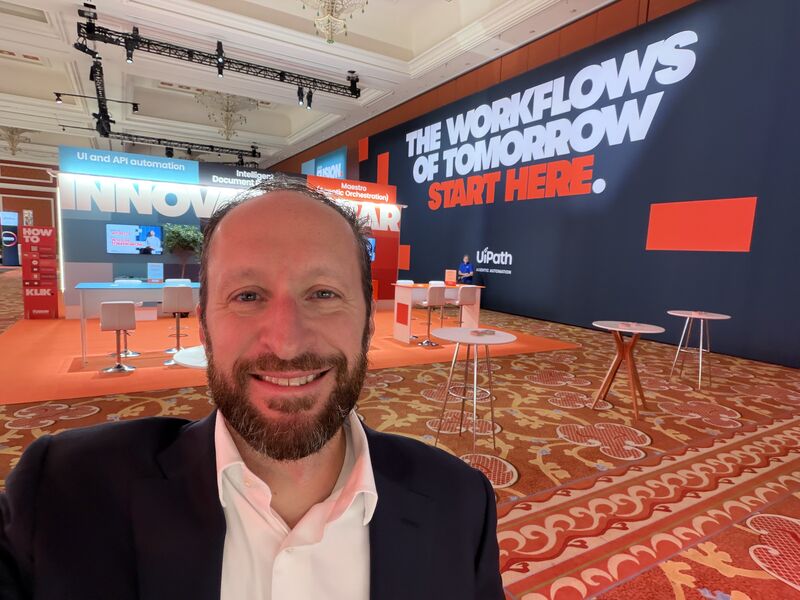
His public explanations start with the process. Long-running work inside a company is difficult because it crosses systems, departments, and moments of judgment. Each handoff can add delay, cost, or error. An agentic system matters when it can improve the whole path, not merely complete an impressive isolated task.
The translation loop
This framing is less cinematic than a swarm of autonomous digital workers. It is also more useful. A hospital intake, an insurance claim, a finance close, or a customer inquiry contains exceptions that cannot be wished away. Atalla's version of the agentic enterprise gives automation a large role while keeping human judgment visible. In one conversation, he described humanity as necessary for checking what AI produces. The point is not nostalgia for manual work. It is accountability for the outcome.
“Every role will be redefined in some way based on AI.”Michael Atalla
Trust lives in the handoffs
Enterprise software has always sold a peculiar combination of change and reassurance. The buyer wants a meaningful improvement, but not an uncontrolled one. Agentic systems make the tension sharper because they can decide, act, and call other tools. The more capable the system becomes, the more the customer needs to understand its limits, supervision, and exception path.
Atalla is direct about the boundary. “AI cannot convey trust,” he has said. The phrasing places a demanding burden on the company around the model. Trust must come from security, governance, product behavior, reliable orchestration, and the record of the organization making the promise. Marketing can introduce that system, but it cannot manufacture confidence separately from it.
That explains why his UiPath story keeps returning to complex work rather than abstract intelligence. A regulated company will not hand over a consequential process because a demonstration went well. It will ask who approves an action, what happens when the data changes, whether the system can show its work, and how a person intervenes when the situation falls outside the expected path.
Atalla once floated a deliberately bold application of this logic: replace the conventional corporate website with a conversational interface. His reasoning was operational. A visitor navigates pages, fills out a form, enters a lead system, waits for a business development representative, and perhaps reaches a salesperson. Each step is a handoff. A useful AI interface could understand intent earlier and shorten the route to a qualified human conversation. The provocation works because it is also a process map.
The leader returns to the work
His view of management is changing alongside the technology. Two decades ago, a Microsoft manager put two goal sheets in front of him. His sheet was filled with verbs such as deliver, complete, and ship. Hers emphasized review and approve. It was a compact lesson about moving from doer to leader. Atalla accepted it and later taught versions of it to others.
He now wonders whether the lesson created too much distance. Large organizations could once afford layers that kept senior people away from the details. AI reduces some of that slack and accelerates the cycle from idea to execution. A leader who only approves may discover that fluency has decayed. Atalla's alternative asks leaders to hold two positions: remain responsible for the larger system and retain the ability to enter the work when the decision requires it.
That is consistent with how he describes leadership elsewhere: listen first, lift others, clear the path, and help teams do their best work. It is also consistent with the biography he writes for himself. Bridge builder. Storyteller. Motivator. Techie. Tinker. Amateur chef. Home-automation enthusiast. The nouns mix corporate responsibility with the pleasure of making something function.
Outside the office, Atalla has supported City Year Seattle and Yellow Wood Academy, organizations connected to education access and equity. He describes himself as a husband and father, as well as a triathlete and martial artist who enjoys competition. These details do not soften the executive profile so much as explain its rhythm: technical curiosity, a taste for practice, and attention to the systems around people.
The next translation
Atalla's career has repeatedly placed him at the seam between a technology and the organization trying to absorb it. Installed Office became a cloud service. Application delivery became inseparable from security. Robotic automation is becoming a system of agents, models, robots, and people. Each change arrives with a new vocabulary, and each vocabulary can conceal as much as it reveals.
The practical idea to take from his work is simple: start with what crosses the boundary. Look for the handoff between teams, the translation between product and customer, the gap between an AI action and a human judgment. That is where a category becomes a business system. It is also where a marketing claim becomes testable.
UiPath's challenge is not merely to announce that the agentic enterprise is coming. Its customers have already heard that from many directions. The harder assignment is to show how a real process changes, where a person stays involved, what improves, and why the platform can be trusted with the work. Atalla has been rehearsing for that assignment since the Macintosh, the unexpected reorganization, and the long move from a box of Office software to a service in the cloud.