Before Metallica was an industry, it was an answer to a classified ad. Lars Ulrich placed the notice in the Los Angeles Recycler. James Hetfield replied. The official birthday is October 28, 1981, which gives the band a date but not yet a destiny. There was no heroic fog around the arrangement: two young musicians wanted to play, and each had something the other needed. Ulrich supplied motion, appetite and a drummer's instinct for structure. Hetfield supplied a right hand that could make a guitar riff feel like a machine learning to snarl.
The name arrived by minor larceny. Bay Area metal fan Ron Quintana was choosing between Metallica and Metal Mania for a fanzine. Ulrich encouraged Metal Mania and quietly kept the other candidate. It is a tidy origin for a band that would spend its life making the most of available material: a newspaper ad, a friend's unused noun, a garage, a U-Haul, a cassette that listeners copied for one another.
That cassette, No Life 'Til Leather, travelled through the tape-trading circuit faster than the musicians could. Long before an algorithm could tell a teenager what to hear next, enthusiasm moved hand to hand, dubbed at home and posted to someone who knew someone. Metallica's first network was slow, physical and persuasive. The music did not ask permission from radio because radio was not in the conversation.
Move north. Find the bass. Change the band.
The early Metallica lineup was not stable. Ron McGovney played bass and Dave Mustaine played lead guitar, but the encounter that tilted the music happened in the Bay Area. Cliff Burton had the technique of a studied musician and the bearing of somebody who would not be hurried into another person's plan. Metallica wanted him. Burton did not want Los Angeles. So the band moved north.
It is hard to resist the comedy of it: a future stadium act relocating because one bass player declined the commute. Yet the decision says something enduring. Metallica has often been described through force, but its more useful habit is pursuit. When the band hears a possibility, it moves toward it. Burton brought musical theory, melodic bass and a willingness to place odd shapes inside fast songs. The Bay Area brought a scene that understood the same mixture of punk velocity and metal precision.
In 1983, the group drove east in a U-Haul to make Kill 'Em All for Jon Zazula's Megaforce Records. Mustaine left before the sessions and Kirk Hammett arrived from Exodus. A year later, Ride the Lightning showed how quickly the writing room had expanded. Acoustic openings, instrumentals and fatalist stories now sat beside the sprint. Metallica had found speed, then discovered that speed was more interesting when there were corners.
The record that refused to sit still
Master of Puppets arrived in March 1986 without a conventional promotional machine behind it. No music videos. Little commercial airplay. It still reached the American Top 30 while Metallica opened for Ozzy Osbourne. The record's control is almost architectural: long songs, abrupt turns, tightly repeated figures and pockets of melody placed where the pressure needs air.
That September, Burton died when the band's tour bus crashed in Sweden. The loss ended one version of Metallica. After more than 40 auditions, Jason Newsted took the bass position. The band returned quickly to work, first touring, then recording cover songs in a garage the members helped convert by hand. Grief is often made legible after the fact. Here, it also appeared as labor: fit out the room, learn the songs, keep the calendar moving.
...And Justice for All followed in 1988, dense and angular. Its single “One” produced Metallica's first music video, seven years into the band's life. The choice mattered. Metallica had spent the decade growing outside the usual machinery, then entered it on its own terms, with a grim black-and-white film built around the antiwar story of a soldier trapped inside his body. The song won the band's first Grammy in 1990.
“I don't like to be pigeonholed, and I really like that people never really know what's going on with Metallica.”Lars Ulrich
When the room became the world
The 1991 self-titled album, usually called the Black Album, simplified the surface without making the sound small. Producer Bob Rock pressed for fuller production and more direct arrangements. The record reached number one around the world, sold more than 16 million copies and produced songs that could travel beyond metal radio. Then Metallica toured it for nearly 300 shows across three years. A group once carried by traded tapes now had to learn the strange civic engineering of moving an arena audience.
Success created a problem more interesting than obscurity: what is a heavy band allowed to become? Load and ReLoad moved toward hard rock, blues and shorter hair. Some listeners regarded every altered silhouette as evidence for a trial. Metallica kept changing the exhibit. In 1999, conductor Michael Kamen and the San Francisco Symphony placed orchestral arrangements around the catalog for S&M. The point was not to make metal respectable. The songs were already doing fine. The point was to hear what else they contained.
This willingness did not guarantee agreement, inside or outside the band. Metallica's history is full of arguments about sound, presentation, ownership and direction. Yet conflict is not the opposite of collaboration. In a durable creative group, it can be the price of having four people who still care where the work goes. Robert Trujillo, who joined in 2003, describes the members as different ingredients whose value appears in combination. It sounds less like romance than a kitchen rule: do not confuse unlike flavors with a broken recipe.
A museum piece that still has a job
In 2015, Master of Puppets was selected for the Library of Congress National Recording Registry. It was the first metal recording chosen for preservation. This is the point at which a lesser story might become marble. Metallica instead kept requiring the title track to function as live music: counted in, played at volume, tested against a crowd that may include people born decades after the record.
The band's reach produced a delightfully literal statistic in 2013. Metallica became the first musical act to perform on all seven continents after playing for 120 scientists and contest winners at an Argentine base in Antarctica. The set took place inside a transparent dome. To respect the environment, amplifiers sat inside isolation cabinets while the audience listened through headphones. Heavy metal became, for one hour, a silent disco at the end of the earth.
There is a compact Metallica philosophy inside that odd scene. Keep the requirement, alter the delivery. The band still plays. The audience still gathers. The place demands another method, so the equipment changes. Tradition survives by being practical.
The practical romance of useful work
Metallica's philanthropy has the same workbench quality. All Within My Hands, the band's foundation, launched the Metallica Scholars Initiative in 2019 with $1 million spread across 10 community colleges. The program backs workforce education and skilled trades. By 2026 it had reached 93 schools across all 50 states and Guam, expanded to the United Kingdom and supported roughly 15,000 students.
The cause fits without straining for symbolism. This band was built through applied education: rehearse until the hands understand, learn the equipment, fix the garage, load the truck, repeat the difficult bar. Skilled trades turn competence into a living by similarly unglamorous repetitions. The grants acknowledge that useful work deserves equipment, instruction and a clear route into employment.
By 2026, the foundation had committed $3.3 million to the American expansion and another $250,000 for the UK launch. These are cleaner numbers than a guitar solo. They are also a second kind of legacy, measured not in streams but in people able to do paid work because a training program had room for them.
Ron Quintana kept Metal Mania for his fanzine. Ulrich kept Metallica for the band. A useful theft can be very polite.
Metallica waited until 1988 and “One” before making a music video. MTV did not create the early audience; the audience arrived first.
The San Francisco Symphony collaboration began in 1999 and returned as S&M2 in 2019, with fans arriving from 65 countries.
M72's two-night stops use different set lists each night, turning memory into part of the ticket.
Four people inside a circle
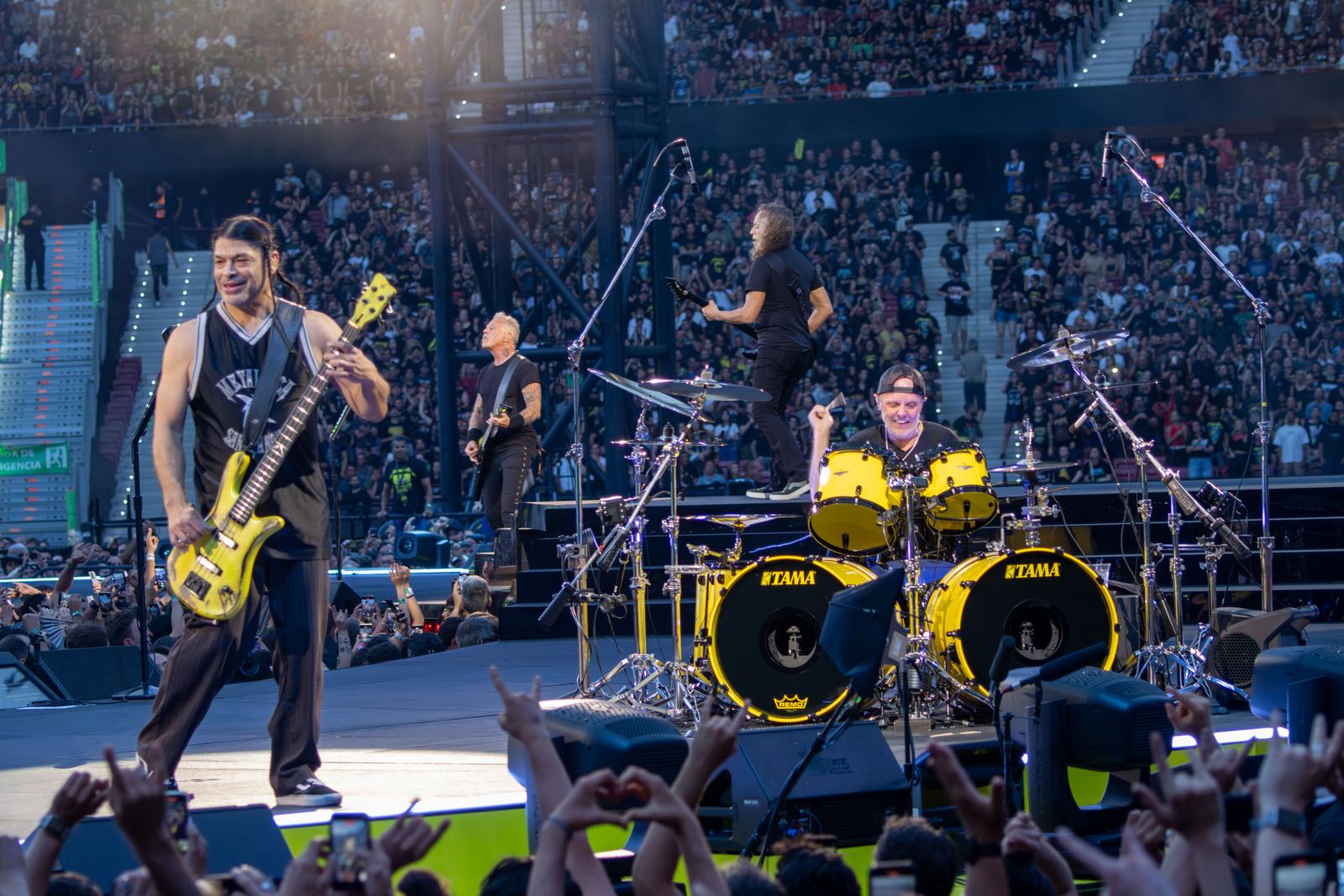
The M72 stage is circular, with the audience gathered both around and inside it. Drums appear at different points. Microphones wait around the ring. The musicians travel rather than occupy a fixed front. It is an apt piece of accidental portraiture. Metallica now works by orbit: four distinct people moving around a catalog too large to stand in one place.
The tour's no-repeat weekends make that orbit visible. Two nights in one city, two set lists. Familiar songs stay, but familiarity cannot become autopilot. In September 2026, the band extended M72 into North America for 12 more dates in 2027. Before those stadiums, another shape waits in Las Vegas. The Life Burns Faster residency at Sphere expanded to 24 shows running from October 2026 through March 2027.
Ulrich called the venue uncharted territory and said the residency offered another chance to reinvent how Metallica interacts with its audience. The statement could stand as a compact account of the whole career. The band has accumulated enough tradition to make change difficult and enough appetite to try anyway. A sphere is simply the newest room with stubborn acoustics, novel sightlines and a reason to rehearse.
“I think every Metallica record has its own journey, its own story, its own path forward.”Lars Ulrich
Forty-five years after the Recycler ad, Metallica is neither a fixed lineup from 1981 nor a clean escape from it. Hetfield and Ulrich remain at the center. Hammett has been present since the debut album. Trujillo has held the bass chair for more than two decades. Burton and Newsted remain audible in the material and in the way the band's history is told. The family portrait has layers.
Longevity is often mistaken for the avoidance of endings. Metallica's version contains plenty of them: members gone, eras closed, arguments lost, tours packed away. The continuity comes from beginning again without pretending to be new. Pick up the old song. Put it in a different room. Count it in. See whether four people can still make it move.