The first public artifact of Fizz Ahmed's career was a white T-shirt. On it stood a tree, except the fruit was made of books. Ahmed drew the design himself, ordered 200 shirts from a manufacturer in Bangladesh, and set up a table in the student center at Brandeis University. The proceeds would buy books for children at a literacy school in Dhaka. He was 19.
This was 2011, before a decade at Google, before an MBA at NYU Stern, before the growth consultancy, the nonprofit board seat and the founding go-to-market job at Lovable. Yet the shirt contains a useful miniature of everything that followed. There is the marketer's instinct for an image and a line. There is the operator's preference for a practical mechanism. Most of all, there is the question Ahmed keeps finding in different rooms: who has the tools to participate?
At Brandeis, the answer concerned schoolchildren. Ahmed had visited the Notre Dame Literacy School in Dhaka, where hundreds of children from poor families could receive lessons and books. The school ran on donations. He returned to campus with a slogan admirably free of committee polish: “Give Me a Book. Give Me a Future.”
A student table, 200 shirts and a hand-drawn tree of books.
The Noogler hat goes on. A ten-year education in how large systems move.
Founding GTM at Lovable, bringing AI software creation into enterprises.
A camera points him toward the work
The foundation did not begin with a strategic plan. Ahmed had been photographing a campus event about human trafficking for The Hoot, the Brandeis student newspaper. A speaker described starting her own nongovernmental organization. Ahmed began taking inventory of what he had: a camera, a drawing hand, friends willing to model a shirt, and a university culture that treated social justice as an activity rather than a decorative noun.
He also had a memory from Bangladesh. As a child, he was close with a boy his parents had hired both as a playmate and to clean the house. The two played together, and Ahmed taught him lessons from school. Friendship and hierarchy had occupied the same room. Years later, the T-shirt campaign gave Ahmed a small lever against the unfairness he had already seen.
“All children deserve the right to learn, regardless of their wealth or social status.”Fizz Ahmed, speaking as a Brandeis student
The line is earnest, but the method was canny. The shirts carried a recognizable symbol. Their manufacture in Bangladesh kept some of the spending in the economy Ahmed hoped to support. Friends became models. A table became a storefront and a conversation. He did not confuse attention with achievement, but he understood that the second often needs the first.
Ten years inside the machine
Ahmed joined Google in 2016 and stayed for a decade. His roles touched new business, agency development, strategy and senior account work. The public traces of that period show a marketer who liked frameworks but distrusted incantations. He explained the ABCDs of effective YouTube advertising - attention, branding, connection and direction - while warning that no framework could replace a creative idea. Later, discussing artificial intelligence, he argued that business leaders needed to distinguish predictive AI from generative AI and resist throwing either at every problem.
That restraint is worth noticing. Marketing is commonly accused of applying perfume to fog. Ahmed's version is closer to translation: organize the data, understand the workflow, choose the appropriate tool, and then explain the change in language a business can act upon. A decade at a company whose products had become verbs offered ample practice.
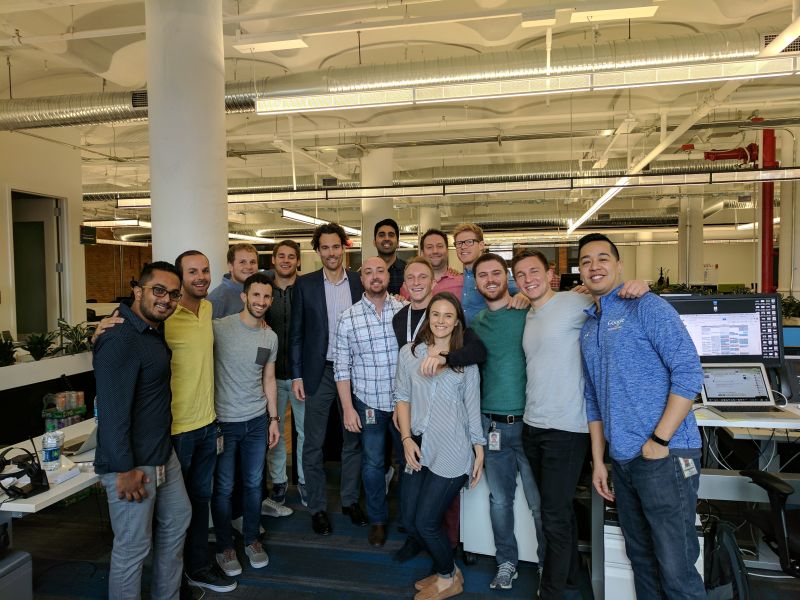
When Ahmed announced his departure in August 2026, he did not present ten years as a lone ascent. He thanked the teammates who challenged and inspired him, said their generosity had made him better, and posted photographs full of crowded offices and shoulders squeezed into frames. The Noogler hat had become an archive of groups.
Years at Google, from 2016 to 2026. Long enough to learn an institution's grammar; short enough to choose a new sentence.
Justice gets a stage, then a canvas
The technology career did not replace the student concern with access. In February 2020, Ahmed hosted exoneree Richard Miles and Centurion advocate Kate Germond for a Talks at Google conversation about wrongful conviction. His opening move as interviewer was revealing. Rather than begin with Miles's arrest and 15 years in prison for a crime he did not commit, Ahmed asked about the life before it: interests, dreams, family, the people around him. He restored the person before discussing what the system had taken.
Later that year, after the murder of George Floyd, Ahmed painted a work titled I Can't Breathe. He used it to raise awareness and money for social and racial justice groups, with Centurion among the beneficiaries. The raffle winner donated the painting back to Centurion. It eventually went to Christina Seix Academy in Trenton, where students were already talking about justice reform. An image made money, then became a teaching object. The old tree of books had acquired a darker palette.
By 2025, Ahmed was on Centurion's board. He was also publicly identified as the founder and chief executive of Growth Theory, a corporate growth-strategy consultancy. In both roles, the useful skill is moving a cause from moral agreement to organized action. Plenty of people believe innocent people should be freed. A functioning organization must turn belief into investigation, litigation, funding and support after release.
One concern, changing instruments
The 99 percent, now with a prompt box
In September 2026, Ahmed joined Lovable's founding GTM team in San Francisco. His brief is to bring the company's AI software-building platform to American enterprises. The move followed closely after his Google farewell: one institutional chapter shut, another opened at startup speed.
Ahmed describes the opportunity in democratic terms. For most of software history, he argues, building was gated by a small technical elite. When the cost of creation falls, the scarce resource changes. Advantage moves toward people with good ideas, judgment and the discipline to ship. This is, naturally, also a sales thesis. Yet it fits a pattern too neatly to dismiss as copywriting. At 19, he was concerned that money determined which child held a book. At 34 or 35, he is concerned that technical permission determines who can make software.
“When the cost of creation collapses, the constraint shifts from ‘who can build it’ to ‘who has the best ideas and the discipline to ship them.’”Fizz Ahmed on joining Lovable
The enterprise version of democratization is less romantic than the word suggests. It includes security reviews, data governance, integration work and the quiet terror of a spreadsheet that only Gerald understands. Ahmed's first public month at Lovable included a hands-on build lab during Dreamforce week. Revenue leaders arrived with laptops and left with working research tools. One attendee, an engineer, built an event-discovery agent in 90 minutes and said a conversation with Ahmed changed his view of Lovable from a fast front-end generator to a tool for building agents connected to real systems.
That is the territory Ahmed has chosen: between the strategy deck and the working thing. His Google experience supplies the enterprise dialect. His nonprofit work supplies the reminder that access is not created merely by announcing openness. Someone has to arrange the table, make the invitation legible, and consider what happens after people arrive.
An optimist with implementation notes
Ahmed's public personality is warm, collaborative and fond of a useful provocation. Shortly after joining Lovable, he asked what people would build if they woke up in 1998 with a laptop, Wi-Fi and the platform. The answers ranged from a Tamagotchi that stayed alive through the school day to a song-lyrics database and a deliberately slow loading screen for dial-up. It was playful market research disguised as time travel.
His own answer, expressed through the shape of his career, might be a bridge. He moved from Bangladesh to the greater Boston area as a child, then from Brandeis to New York business school, Google, and San Francisco. He speaks Bengali and English. He has occupied rooms where technology's future is discussed and rooms where institutional failures are counted in lost years. The combination makes his optimism more interesting. It comes with implementation notes.
There is an obvious risk in every democratizing technology: lowering the barrier does not guarantee wisdom on the other side. More people can build foolish things, insecure things, ugly things. Ahmed's formulation quietly accepts this. Once access expands, ideas and discipline matter more, not less. The locked door was only the first problem.
The tree on that 2011 shirt offered a simple promise. Give a child a book and the future grows another branch. Lovable offers a newer and more commercial promise: describe the software and watch it take form. Ahmed now stands in front of enterprises making the second case, with the first one still visible behind it. A career may change its instruments without changing its key.