In 1983, the future needed an interpreter. Personal computers were still exotic objects, the sort of machines that came with a vocabulary lesson. Melissa Waggener Zorkin saw a business in closing the distance between what technology could do and what people could imagine doing with it. She began with three colleagues, a free office above the Willamette River in Portland and a thesis that was less fashionable than it now sounds: communication works better as a team sport.
The firm that started as The Waggener Group would become Waggener Edstrom and, eventually, We. Communications. The modern name contains a compact piece of history. The W comes from Waggener; the E from Pam Edstrom, the early partner who joined in 1984. It is also a plain-English statement of method. After 43 years, more than 1,500 employees and work spanning over 100 international markets, “we” remains a more revealing word than “me.”
Zorkin's career is often told through scale, awards and the unusually durable relationship her agency built with Microsoft. Yet the more useful story begins with a question. Her father asked it when she brought him an idea, including what she has called her “crazy science fair” projects: “To what end, Melissa?” Four words. They insist that enthusiasm account for consequence. What will this change? Who is it for? What happens after the clever plan?
A computer on every desk sounded outrageous
Before starting her agency, Zorkin worked at Tektronix and then at Regis McKenna's Portland office, where she led the Microsoft account. The timing put her near the opening scenes of the personal-computer era. Microsoft had a large idea and a small public vocabulary: a computer on every desk and in every home. Today the phrase has the polished inevitability of history. In the early 1980s, it asked reporters and customers to picture a life that barely existed.
Zorkin remembers taking Bill Gates on an early press tour. The work was not simply publicity for a product. It was translation for a social shift. A machine once reserved for institutions was becoming personal, and the communicator's task was to connect circuitry with daily life. This became the agency's native terrain: stand where innovation meets its audience, then find the human terms.
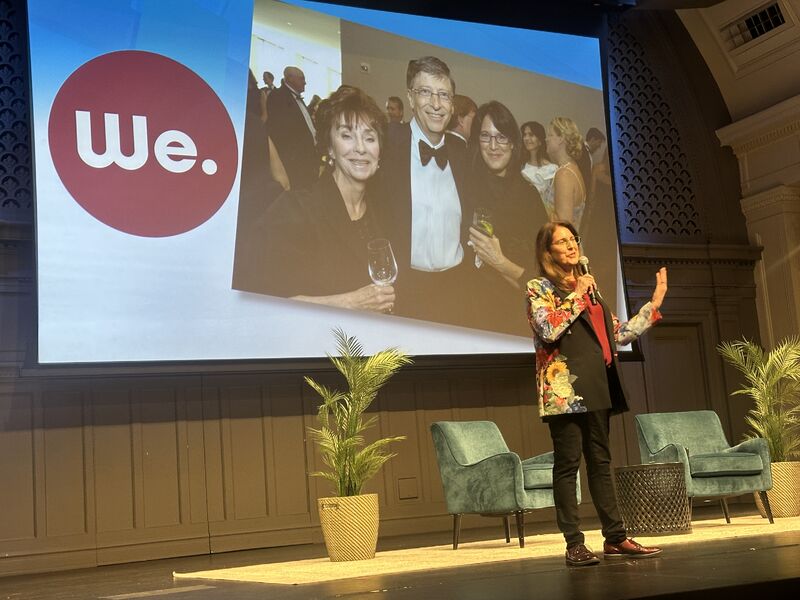
At Microsoft's 50th-anniversary gathering in Seattle in 2025, that old assignment returned as a story. Zorkin stood onstage and described the vision as “quite outrageous at the time.” The room knew the ending. That is the luxury anniversaries provide. The original communicators had no such comfort; they had to make the strange intelligible before the result was obvious.
Independence is a daily verb
Many agencies founded in the last century were absorbed into larger networks. We. remained independent. Zorkin talks about that independence fiercely, but not as isolation. The agency has expanded through partnerships and international relationships, including its work with Avian Media in India. Independence, in this telling, is the ability to choose a horizon: invest for the next change, protect a culture and decide which client work has a purpose beyond volume.
That horizon has widened with the business. The early reputation was built in technology, but We. now works across technology, consumer and health sectors, along with corporate reputation and public affairs. The expansion is less a departure than an application of the founding skill. A new device, a corporate change and a complicated public issue all create the same first problem: experts know too much, audiences know too little and confidence rushes in before understanding. A communications agency occupies the narrow ground between them. Its value depends on whether it can make complexity clear without making it false. Independence gives Zorkin room to defend that ground over a longer period than a quarterly campaign.
Her proudest accomplishment, she told PRNEWS in 2011, was building a large independent agency that could “get and keep great people.” It is a revealing priority. Revenue is a result; retention is a relationship. An agency sells judgment made collectively under pressure. If the people leave, the product leaves by the elevator.
“Always put people at the heart of every decision.”Melissa Waggener Zorkin's stated formula for business
The principle becomes credible in the small habits. Zorkin makes a point of meeting every intern who joins We. In June 2026, she wrote about leaving a spring-cohort conversation with questions of her own. That reversal matters. The meeting is not a ceremonial audience with the founder. It is an information channel in both directions, one that lets the newest people question the oldest assumptions.
Her public view of leadership likewise makes room for discomfort. In a conversation about corporate activism, she argued for vulnerability, mindfulness and conviction, especially when leaders are challenged. She used the phrase “unvarnished input.” It is an excellent phrase because varnish is precisely what corporate communication is often accused of applying. To ask for the unvarnished version is to accept that listening may alter the speaker.
Four decades, four inflection points
A four-person Portland beginning, built around teamwork and technology stories.
Ernst & Young names her Pacific Northwest Regional Entrepreneur of the Year in her category.
PRWeek Hall of Fame induction and the launch period for the Young Changemakers program.
A renewed focus on AI, trust and the human judgment that machines cannot supply on their own.
A mentor with institutional memory
Mentoring is the bridge between Zorkin's private habits and public commitments. She serves on the boards of ColorComm and the USC Annenberg Center for Public Relations. She previously spent more than 15 years on the Mercy Corps board. With PRovoke Media, We. helped create the Young Changemakers Awards for communicators aged 22 to 29 from underrepresented and marginalized communities across several regions. Winners receive more than applause: mentoring, a platform to publish, podcast appearances and access to major industry gatherings.
The architecture is worth noticing. Awards often look backward, certifying work already completed. This one is designed as forward motion. It gives young professionals rooms, relationships and distribution they can use next. Zorkin has also helped women entrepreneurs build businesses through local and global organizations. The pattern is not merely recognition; it is access.
Her own honors now form a tidy procession: a 2008 Stevie Award for Best Executive in North America, the 2009 regional Entrepreneur of the Year award, the PRWeek Hall of Femme, the ICCO Hall of Fame and the PRWeek Hall of Fame. In 2024, she made the PRWeek US Power List for the fourth time, with the recognition pointing partly to her leadership around artificial intelligence in public relations. She responded by spreading the credit across the agency team. Awards may arrive under one name; agency work rarely does.
The next machine enters the room
The symmetry in Zorkin's career is almost too neat. She built the agency while personal computing moved from the lab and office into ordinary life. Now she is leading it while generative AI changes how people find information, how brands become visible and how trust is formed before anyone clicks a link. Once again, the technology has arrived before its social grammar is settled.
Her recent language about AI avoids both panic and carnival barking. The consequential questions, she wrote in 2026, are about people: how teams adapt, how trust is built and how tools can support creativity, empathy, judgment and connection. Those nouns are not nostalgic decorations. They are the work machines make more valuable by making output cheap.
“Some of the most important conversations about AI right now aren't really about technology. They're about people.”Melissa Waggener Zorkin, 2026
We. has put research behind that position, examining how AI-generated answers affect reputation and visibility. The communications professional now has an unfamiliar audience: the model that reads, compresses and recites everyone else's work. This creates tactical questions about citations and search. It also revives Zorkin's oldest strategic question. To what end are these systems being used, and whose understanding improves?
In February 2026, she published an essay arguing that this moment in communications feels different and full of possibility. Communicators, she wrote, get to explain what comes next. The thought echoes the early Microsoft years without pretending the technologies are identical. The durable skill is not knowing the future. It is helping people enter it with enough context to make choices.
The useful measure of a long career
Zorkin's public biography offers the conventional closing notes: she travels, enjoys outdoor activities with her family and continues to lead the company from the Pacific Northwest. But her more distinctive legacy may be procedural. Ask what the work is for. Keep the company independent enough to act on the answer. Invite criticism without requesting that it first become polite. Meet the interns.
None of these ideas is flashy. That may be why they travel well across decades. Technologies molt. Agency names shorten. The number of markets grows. A founder eventually finds herself on a stage, explaining the implausible old future while a new implausible future waits backstage.
There is also a useful modesty in the firm's current name. We. is both a declaration and a reminder that no founder, however visible, scales alone. Edstrom's E remains beside Waggener's W. Colleagues across regions turn the initials into daily work; new leaders carry parts of the operation that once fit around one small table. Zorkin's achievement is therefore not simply that she built an institution. It is that the institution can keep adding authors to the sentence without losing the original grammar of collaboration.
The temptation in communications is to confuse novelty with meaning. Zorkin's question separates them. It followed her from childhood projects to a free Portland office, from an early Bill Gates press tour to a global firm debating AI and trust. Four words have carried a surprising amount of institutional weight. The future will always need interpreters. The good ones still ask where it is going.