A film crew’s lunch break seems an unlikely place to look for a software business. Yet record it incorrectly, and the mistake can travel: into a timecard, into a paycheck, into a production’s accounts. The person responsible for the budget eventually meets the consequences of a detail everyone else was eager to leave behind.
Media Services lives in that passage between what happened on set and what the production owes. Its business combines payroll administration with software for calculating pay, tracking costs and handling residuals. The useful way to understand it is to follow one piece of information as it changes hands.
- For producers: entertainment payroll, tax administration, residuals and incentive advice.
- For accountants: Showbiz calculations and MediaWeb cost reporting, connected to payroll.
- The buying detail: MediaWeb and Mobile Timecards are included for payroll clients; standalone budgeting and cloud collaboration have separate costs.
01 / A workday with several price tags
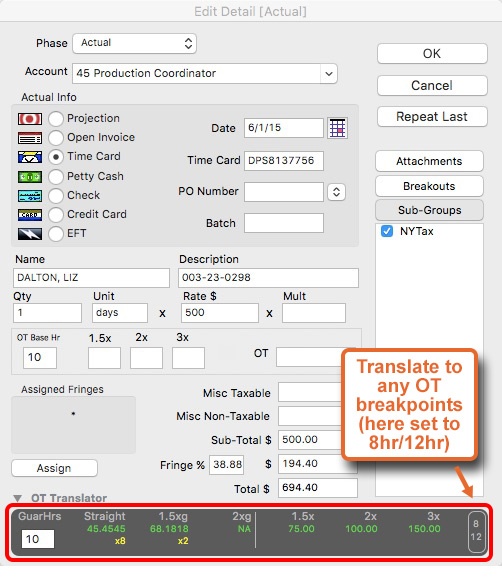
Ordinary payroll has its complications. Entertainment adds some unusually precise ones. Showbiz Timecards Crew, part of Media Services’ software family, calculates overtime, meal penalties, night premiums and turnaround penalties. It also allocates pay among jobs, episodes, locations and accounts.
That last feature tells you something about the customer. A production accountant may need to know both what someone earned and where the expense belongs. One person’s week can be divided across seven jobs; a single day can have three splits. The paycheck is one answer. The allocation is another.
Consider the difference in questions. A crew member asks whether the pay is correct. An accountant asks which episode incurred the cost. A producer asks whether the show is still within budget. These questions concern the same workday, but a useful system must preserve enough detail to answer each of them.
Media Services’ payroll customers include independent films, television, commercials and digital content. Its homepage displays client logos for Netflix, Amazon Studios, HBO, Tinopolis, Twitch and MJZ. That collection spans very different kinds of production. The shared need is a reliable way to turn a temporary workforce’s activity into payments and records.
02 / The handoff is the product
The company’s Mobile Timecards tool lets crew members enter call, wrap and meal times, then submit them for approval. Production teams define the approval workflow and follow it through a dashboard. Capturing a time entry and deciding that it is ready for payroll remain separate acts.
This is a sensible division of labor. The person who worked the day records it; the production reviews it. Software can move the entry along without requiring the accountant to reconstruct every conversation. Someone still needs to know whether the record matches the work.
- 01RecordCall, meal, wrap
- 02ApproveProduction review
- 03PayCalculate and process
- 04TrackCosts and accounts
Illustrative workflow, not a measure of processing speed.
MediaWeb takes the next handoff. It is browser-based production accounting software, with an automated payroll feed from Media Services. It supports multiple budgets, standard and custom reports, file attachments and vendor payments by ACH. Purchase-card data can come in from Cashet or PEX.
The important connection is between paying and knowing what was paid. Re-entering an expense creates another opportunity for the number, its account code or its supporting document to become separated. MediaWeb’s payroll feed is designed to carry that information into the accounting workflow.
For a producer, the appeal is fairly prosaic: fewer disconnected tasks. For Media Services, the same connection makes payroll a natural route into the customer’s broader financial work. MediaWeb is free for payroll clients. So is Mobile Timecards. The software bundle gives the service relationship a life beyond payday.
03 / What the invoice actually buys
Media Services sells an employer-of-record payroll service. Its published offering includes payroll tax withholding and filings, W-2s, check or ACH payment, and workers’ compensation administration for crew and cast. Its pitch is to take on employment administration that a production would otherwise have to arrange.
The company advertises no setup fee and same-day setup. Those promises concern starting the service. The ongoing handling fee is negotiated, according to its FAQ. A buyer needs a production-specific quote to understand the bill.
Showbiz Budgeting 10 / two computer installs
Store listing checked October 2, 2026. Optional cloud subscription is additional.The separate Showbiz software business makes the model more interesting. Budgeting 10 combines desktop budgeting with optional cloud collaboration. The cloud feature requires the desktop purchase and a monthly or annual subscription. A five-day trial lets a prospective buyer work with the software before purchasing.
Budgeting also supports actualization: tracking spending against the plan. Payroll expenses, purchase orders and petty cash become evidence about how the production is progressing. A beautiful initial budget deserves some skepticism until actual costs begin arriving.
For a buyer comparing offers, the useful question is what the quoted bundle covers. Payroll handling, accounting access, desktop licenses and collaboration subscriptions are different purchases. Treating them as one vague “software cost” would conceal the very distinctions the tools are meant to clarify.
04 / The film ends. The calculations continue.
Payroll follows work. Residuals follow the contractual reuse of that work. Media Services processes residuals for studios, networks, streaming platforms, distributors and producers, and describes experience across thousands of film and television titles.
Its system supports the contractual formulas associated with subscription streaming, electronic sell-through, rentals and advertising-supported streaming. The relevant guild agreements include SAG-AFTRA, DGA and WGA. Distribution changes the calculation, which is why a residuals business needs both software and people who understand the agreements.

One distinctive feature is the payment decision. Media Services provides estimates before a run and waits for the client’s approval to issue payments. The residuals portal supplies invoice history. Clients can therefore review the financial consequence before authorizing the transaction.
That is a useful principle far outside television: make the calculation visible before the money moves. Automation has more value when it preserves a decision point than when it merely makes an opaque process faster.
05 / A specialist joins a larger cast
Media Services’ history reaches back to 1978. In February 2020, Cast & Crew announced an agreement to acquire it, with support from parent EQT. The announcement said Media Services would retain a distinct brand under then-chief executive Barry Oberman. The terms were undisclosed.
“Before we had payroll clients, we were the payroll clients.”Media Services / its production payroll page
That company statement neatly expresses the position it wants to occupy: a service built around the production accountant’s problems. Its vision emphasizes collaboration, support, accountability, timeliness and security. Its recruiting page describes a casual environment and roles in payroll processing, programming and business analysis.

Entertainment Partners and Wrapbook offer alternative specialist payroll and accounting workflows. Digital timecards alone do not distinguish Media Services in this market. Its case rests on the particular combination of Showbiz tools, bundled MediaWeb accounting, residuals expertise and personal payroll support. The right comparison is the entire working process.
Its public education follows the same audience. The free Showbiz Labor Guide supplies union and guild rates. Recorded webinars demonstrate accounting and timecard tools. By June 2026, its blog was also featuring conversations about film bankability and vertical microdramas, alongside its production-management material.
06 / Borrow the method, check the inputs
A producer can copy the underlying discipline without buying every tool: record the work once, define who approves it, retain the account allocation and connect the payment to the cost report. The practical benefit is that each department receives a record it can use.
Incentive consulting extends that discipline to location decisions. Media Services considers production type, budget, local hires and available program funds, and helps tag qualifying expenses. A headline tax-credit percentage is only useful when the production’s costs actually qualify.
The conditions matter. A calculation cannot repair incorrect time entries or a poorly configured approval process. Workers’ compensation coverage has stated exclusions, including foreign hires working overseas and undisclosed hazardous activities. These arrangements need to match the actual production, rather than an imagined, simpler one.
There is a modest lesson here for anyone managing complicated work. Preserve the detail at the moment it is created. Let the people with context approve it. Give the next person a usable record. On a film set, a lunch break can be a small event with a surprisingly long financial afterlife.