The telephone rings. Somewhere inside the business, a database knows who is calling. Somewhere else, a ticket records the last complaint. The person answering is expected to reunite these scattered acquaintances while sounding delighted. It is an impressive demand to make of someone whose other hand is still reaching for the headset.
CDC Software works on that reunion. Its product occupies the space between a contact center’s phone system and its customer records. The ambition is modest enough to be useful: let the agent begin with context, and let the software carry the paperwork that follows.
- Connect what exists. CDC links telephony, CRM and other business systems.
- Keep the useful differences. Chico’s retained separate phone systems across two centers.
- Budget by seat. Published annual subscriptions start at $25 per user per month.
A number is a rather poor introduction
A telephone number identifies a call. A customer record can explain why that call matters. CDC’s integration retrieves relevant information and presents it through a screen pop: a record appearing in the agent’s working application. Afterward, call details and recordings can be attached to the appropriate system of record. The practical reward is fewer journeys between screens.
Computer telephony integration, or CTI, has an unfortunate name for an ordinary courtesy. If you have already told a business something, you would prefer its next representative to know it. CDC sells the machinery behind that courtesy through a subscription platform and professional services.
The platform’s technical overview contains an especially revealing detail: the voice path does not pass through CDC. Speech stays between the telephony system and the agent’s desktop or softphone. CDC handles the associated information. That makes its place in the market easier to understand. It connects the equipment that carries the conversation to the applications that give the conversation a memory.
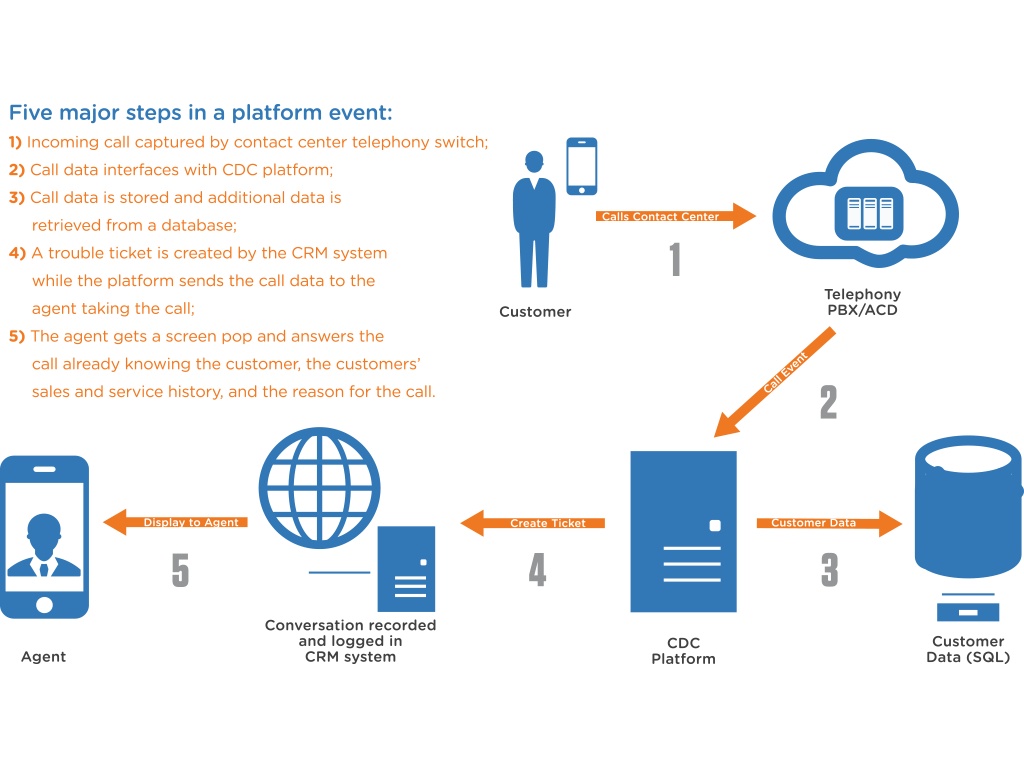
Chico’s had two perfectly good reasons to be different
In 2014, Chico’s wanted its customer records and calls connected. Its two contact centers used Cisco and inContact, with separate Zendesk instances. Different functions had produced different telephony needs. Replacing both arrangements with one uniform system would have solved a diagram more neatly than it solved the business.
Zendesk recommended CDC. The implementation used a separate platform instance for each center, configured for local requirements. Chico’s kept its distinct operating arrangements while simplifying procedures and training across the company. The case study reports improved efficiency and limited maintenance; it presents the outcome qualitatively.
The decision offers a useful distinction for a technology buyer. Shared procedures do not always require identical equipment. Before commissioning a replacement, examine the point where information stops moving. A connector may be enough. A procurement exercise that begins by counting vendors can overlook the workflow employees actually need.
Standardize the handoff. Preserve the local workflow.
The specification met the people
T-Mobile’s internal support desks expose a different problem. Human Resources and IT used Avaya telephony and Zendesk, but their requirements diverged. CDC delivered two implementations. IT needed automatic ticket creation for every call and a way to follow up on abandoned calls. HR needed caller verification and tracking for departmental escalations.
Then people used the system. Some preferences differed from the requirements agreed before launch. CDC’s account describes adjusting screen pops and other features through settings rather than rewriting code.
That is the most instructive wrinkle in the story. A requirements document describes anticipated behavior. A working support desk supplies the evidence. Here, the first mismatch reported after launch concerned preferences, and configuration provided a way to revise them.
For a buyer, the transferable habit is to leave a deliberate interval between installation and declaring victory. Watch what agents do with the new information. Ask which interruptions help and which merely announce that the software is awake. A successful connection can still produce an irritating screen.
“CDC Software has been extremely flexible in understanding and quickly implementing our changing needs.”Polar, in CDC’s published customer case study
Forty countries hiding inside a phone number
Polar, the Finland-based maker of fitness and heart-rate monitoring products, brought another exception. When it approached CDC in January 2016, it wanted Cisco connected to Zendesk, with telephone-number handling for more than forty countries.
CDC created a connector using E.164 number formatting and database-driven settings that could change while the platform ran. The resulting rules supported international outbound dialing through a Zendesk softphone. Agents could click a number in a ticket to place a call.
CDC identifies Polar as its first customer using Click-2-Call with international outbound dialing rules. The interesting expertise lies in the exception: a familiar button becomes useful only after the telephone conventions behind it have been handled properly. Country information inferred from a number also deserves care. It is a numbering clue, not proof of someone’s present physical location.
The subscription has arithmetic, too
CDC’s published pricing starts at $25 per user per month on an annual subscription basis, with volume discounts for fifty or more users. An illustrative twenty-seat deployment at that starting rate comes to $500 a month, or $6,000 over twelve months. This is subscription arithmetic, not a complete implementation quote.
$6,000 per year at the published starting rate. Services, scope and contract terms determine the actual bill.
The commercial argument is that reusable connectors and configuration can avoid commissioning every integration from scratch. CDC also sells custom connectors, configuration and implementation work. Buyers should therefore separate the recurring seat charge from the work needed to make their particular environment behave.
The platform combines a rules engine, workflows, data maps and connectors. Its published catalog spans more than ninety contact center systems, including telephony, CRM, recording and data connections. Cloud, on-premise and hybrid deployments are supported. These are choices to evaluate against a real environment, rather than reasons to assume every proposed combination will be effortless.
A business built around the handoff
Founder and CTO Tim Chapin’s background includes enterprise telephony architecture and call-recording work. CDC’s institutional story also includes regional support: Ben Franklin Technology Partners announced a $100,000 loan investment in July 2015 to expand commercialization. Later that year, CDC reached the finals of the organization’s Venture Idol pitch competition.
Its ecosystem includes an announced MuleSoft partnership and apps listed in the Zendesk and Freshworks marketplaces. In April 2026, CDC announced CDC Unify B.V., a Utrecht subsidiary providing regional sales engineering, professional services, implementation and technical support. The expansion gives a concrete role to the people surrounding the software.
CDC’s natural alternatives are custom integration work and the connectors already offered by a phone or CRM vendor. The decision turns on the handoffs: which records need to travel, which actions should happen automatically, and how many different systems must participate. A simple requirement may be adequately served by an existing native connector. More particular workflows invite more particular investigation.
The useful starting exercise is to follow one call all the way through. Write down the information the agent needs, the record that must be created, the transfer that must preserve context and the permissions that govern access. Test the awkward cases, including an unknown caller and an abandoned call. Integration cannot rescue inaccurate records or an undefined process by moving them faster.
A business can own a fine telephone system and a fine customer database while making its employees act as the cable between them. CDC’s customer stories suggest where to look first: the handoff. Sometimes the next improvement begins with persuading the equipment already in the room to make a proper introduction.
See the handoffs for yourself
Explore CDC Software, its connector catalog, pricing and company blog. Follow the company on LinkedIn, X, Facebook or YouTube.
Customer stories: Chico’s · T-Mobile · Polar. Also explore the Zendesk app listing and Utrecht services.