Consider the peculiar life of an appraisal. Someone visits a house, looks at its rooms, studies comparable sales and delivers an opinion of value. Then that opinion must travel. A lender needs the report, a reviewer needs the evidence, and the file needs a record of who did what. The house stays where it is. The information is the thing that has to move.
That movement helps explain a purchase CoreLogic made in 2016. It acquired FNC, an appraisal technology business in Oxford, Mississippi, and paid $400 million in cash at closing. The object of the purchase was software that helped lenders order, track, document and review property valuations. Paperwork, it turns out, can be an expensive asset when enough money depends on its arrival.
- The business: property data, analytics and software for the people financing, insuring and managing buildings.
- The FNC connection: an acquired appraisal workflow business, based in Oxford.
- The useful distinction: knowing a property and processing a decision about it are different jobs.
- The current name: CoreLogic announced its Cotality brand in March 2025.
The $400 million handoff
The acquisition announcement had a bigger number: $475 million. The completed deal deserves closer reading. CoreLogic’s annual report recorded $400 million paid at closing, subject to adjustments, and up to $75 million payable in 2018 if FNC achieved specified revenue targets in fiscal 2017. Those are different kinds of money. One bought the business immediately; the other depended on what happened later.
Cash paid at closing
Maximum consideration: $475m. Contingent payment tied to fiscal 2017 revenue targets; not a statement of the eventual payout.CoreLogic was already assembling a valuation business. Its then-CEO, Anand Nallathambi, called FNC “a market leader with a proven track record.” In its announcement, it described FNC’s workflow technology as complementary to its property valuation data, analytics and services. The strategic attraction was straightforward: the information supplier would also have software through which customers used that information.
Here is the commercial logic. A lender can change the dataset it consults. Changing the system that carries orders, messages and review steps through an institution requires a different sort of effort. Connecting the two gives a supplier more occasions to be useful. That is an interpretation of the deal’s design, rather than a claim that customers could never leave.
Oxford enters the machinery
The Oxford connection belongs to FNC. CoreLogic’s headquarters is in Irvine, California. The distinction matters because the companies arrived by different routes. The independent CoreLogic business emerged from First American’s separation in June 2010; the information business took the CoreLogic name while First American Financial carried the title and settlement business.
FNC began in 1995 with Bill Rayburn, Dennis Tosh, Robert Dorsey and John Johnson, University of Mississippi professors. An alumni account describes an early plan drawn on a napkin at McAlister’s. It also identifies the division of labor: banking relationships on one side, economics and information systems on the other. A good idea needed someone who could build it and someone a bank would listen to.
The founders’ setting offered another practical problem. Recruiting programmers in Mississippi required selling the place as well as the job. The same account describes attractive pay and benefits, community activities and a deliberate effort to help recruits settle into Oxford. Today, Cotality’s office list still includes FNC’s Office Park Drive address. The acquisition changed ownership without erasing the geography.
The report has to travel
In the current product family, Collateral Management System, or CMS, handles valuation workflow: ordering, communication, tracking and configurable rules. AppraisalPort provides the appraiser-facing connection to lenders and appraisal management companies. Together, these tools address an unromantic source of delay: a job exists, but the right person has not received the right information in the right form.
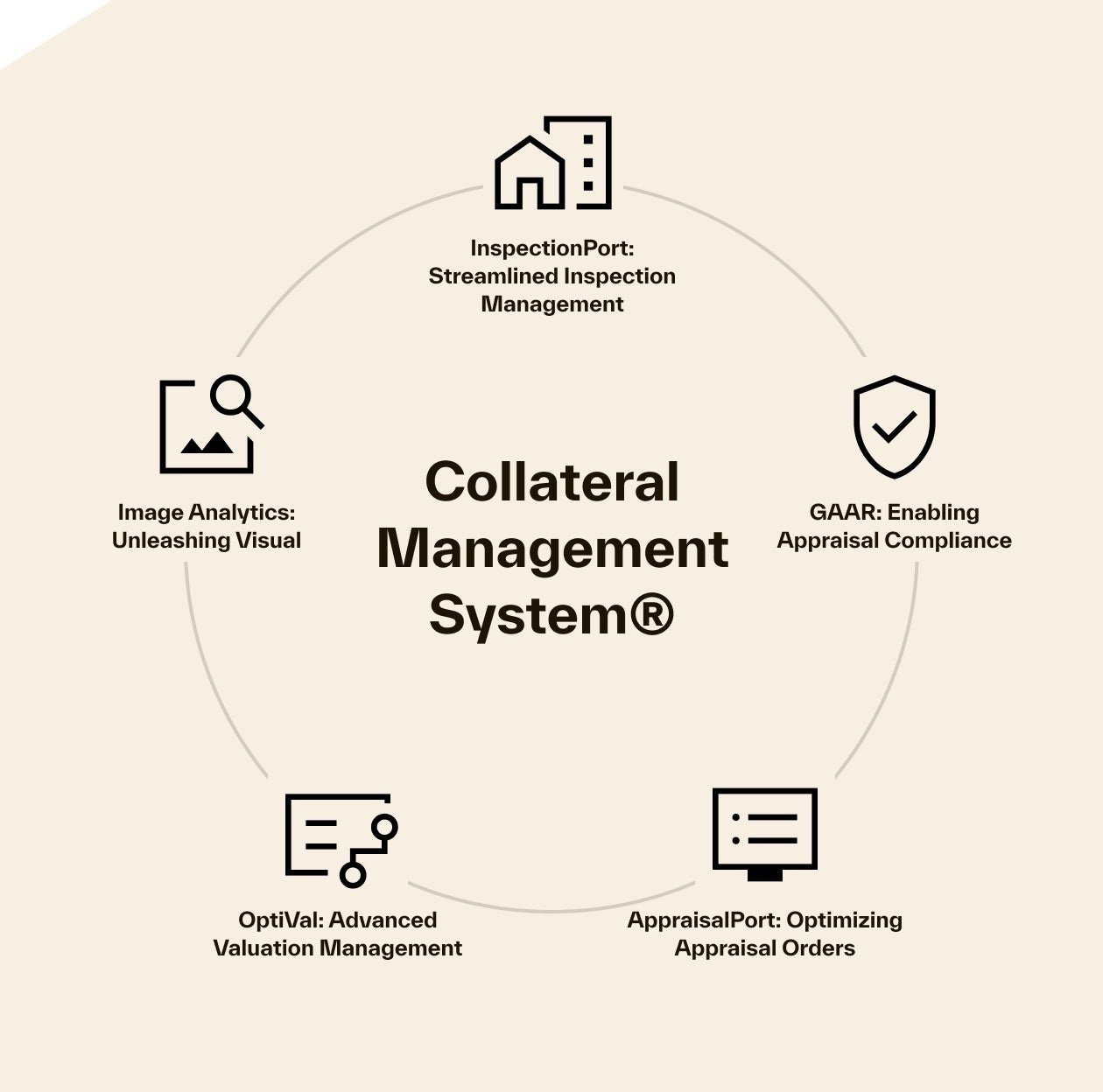
AppraisalPort lets appraisers receive and accept assignments, send reports and exchange secure messages. Order information can populate forms software, reducing repeated entry. The company advertises lender access to more than 80,000 appraisers nationwide. Treat that as a company-reported network figure, rather than a count of people working on the platform at this moment.
For a lender, the benefit is coordination. For an appraiser, it is a channel to clients and a manageable queue of work. AppraisalPort’s own description draws a boundary: the platform does not produce appraisals or operate as an appraisal management company. Software can carry a professional judgment without becoming the professional who made it.
- 01Order
Lender requests valuation - 02Exchange
Appraiser accepts and submits - 03Review
Rules and images flag issues - 04Decide
Lender applies its requirements
A simplified workflow, not a promise that every loan follows these steps.
A photograph becomes a second opinion
Image Analytics adds a different kind of check. Working within CMS, it classifies appraisal photographs and assesses condition and quality against the ratings used in mortgage appraisal reports. It can identify features such as solar panels and flag discrepancies between visual evidence and reported data.
That is a concrete role for computer vision. A photograph of a kitchen contains information that a room count does not. A reviewer may need to know whether the evidence agrees with the report, whether an expected image is missing, or whether a feature deserves another look. Automation can direct attention to a possible inconsistency.
Cotality publishes high detection figures for selected Image Analytics tasks. Those figures should remain attached to the tasks and testing conditions they describe. A buyer should measure performance on its own reports, including false alarms. An image flag is useful when it leads to a better review; its existence alone does not settle the value of the house.
The data delivery that drew the FTC back
CoreLogic’s history includes a less flattering lesson about data as a product. Its DataQuick acquisition drew Federal Trade Commission competition concerns in 2014. The settlement required it to license property data to RealtyTrac, preserving an alternative supplier in the market for national assessor and recorder bulk data.
In 2018, the FTC modified that order to address compliance deficiencies. The commission said required data and information had not been delivered on time and that incomplete delivery had hindered RealtyTrac. CoreLogic denied violating the order and disagreed with the stated facts and conclusions, but agreed to the modifications in settlement.
The revised obligations included technical transfer and service-level requirements and additional technical assistance. For customers, the lesson is tangible: a data contract needs acceptance checks. Completeness, update timing and quality must be tested against what actually arrives. A large database is not much comfort when the missing part is the part your business needs.
A data contract earns its keep at the moment someone checks what arrived.Editorial takeaway from the DataQuick record
A broader name, the same useful habit
Funds managed by Stone Point Capital and Insight Partners took CoreLogic private in June 2021 for $80 per share in cash. In March 2025, the company announced the Cotality brand, describing an evolution beyond its mortgage-oriented financial services origins into a broader property information business.

The expansion is visible in its newer offerings. Property Vision, announced in October 2025, brought a mobile inspection application with property data and image analytics to home inspectors. Cloud delivery offers another route: Cotality makes linked property information available through Google Cloud, allowing organizations to work with data inside their existing environment.
The workforce reflects those overlapping jobs. Cotality describes teams of housing economists, data scientists, technologists, property professionals and environmental experts. Its careers page reports 5,179 people in eight countries. Those figures belong to the broader company, not the much smaller FNC record that still circulates in business directories.
As of October 2, 2026, a fresh example comes from borrower qualification. The company announced an expanded integration between AutomatIQ Borrower Income Analysis and Fannie Mae’s Income Calculator, covering wages and variable income. Borrower paystubs and W-2s become inputs to a workflow that returns findings for underwriting. The raw material changes; the habit of bringing information closer to a decision continues.
Buy the bottleneck you can measure
CoreLogic’s business is business-to-business: data licensing, software, analytics and services purchased by organizations with property decisions to make. Its own FNC announcement emphasized recurring revenue. AppraisalPort offers free registration, but that is not a price list for every service. A procurement decision should account for implementation, integration, training, data rights and transaction charges.
The alternatives depend on the job. ATTOM supplies property and mortgage data; Verisk’s ProMetrix serves commercial property insurance underwriting. A lender may also maintain internal systems. Cotality’s appeal lies in the combination of datasets, domain expertise and workflows. Whether that combination is economical depends on which pieces a customer actually needs.
The useful thing to copy is the sequence. Pick a decision that stalls. Identify the information and handoffs behind the delay. Pilot a change and measure turnaround, rework and review quality. Sparse local coverage, low transaction volume or expensive integration can spoil the arithmetic. Human review still needs a place wherever exceptions carry consequences.
For a homebuyer, the appraisal is a milestone between an accepted offer and a set of keys. For the institutions behind that purchase, it is a chain of tasks. CoreLogic found a business inside the chain. Its $400 million payment is a reminder that the quiet parts of a transaction can command a very audible price.