Consider the small indignity of a government affairs morning. A bill has changed. Someone has mentioned it in a hearing. The colleague who knows the issue is away. The person whose office you need to call has a new staffer. None of these events is especially mysterious. Put together, they can consume the morning before anyone has decided what to do.
Bloomberg Government, usually shortened to BGOV, sells relief from that kind of accumulation. Its product puts reporting, legislative documents, contact directories, spending intelligence, and collaboration tools in a paid workspace. The attraction is the distance between a useful fact and a usable briefing. Washington has a talent for making that distance surprisingly long.
- The buyer: teams paid to understand or influence government decisions.
- The job: connect policy news to documents, people, money, and the next action.
- The turn: an early analysis-heavy pitch became a practical workflow product.
- The test: whether an integrated subscription saves enough work to earn its place.
The think tank meets the working day
BGOV launched in 2011. In a tenth-anniversary account, Bloomberg Industry Group executive Josh Eastright described the original concept as something like a think tank, with analysts working alongside journalists. Selling it proved difficult. Customers wanted a product their teams could use to save time and coordinate work. After a couple of years, the business shifted toward data, news, and workflow tools.
“a solution that could be used by their entire team”Josh Eastright, reflecting on BGOV’s early years, 2021
That history suggests a useful lesson for anyone selling expertise: look for the unfinished task on the customer’s desk. Analysis becomes more useful when a team can carry it into a meeting, an outreach list, or a shared decision. BGOV’s product made those handoffs part of the offer.
The launch required resources. Washingtonian reported in March 2011 that Bloomberg had reportedly committed $100 million to staffing, acquisitions of resources, and a national sales strategy. It described a recruiting effort involving well over 100 reporters, editors, and analysts. Membership was then $5,700 a year. These are launch-era figures, useful for understanding the scale of the bet.
The reported launch-era membership price. Today’s website directs buyers to request pricing.
The directory is part of the story
The present product is aimed at corporate government affairs departments, associations, nonprofits, lobbying and law firms, government offices, and contractors. These buyers have different motives. An association may need to explain a proposal to its members. A corporate team may need to identify a policy risk. A contractor may care about which program is receiving money. Each needs information that can survive a practical question: what does this mean for us?
BGOV’s directories help answer the next question: who handles it? They bring together contact details, biographies, committee memberships, sponsored bills, and voting records. The company says the directories are updated daily. Users can filter and export lists rather than reconstruct them from scattered office pages.
A directory sounds unromantic beside a scoop. Yet a beautifully informed briefing addressed to the wrong person is a peculiar sort of accomplishment. Connecting a policy issue to the office and staff responsible for it makes the information more useful. Meeting notes and tags then help a team retain what it learned.
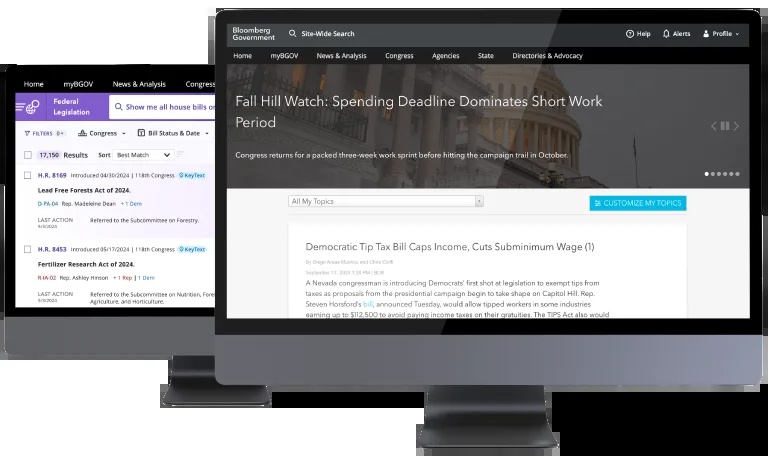
The newsroom supplies context for that paperwork. BGOV offers breaking policy coverage, analysis, custom alerts, and access to material from more than 35,000 outside news sources. Its Hill Watch Live series brings subscribers into briefings with reporters and analysts while Congress is in session, including a live question-and-answer portion. A team can ask about the significance of a development as well as read its description.
One clause can travel a long way
At the state level, the research problem multiplies. Similar proposals can surface in several legislatures, at different stages, with wording that matters. BGOV’s tracking tools include bill summaries, version comparisons, heatmaps, session calendars, and access to legislative supporting documents. These help users follow both the text and its progress.
In December 2023, BGOV introduced AI-powered state bill comparison. It searches for similar text across state bills, allowing users to examine current proposals and earlier efforts. At launch, the company said the feature was included for subscribers at no additional cost. Pairing it with legislative heatmaps made the geographic spread of an issue easier to inspect.
For a team following an issue across several states, that suggests a practical sequence: locate similar language, read the differences, check the timetable, and identify the relevant offices. The software helps assemble the comparison. The team still has to judge whether two clauses that look alike would produce similar effects.
- 01NoticeNews + alerts
- 02CompareBills + versions
- 03ConnectOffices + staff
- 04BriefNotes + reports
Its newer AI tools also summarize bill text and hearings, let users question a bill within a chat window, and extract appropriations line items. BGOV describes the bill answers as grounded in the bill’s text. Its AI news summaries receive editorial review. These are useful distinctions when a short answer might otherwise disguise an important qualification.
The dollar has an itinerary
Federal Funding Flow, announced in July 2025, tackles another recurring piece of research: connecting budget requests, congressional appropriations, and agency spending. BGOV said the tool responded to demand from professionals struggling with manual collection and limited visibility. The interface centralizes documents, updates, and historical data.
The published product includes an appropriations tracker, a line-items table with linked source material, and agency spending tables that connect appropriations to contract data. For someone preparing an advocacy argument or assessing a market, those connections can turn an isolated budget number into a more useful question about a program’s direction.
Federal Funding Flow connects these stages. A proposed allocation still needs to be distinguished from a spending outcome.
That distinction matters for contractors. A policy priority, an allocation, and an awarded contract describe different things. Reading them together can help a business examine demand and spending history before committing effort to an opportunity. It cannot guarantee that the next award will follow yesterday’s pattern.
A business built around other people’s attention
BGOV also studies the market its customers inhabit. Its April 2026 lobbying report put total 2025 spending at approximately $5.3 billion. The analysis included 360 firms meeting its revenue and filing criteria, with 80 designated standouts. For the first time, the report examined specific agencies lobbied and how engagement had shifted.
Domestic and foreign trade filings rose 42% from 2024 to 2025, according to the report. The interesting feature is the ability to examine where attention went. An annual total describes the industry’s size; issue and agency changes help describe what occupied it.
Social monitoring extends that view beyond formal records. BGOV’s 2023 launch added keyword searches, alerts, dashboards, and sentiment analysis across platforms including Twitter, Reddit, and YouTube. In the announcement, AJW associate Matt James praised the relevance of delivered information and the customized setup. It is a specific use case: following conversations before they become another urgent research assignment.
Put an actual problem in the demo
BGOV occupies the overlap between specialist publishing and enterprise software. Alternatives vary with the job: policy coverage, legislative monitoring, advocacy coordination, or procurement research. Its distinctive proposition is the bundle of newsroom context and working tools. A buyer should compare how that bundle handles a real task against the resources the team already uses.
The subscription model makes sense when people repeatedly need to connect developments across issues and jurisdictions. A narrow, occasional search may be manageable through public records and official alerts. A frequently reused workspace has a different economic argument. Buyers can measure the work involved without pretending that every saved minute has the same value.
A useful demonstration would begin with one live issue. Find its bill, inspect a revision, locate the responsible staff, and prepare something a colleague can use. Then check the underlying text. BGOV’s September 2026 midterms guide illustrates this approach with bill research and AI-powered Stakeholder Intelligence, linking analysis to outreach priorities.
The transferable habit is to keep the evidence, the people, and the next task close together. A team can copy that habit even with simpler tools. Bloomberg Government charges for making it easier to maintain at scale. In a city where information is plentiful and calendars are crowded, that is a reasonably concrete thing to sell.