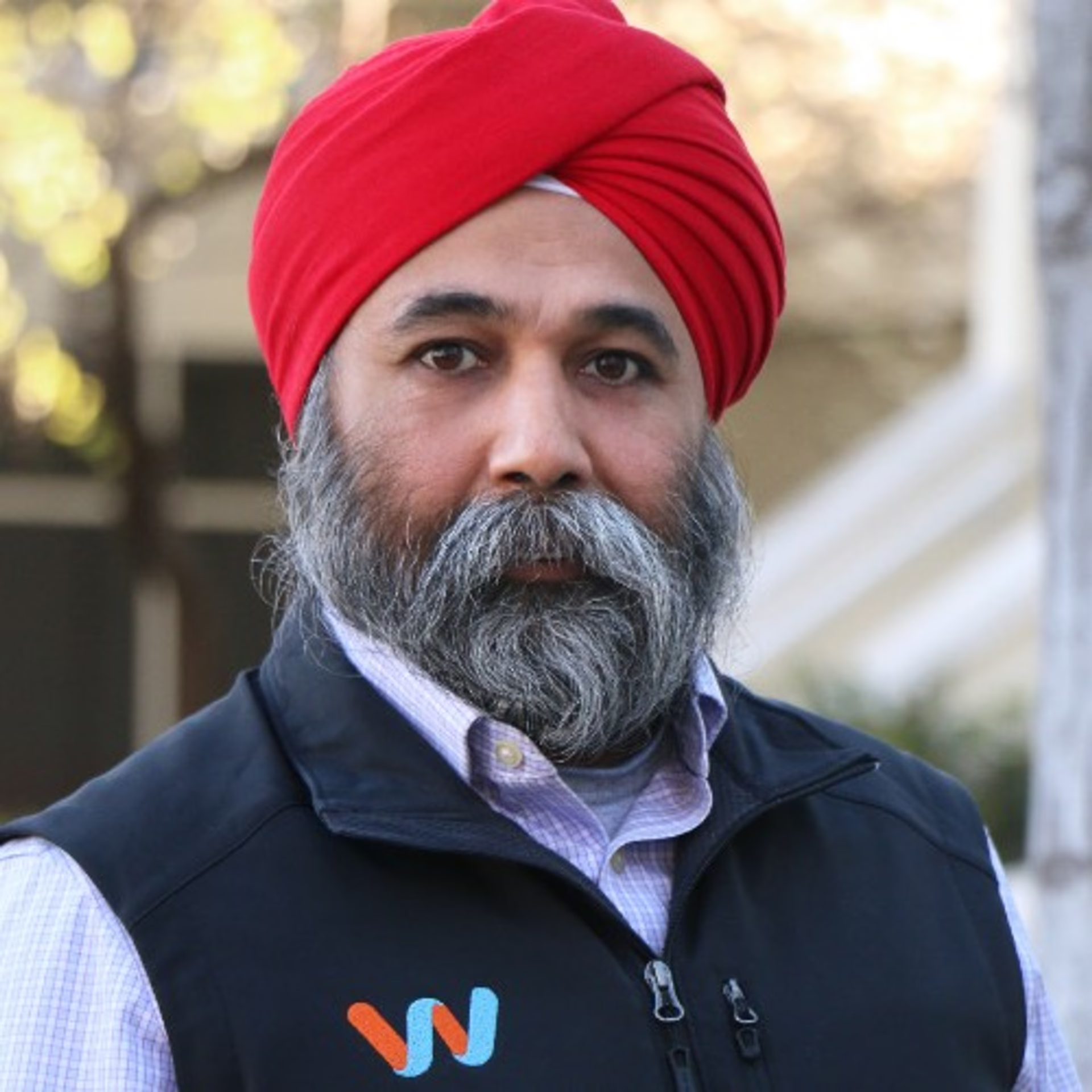
The Man Who Builds What Doesn't Exist
In 1995, a 17-year-old from India sat the IIT Joint Entrance Examination - a test so difficult that fewer than 1% of applicants pass. Mayank Bawa placed 4th nationwide. That year set the tone for everything that followed: a career built not on following categories, but on inventing them.
Bawa arrived at Stanford University in 1999, a Sequoia Capital fellow in computer science, and left a decade later having turned his PhD dissertation into a company that helped define Big Data as an industry. That company - Aster Data Systems, co-founded with fellow PhD students George Candea and Tasso Argyros - was acquired by Teradata in 2011 for $325 million. He was 34 years old.
Most people would stop there. Bawa used the pause to find the next blank space on the map.
"A big vision, a strong work ethic and a resolute value system create long-term success. Expect short-term failures and learn from them."
- Mayank BawaHow Three PhD Students Defined Big Data
The founding of Aster Data in 2005 is a lesson in academic research becoming industry infrastructure. Bawa and his co-founders were working on distributed data systems inside Stanford's computer science department. Their advisor - a professor who had previously seeded both Google and VMware as Stanford spinouts - recognized what they had built and wrote the first check.
Aster Data's breakthrough was SQL MapReduce - a programming framework that bridged the MapReduce paradigm (Google's distributed computing model) with SQL, the language every enterprise database analyst already understood. Instead of forcing data scientists to learn entirely new systems, Aster let applications run where the data lived, in multiple languages including Java, Python, Perl, and C++.
The impact was immediate. Gartner called Aster Data a "Cool Vendor" in 2009. The World Economic Forum named Bawa a Technology Pioneer in 2010. The Wall Street Journal ranked Aster #7 in its list of Top 50 Venture-Backed Companies. Silicon Valley Business Journal put Bawa in its Top 40 Under 40 at the age of 32.
Gartner "Cool Vendor" - Aster Data Systems named among the most innovative companies in analytics
World Economic Forum Technology Pioneer & Gartner Visionary Leader recognition
Teradata acquires Aster Data Systems for $325 million - Bawa becomes Co-President of Teradata Aster
Forbes Young Innovator List & WSJ Top 50 Venture-Backed Companies - ranked #7
The Problem No Software Touched
After three years running Teradata Aster's R&D and sitting on Teradata's CTO Council, Bawa did what founders do: he looked for the next unsolved problem. In 2014, he met Amit Sinha - a veteran of SAP who had spent his career in fast-data analytics - at a coffee in Palo Alto. They started comparing notes on the same pain point from different angles.
The insight was counterintuitive. Enterprises had software for everything: CRM for customer relationships, ERP for internal operations, marketing automation for campaigns. But when a company needed to execute a joint marketing campaign with a partner, co-sell a deal alongside a system integrator, or track shared revenue with an alliance - there was nothing. Bawa articulated it precisely: "There is no software helping marketing teams execute their projects when their work spans company boundaries."
Instead of launching immediately, Bawa spent two years interviewing marketing and alliance leaders at more than 75 companies. This wasn't market validation theater - it was the same rigor he'd applied to academic research, now aimed at product definition. WorkSpan didn't write a line of product code until the problem was understood with PhD-level specificity.
WorkSpan's name is not a brand - it's a thesis statement. Work that spans company boundaries had no software infrastructure. Every other collaboration category (sales, marketing, finance) was covered. Cross-company execution was the white space.
$50 Billion Reasons the Problem Was Real
WorkSpan's bet - that partner ecosystems would become the defining go-to-market motion of enterprise technology - turned out to be early, then right. By 2022, the company had secured a $30 million Series C led by Insight Partners. By 2025, a Series D arrived alongside the launch of WorkSpan AI.
Today, WorkSpan calls itself the world's leading Ecosystem Business Management platform. The numbers behind that claim: 15,000 companies on the network, the top 10 technology and telecommunications ecosystems powered by the platform, and $50 billion in joint pipeline under management. The customers are not startups experimenting with partnerships - they are the companies that define the enterprise technology stack.
Bawa identified the specific tax holding back partnerships with characteristic precision. He calls it the "Sales Complexity Tax" - the friction that makes sellers reluctant to bring partners into deals even when those partnerships would increase win rates. His diagnosis: "Your sellers need partnerships to grow revenue, but they don't want to add partners to their deals for fear of complexity."
WorkSpan by the Numbers
AI Teammates for Every Partnership
The 2025 Series D wasn't just capital - it was a product pivot announcement. WorkSpan AI embeds AI agents directly into CRM systems, giving sellers an always-available partner intelligence layer for every account and opportunity. The frame Bawa uses captures the ambition precisely: "Each AI agent represents the best version of a specific partnership, available to the seller 24/7, providing instantaneous answers and insights."
The logic follows his pattern. First, understand the structural problem (partner complexity tax). Then, identify why existing solutions fail (partners don't live where sellers work). Then, build the infrastructure that makes the problem disappear. AI lets WorkSpan put the right partnership intelligence at the moment sellers need it - inside the CRM, not in a separate portal no one opens.
The 2025 funding brought Dr. Ekta Dang from U First Capital onto the board. Her observation on the market: "The intersection of AI and partnership ecosystems represents one of the most promising frontiers in enterprise technology today." Bawa had been building in this intersection for a decade before it became a hot thesis.
"AI is reshaping the world, and thanks to our investors, we're taking it to the next level. With this Series D raise, we're building smarter, more responsible AI solutions that drive real impact in Sales and Partnering."
- Mayank Bawa, on WorkSpan's Series D (2025)Research First. Product Second. Always.
There is a thread connecting IIT-JEE rank 4, a Stanford PhD in distributed systems, Aster Data's SQL MapReduce, and WorkSpan's 75-company research sprint before building: Bawa does not ship until he understands the structure of the problem at depth. This is not caution - it is a specific intellectual style that prioritizes deep understanding over fast iteration.
His published philosophy on success - "expect short-term failures and learn from them" - is more interesting for what it doesn't say. Silicon Valley's standard framing is "fail fast." Bawa's is subtly different: plan for failure, don't accept ignorance. The distinction matters. WorkSpan wasn't built by pivoting rapidly. It was built by spending two years making sure the first version was worth building.
He holds two patents in database technology and has published academic papers in computer science. The resume is built on outputs that require understanding problems well enough to own them permanently - patents, papers, platforms - not experiments that get discarded when the next hypothesis arrives.
"Your sellers need partnerships to grow revenue, but they don't want to add partners to their deals for fear of complexity."
"There is no software helping marketing teams execute their projects when their work spans company boundaries."