Matthew D’Auria has conceded that someone in his household is cooler than he is. The rival is Angus, a Scottish terrier. It is a useful opening admission from a chief executive: the title can settle the office seating plan, but it offers little protection against a dog with presence. When D’Auria spoke about Angus in 2023, the terrier was ten. The affection was unmistakable; the contest, apparently, already decided.
D’Auria became chief executive of OPEN Health in March 2025, after leading Healthcare Consultancy Group, known as HCG, within Omnicom. There are more than 25 years of professional experience behind that appointment. Yet the career becomes more interesting when read as a series of changes in the way he works with people. He began in a laboratory. He moved through client organisations and agencies. Eventually, he was responsible for groups of specialists whose work depended on making complicated ideas understandable to somebody else.
A career like that changes the meaning of expertise. At a bench, a question can be investigated through a particular experiment. At the head of a company, the questions include who gets heard, which teams should work together, and how a promising idea survives its passage through an organisation. D’Auria’s public comments return to those practical questions. His professional story follows the distance between knowing something and helping other people do useful work with it.
The scientist leaves the bench
He holds a Bachelor of Science from the University of California, Berkeley. His early career included work at AstraZeneca, followed by senior and leadership roles at Syneos Health, Envision Communications, and The Scienomics Group. The sequence crosses the boundary between a client’s business and the agencies that serve it. That is an education of another kind: learning the problem from the side that commissions the work, then from the side expected to deliver it.
“First and foremost, I consider myself a scientist.”
Matthew D’Auria, 2023
The sentence preserves a connection to his starting point without treating that starting point as a permanent address. A scientific background can travel into other kinds of work. It can inform the questions someone asks of an argument, the evidence they expect, or their willingness to revise an answer. In D’Auria’s case, the documented career took that background into communications and then into organisational leadership. Each move widened the number of people involved in turning an idea into something usable.
By 2017, he was president of The Scienomics Group. That year, HCG announced a dedicated business called Scienomics CARBON under his leadership, with offices in Greenwich, New York, and San Francisco. The announcement provides a concrete marker in the progression: responsibility for a specialist business operating across several locations. By 2020, he was publicly identified as HCG’s chief executive. The scale of the job had changed again.
President of The Scienomics Group.
Publicly identified as HCG’s CEO.
Appointed CEO of OPEN Health.
Twelve years, and a thank-you
In March 2025, D’Auria announced his departure from Omnicom after 12 years. His farewell dwelt on colleagues: their curiosity, energy, courage, and commitment to one another. He wrote about what he had learned from them, and left the details of his next job for another day. The emphasis is revealing. A departure is one of the few moments when an executive can decide what the last paragraph of a professional chapter should contain.
He chose the people. That choice sits beside the familiar vocabulary of growth and transformation in his career. It also gives that vocabulary a human referent. Organisations are full of plans whose success depends on colleagues who were absent when the plans were drafted. A strategy has to reach them, make sense to them, and leave them room to contribute. The farewell does not measure whether that happened. It shows whom he considered worth acknowledging when the chapter closed.
Replies to the post added another perspective. Andy Hayley remembered working together on collaborations and pitches, as well as having coffee. Jennifer Terrell described D’Auria as an influential leader and mentor in her career. These are individual recollections, rather than a verdict on an entire organisation. They matter because they describe the ordinary contact through which leadership is experienced: a conversation, a piece of shared work, advice that someone still remembers after a job has ended.
The company also brought him into settings where newcomers could consider a different career. In December 2022, HCG’s scientific career exploration forum scheduled D’Auria to give the welcome. Its programme brought together executives, specialists, and talent acquisition colleagues for a virtual event aimed at doctoral students and postdoctoral professionals. A former laboratory worker stood at the entrance to a discussion about routes beyond laboratory work. The symmetry needs no invented childhood ambition to make it interesting.
The twelve-year figure describes his time at Omnicom, including the specialist leadership that preceded the group role. That distinction gives the farewell its weight. He was leaving a place in which his responsibilities had developed over time. Moving to another organisation meant carrying that experience into a different set of relationships, with colleagues who would have their own expectations of the person taking the chief executive’s chair.
Seven agencies at one table
Near the end of his HCG tenure, the organisation was changing its own shape. In a December 2024 interview, European president and chief operating officer Nina Hinchcliffe described the reorganisation of seven smaller agencies into a single entity. D’Auria took part alongside Hinchcliffe and Greg Imber, the North American president and chief operating officer. Here was a tangible version of transformation: the boundaries inside the business were being redrawn.
For any collection of agencies, those boundaries can have practical consequences. They affect how a client finds the right specialist, how colleagues share a brief, and how much knowledge remains inside one team. Bringing businesses together creates an opportunity to simplify those exchanges. It also gives leadership a coordination problem. A shared name does not write the next brief, assign responsibility, or resolve a disagreement. Those are the small working arrangements through which a reorganisation becomes real.
HCG’s December 2024 executive interview described seven smaller agencies coming together as one entity.
D’Auria had already spoken in 2023 about changing established approaches to communication. In a discussion of organisational transformation, he favoured experimentation and accepted that progress could involve turns and revisions. The point is especially relevant when several groups are being asked to work differently. People need a way to try something, see what happens, and adjust. Otherwise, change can become an elaborate presentation that never quite gets as far as Tuesday morning.
“There is no one straight route to the success of our transformation.”
Matthew D’Auria, 2023
The next chair comes with a team
OPEN Health announced his appointment on 31 March 2025. D’Auria succeeded interim chief executive Vivid Sehgal, who moved onto the board as a non-executive director. Board chairman Dave King pointed to D’Auria’s international experience and approach to innovation. The remit included refining and putting an innovation and growth strategy into practice. A new chief executive had arrived; some continuity remained around the board table.
In February 2026, the organisation announced four senior leadership appointments: Shauna Aherne, Jeremy Williams, Brandon Boland, and Erik Sakowski. The business responsibilities included enterprise growth and strategy, brand and communications, and global client partnership. D’Auria’s accompanying comments emphasised coordinating growth, brand, and client relationships. Rather than leaving the strategy as a statement from the chief executive, the announcement attached responsibilities to particular leaders.
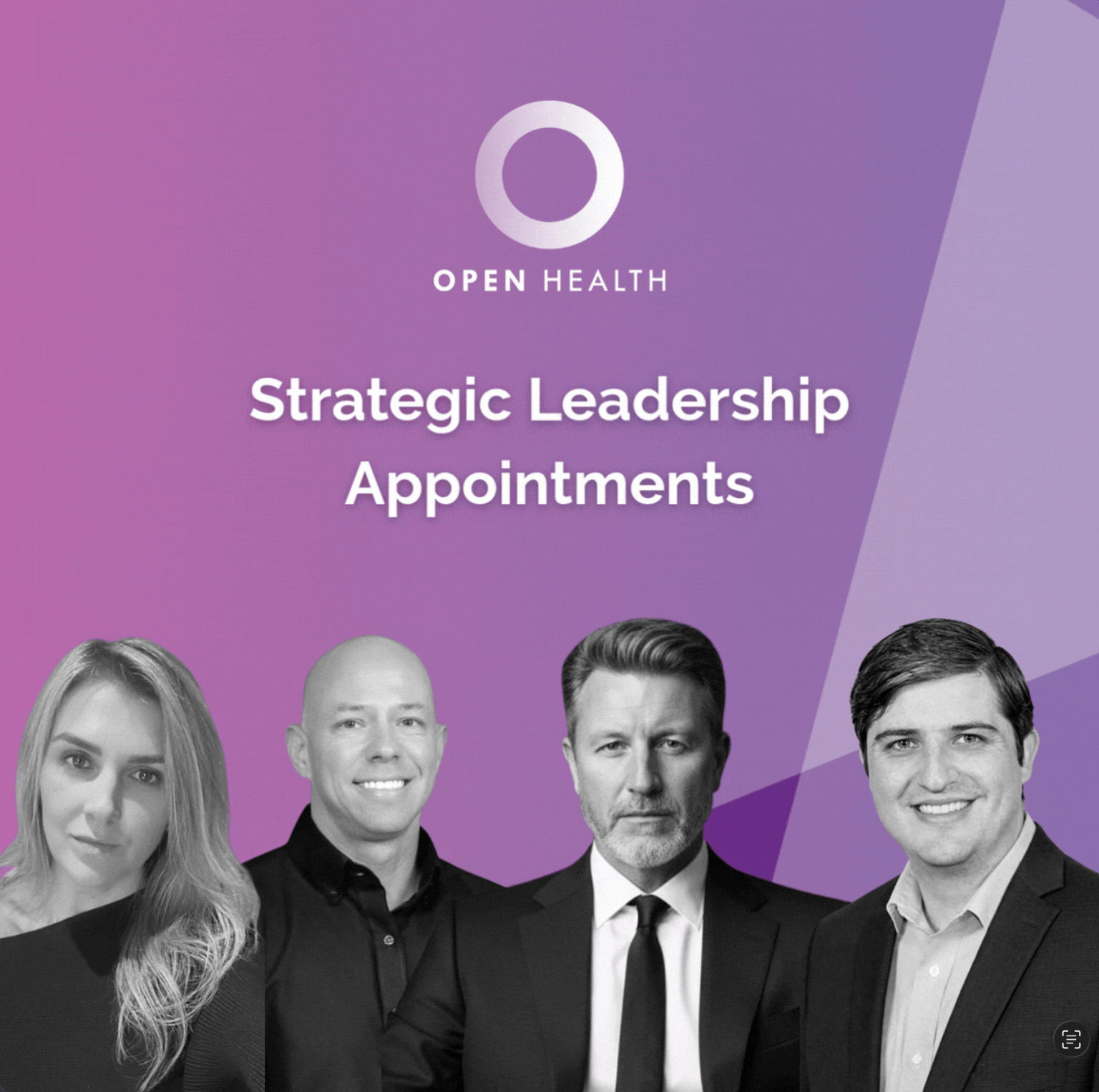
Williams offers a connection between the two chapters. In 2023, he was identified as a global director at HCG when writing about organisational transformation and quoting D’Auria. In 2026, he joined OPEN Health to lead brand and communications. The career story contains both a change of employer and a familiar professional connection. That is how many working lives develop: institutions change, while some of the people and conversations carry on.
The arrangement invites a practical question about the chief executive’s role. When growth, communication, and client relationships have their own leaders, the work at the centre includes making their priorities fit. A company can pursue a new opportunity while telling a coherent story about itself and keeping existing commitments. Whether those activities support one another depends on decisions made across the group. D’Auria’s emphasis on alignment gives this stage of his career a clear organisational question to follow.
A different kind of ensemble
Away from the job title, D’Auria has said that he would have liked to become a musician. What appealed to him was music’s capacity to bring people together. He also enjoyed Succession, including its ending. The combination has a certain charm: an executive interested in an ensemble, and entertained by television’s spectacular demonstration of how badly a family can manage one.
The musical interest makes a fitting lens for the career, provided it remains a lens. There is no need to turn him into a conductor issuing instructions to an imaginary orchestra. The useful parallel is simpler. Several skilled people can be in the same place without producing work that fits together. Coordination asks something additional of them: listening, timing, and an understanding of what the other person is trying to do. Those requirements give substance to the organisational questions that recur in his public work.
D’Auria’s next chapter is being written through those questions. His record includes specialist leadership, a group reorganisation, and a move to another chief executive role. His stated priorities include investing in talent and helping different responsibilities reinforce one another. The interesting work lies in the space between the appointment and the next decision: who contributes, how teams learn, and what they can accomplish together. Angus, one suspects, would reserve judgment until the meeting was over.