Matt Luongo’s career in Bitcoin begins, rather charmingly, with money he could not drink. In 2011, he found himself holding more than $300 in Starbucks gift cards and one small complication: he did not drink Starbucks coffee. He suspected somebody else would value the cards, started reselling them and built an app when the little operation became cumbersome. Then the modern financial system introduced itself in its preferred manner. PayPal’s rules did not welcome the business. Other processors followed. The door clicked shut.
Bitcoin arrived as a practical answer before it became a philosophy. It was a payment network that did not have a compliance desk waiting to dislike his tiny market. In 2014, Luongo launched Card for Coin, buying and selling gift cards for bitcoin. The side project grew into Fold, one of the early attempts to make Bitcoin useful at familiar merchants and, later, to make earning it feel as ordinary as receiving points.
It is tempting to turn this into a neat origin myth: plucky engineer meets censorship-resistant money and lives happily on-chain ever after. Luongo’s actual story is more useful because he kept arguing with its implications. He tried to live on bitcoin in early 2014, followed the developer mailing list and inhabited the odd, sparse period after Mt. Gox when the community felt closer to a makerspace than an asset class. Yet the more credible Bitcoin became, the less comfortable its unfinished edges looked.
The evening “later” stopped being good enough
At a Bitcoin client-development panel in 2015, held in a dingy San Mateo basement, Luongo watched a room crowded with young founders discuss the future. Drinks followed. So did an unpleasant thought. If Bitcoin succeeded while every balance and transaction remained legible on a public ledger, the movement might speed up the disappearance of cash and replace it with something even easier to observe. He raised the concern with friends. The answer was that privacy could be fixed later.
A year later, another conversation followed the same rhythm. Luongo was running a payments company dependent on cheap transactions just as Bitcoin’s block-size fight was hardening. A developer told him Lightning would arrive and the payment problem could be fixed later. For a builder whose business needed the cheaper path, the reply should have been soothing. It was not. Bitcoin’s conservative engineering protected the network from capture, but it also meant applications could not wait around for the base layer to become whatever their business plans required.
I began using Bitcoin because it solved a problem.Matt Luongo, reflecting on his route into crypto
This is the productive contradiction at the center of Luongo’s work. He believes Bitcoin has a singular claim as money, yet rejects the idea that its surrounding technology is complete. His term for the position is “monetary maximalist.” The asset can remain conservative while builders explore privacy, programmability, credit and payments elsewhere. Fidelity to the money does not require pretending every product already exists.
Crossing the cultural border
Luongo’s answer to the privacy problem led somewhere that once felt nearly impolite for a Bitcoiner: Ethereum. He had been studying decentralized marketplaces and thinking about whether Fold’s middleman role could itself be removed. Ethereum offered expressive smart contracts, but public chains still had no native way to work with private data. Keep Network emerged from that gap, designed as a bridge between public blockchains and information that should remain out of public view.
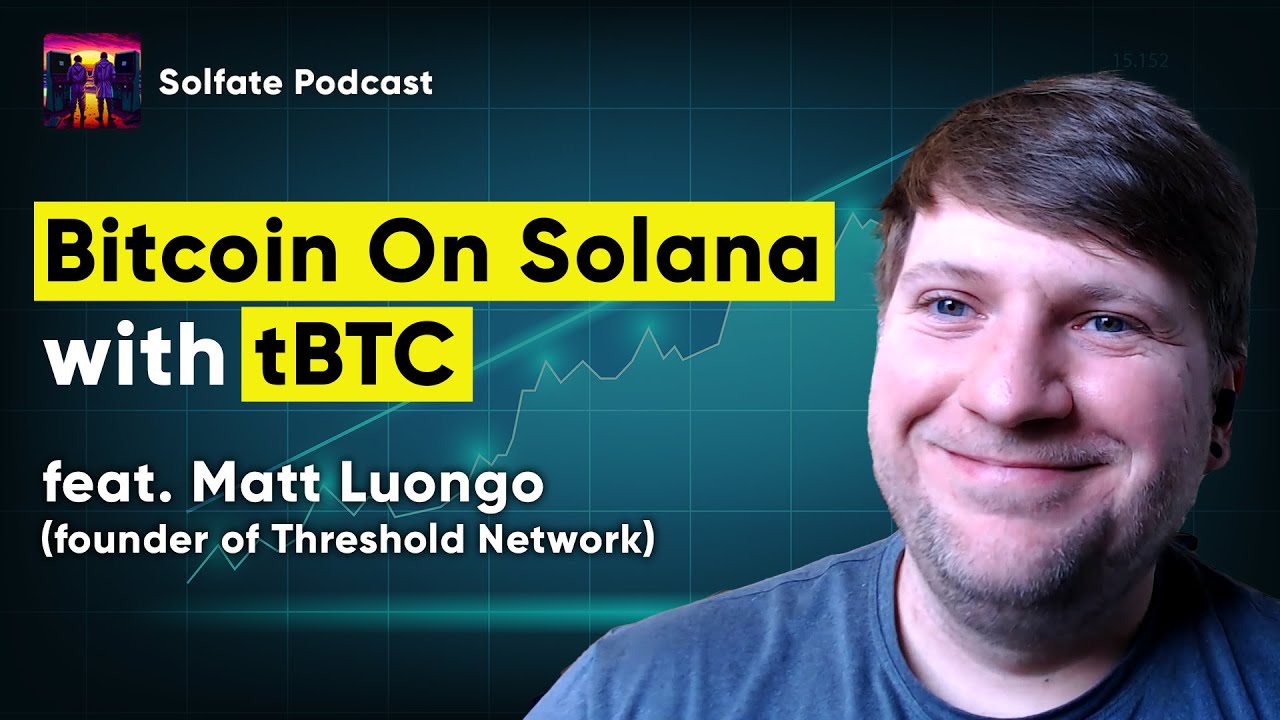
The next puzzle was bitcoin itself. How could it travel into programmable financial applications without asking one company to hold the real coins and issue an IOU? tBTC pursued a trust-minimized route. Groups of independent participants, cryptographic controls and visible safeguards would spread the work that a custodian normally performs. The first version launched in 2020. Keep later combined with privacy protocol NuCypher to form Threshold Network, and a redesigned tBTC became one of the merged network’s central applications.
on its native chain
+ protocol rules
in smart contracts
The aim is not magic teleportation. It is to make the trust assumptions explicit, distributed and harder for any single operator to abuse.
Luongo tends to be precise about that language. “Trustless” is a seductive word in crypto, and bridges have supplied expensive evidence of its abuse. A system can reduce reliance on a central party without abolishing risk. The serious work is in naming who can act, what collateral or cryptography constrains them, how failure becomes visible and how users get out. In an industry fond of weightless nouns, he keeps returning to the plumbing.
A studio built around an honest admission
Before crypto, Luongo studied computer science at Georgia Tech, tutored introductory logic and built the sort of public Stack Overflow history that makes “technical founder” more than biography varnish. His first startup, Scholrly, tried to improve academic research discovery by helping people navigate papers and citation graphs. It failed. His later telling is refreshingly diagnostic: knowing what users like is not the same as knowing who will buy, and investor enthusiasm is not product-market fit.
The more durable lesson was personal. Luongo has described himself as a strong zero-to-one founder, energized by discovering a business and less attached to operating every detail from one to ten. Thesis* became the organizational version of that self-knowledge. It builds from its own balance sheet, develops products internally and, when one shows the shape of a company, brings in a leader eager to own the next stage.
Design the company around the work you repeatedly do well, then make the handoff a feature rather than an apology.
Fold offers the cleanest example. Luongo moved from chief executive to board member as the company developed under Will Reeves. In February 2025, Fold began trading on Nasdaq under the ticker FLD. A drawer of coffee cards had traveled a long way, though not in a straight line and not under one operator.
The portfolio returns to the checkout aisle
Thesis* has since ranged across wallets, staking and Bitcoin-focused finance. Taho pursued a community-owned Web3 wallet. Acre offered a route into bitcoin staking. Mezo, announced in 2024 and launched on mainnet in 2025, aims at a wider “Bitcoin economy” where holders can borrow, earn and spend without treating the asset as museum property. The phrase is grander than the diagram, but the diagram matters: infrastructure underneath, usable financial products above, bitcoin moving through both.
Then came a pleasing return. In July 2025, Thesis* acquired Lolli, the Bitcoin rewards company that had once competed with Fold. Luongo called it a homecoming. The plan emphasized games, faster reward payouts and a renewed gift-card marketplace. In 2026, Lolli added automatic cashback tied to linked cards. The consumer edge that first pulled him toward Bitcoin had come back into the portfolio, now connected to a deeper stack of custody, liquidity and network infrastructure.
The sequence reveals Luongo’s preferred scale of thought. He can talk about monetary rights and the capture of financial systems, then return to whether a reward arrives quickly enough to delight someone. The lofty principle and the checkout experience are supposed to constrain each other. Decentralization that nobody can use becomes a seminar. Convenience that quietly restores the gatekeeper becomes the original problem in fresher clothes.
Finance is a human right.Luongo’s stated premise for Thesis*
Still arguing with “later”
There is an impatience in Luongo’s public writing, though it is aimed as often at his own industry as at its critics. When US spot Bitcoin exchange-traded funds arrived in 2024, he did not simply celebrate institutional approval. He asked whether builders had earned it. Bitcoin had survived, but privacy remained awkward, scaling remained fragmented and the next billion users had not arrived. Survival, in his formulation, was an opening rather than a completed assignment.
That posture keeps the profile from settling into a victory speech. Thesis* raised capital, Fold reached the public market, tBTC survived redesign and Mezo launched. Each milestone also creates another layer that can centralize, leak information or confuse a user. The answer is more engineering, clearer trust models and products whose usefulness is visible before their ideology is explained.
Luongo’s career has moved from a rejected payment account to an attempt at an entire Bitcoin economy. Yet the distance between those ideas is smaller than it looks. Both ask who may transact, who can say no and what machinery sits between a person and their money. The coffee cards supplied the question. Thesis* is his long, unfinished set of answers.