Patrick Nettles thought of the name in the shower. The business already had a technology, a small team, and investors with instructions: begin with C, keep it to two syllables, and avoid a word that meant something else. Hundreds of suggestions had passed through the exercise. Nettles wrote Ciena on the board. Colleagues circled it. The syllable requirement survived about as well as most rules do when people finally find an answer they like.
There is an agreeable mismatch between that domestic flash of inspiration and the company that followed. Ciena sold equipment to telecommunications carriers, where a pleasing name counts for considerably less than a system that works. Nettles spent his career crossing that distance between an interesting idea and an organization capable of delivering it. He became Ciena’s first chief executive in 1994, took it public in 1997, and remained involved until his board retirement in 2025. The shower story supplies the joke. The intervening work supplies the subject.
A physicist with several sets of keys
His education began with physics at Georgia Tech, where he graduated in 1964, followed by a Caltech doctorate in 1971. He taught briefly at the University of North Carolina at Chapel Hill before entering industry. Scientific Atlanta employed him from 1972 to 1980. Before Ciena, he had accumulated a collection of responsibilities that looks almost designed to frustrate anyone trying to put him into one professional box.
At Optilink, he was chief financial officer. At Protocol Engines, an enterprise that grew out of Silicon Graphics, he was president and CEO. At the software company Blyth Holdings, he served as executive vice president and chief operating officer. Finance, engineering, software, management: each required a different way of asking whether something worked. A technology could be sound while its economics failed; an appealing business plan could still depend on equipment nobody could reliably build. Nettles had worked on several sides of that table before Ciena asked him to run the meeting.
The customer was waiting elsewhere
David Huber began the company in 1992 with an optical idea aimed at cable television. Venture capitalist Jon Bayless introduced him to Nettles, who joined in early 1994. Nettles helped turn attention toward long-distance telephone carriers. The distinction mattered: a technology can have several possible uses, but a young company has limited time to discover which customer has a sufficiently urgent problem.
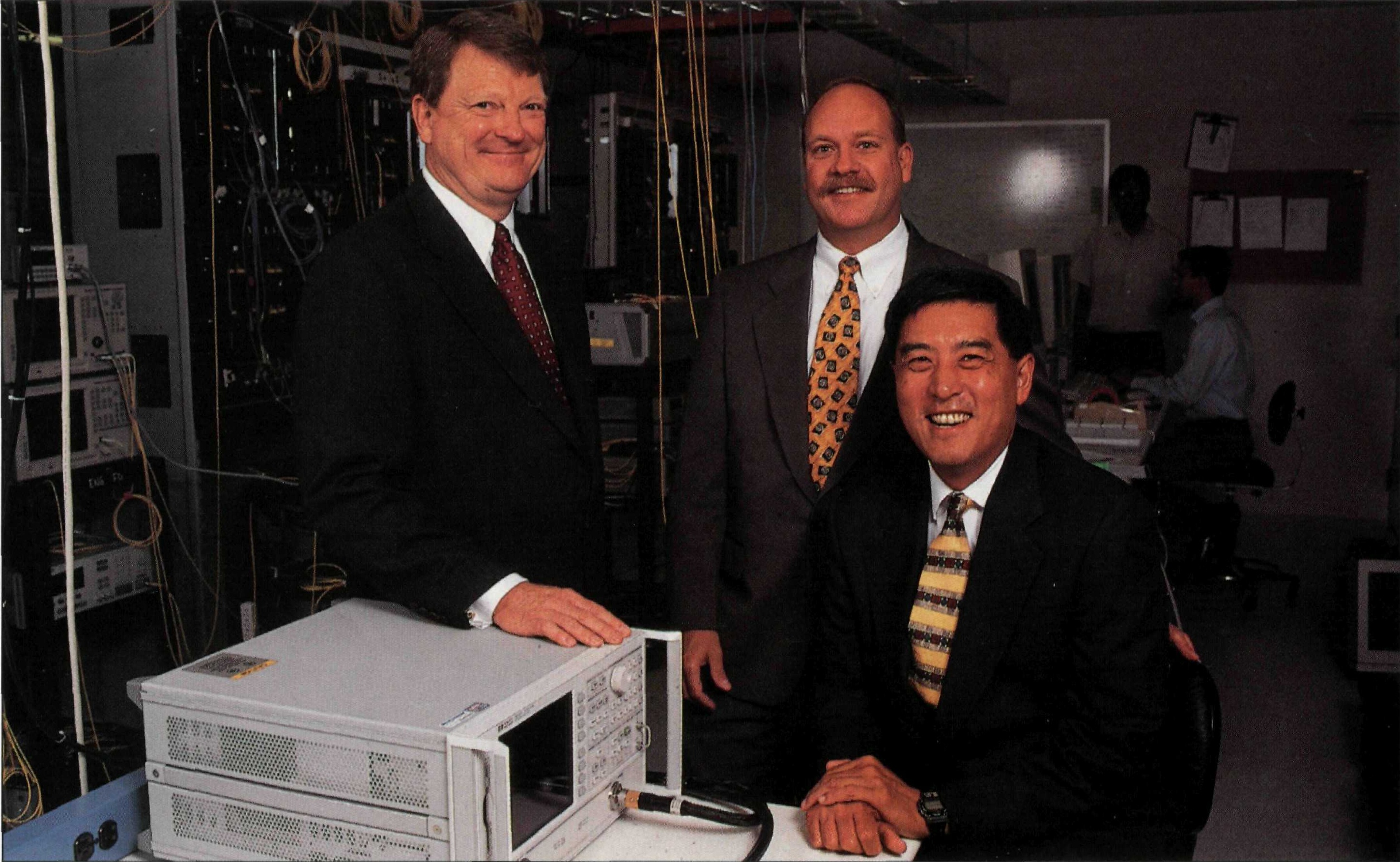
The founding group brought together Huber, Nettles, sales and marketing leader Larry Huang, and product development leader Steve Chaddick. Three were Georgia Tech alumni. The familiar college connection sat alongside quite different professional jobs. Someone had to develop the technology, someone had to translate it into equipment, someone had to find a buyer, and someone had to keep the business standing while all of that happened. Calling them founders compresses a useful division of labor into a single word.
Sixteen channels, one practical proposition
On March 28, 1996, Ciena formally introduced its MultiWave 1600 Transmission System. The announcement specified sixteen optical channels over one fiber pair, with approximately 40 gigabits per second of capacity across 600 kilometers. Dense wavelength division multiplexing, usually shortened to DWDM, sends separate signals on different wavelengths through the same fiber. More conversations can travel along infrastructure that is already in the ground.
The appeal extended beyond the headline capacity. The system worked with existing transmission terminals and included network management facilities. A carrier contemplating new equipment had to consider the network around it, the cost of installation, and the investment it already owned. Compatibility belongs in the story beside invention. Nettles was selling to organizations that needed a way to expand while continuing to operate. For those buyers, the practical question was whether a new system could enter a working network without turning the rest of it into an expensive archaeological site.
Separate wavelengths. Shared fiber. More room to carry traffic.
In Ciena’s photographic archive, the first shipment has its own keepsake: a crate signed by early employees. The destination was Sprint. A signed crate is a pleasingly literal business milestone. People had built something, packed it, and sent it to a customer. The photograph gives the early company a scale that later financial numbers tend to erase.
The bell was only one part of the job
Ciena went public on February 7, 1997. By the end of its first trading day, its market capitalization was $3.4 billion. That figure described the stock market’s valuation of the company; it was not the amount of cash the offering raised. Fiscal 1997 revenue reached $373.8 million, up from $54.8 million the previous year. The jump was approximately 6.8 times.
Growth of that kind asks less photogenic questions than an opening bell does. Can suppliers keep up? Can manufacturing expand without quality slipping? Can a business bring in more customers while satisfying the ones that made its early success possible? Nettles’s shareholder letter addressed supply chains, factories, training, and customer relationships. His sentence about execution was short enough to survive the surrounding financial detail.
“Vision without execution is meaningless.”Patrick Nettles, 1997 shareholder letter
Getting the boxes to speak to each other
In April 1998, Cisco and Ciena announced plans to connect routing and optical transport more directly. Their initial work would interface Cisco’s 12000 Gigabit Switch Router with Ciena’s long-haul DWDM equipment, removing the need for certain intermediate network elements. The companies also helped establish the Optical Internetworking Forum, a place for vendors and users to agree on specifications.
This is an easily overlooked part of Nettles’s business. The internet’s physical equipment arrives from different companies, and a carrier must make those products cooperate. An improvement inside one box has greater value when it fits the other boxes around it. For a supplier such as Ciena, partnerships and interoperability belonged beside product development. The arrangement with Cisco showed the company working on that larger problem: how to connect its optical capacity to the systems that directed traffic into it.
Then the deal came apart
The same year brought a much less orderly sequence. Ciena announced an agreement to merge with Tellabs in June. In August, AT&T told Ciena it would stop evaluating its DWDM systems. The companies revised their merger terms, reducing the exchange ratio from one Tellabs share per Ciena share to 0.8. Adverse investor reaction raised doubts about shareholder approval. The agreement to terminate was announced on September 14.
These events belong in Nettles’s story because they interrupt the comfortable progression from invention to customer to stock market celebration. A working product does not spare its maker from competition, a disappointing customer decision, or a transaction that fails. Running Ciena continued after the merger stopped. The same organization that had attracted a buyer still had to sell equipment, develop its next products, and decide how to proceed independently.
Steak before sizzle
By 2000, Nettles was explaining his approach with a phrase about putting steak before sizzle. He favored talking to customers over courting a broader audience and was wary of promises that a company could struggle to defend. Asked about the difficult period, he reached for a football influence: Alabama coach Bear Bryant, whom he admired growing up in the South.
His reminiscences could be less solemn. He recalled Georgia Tech fraternity members devising a powerful water-balloon sling and practicing their aim during ROTC drills. The physicist’s professional reputation for reserve leaves room for a remembered campus prank. Technical ingenuity, apparently, could be applied to more than the curriculum. These glimpses make him easier to picture than a list of board appointments does: practical about customers, restrained about promotion, amused by what clever students could get up to.
A second chapter measured in decades
Gary Smith became Ciena’s CEO in May 2001. Nettles became executive chairman. The change separated running the company from the longer work of board leadership, and Nettles’s second chapter lasted far longer than his first. He held the executive chair through December 2024, then remained a director until retiring at the 2025 annual meeting.
In November 1997, he received Ernst & Young’s national Entrepreneur of the Year award in the Emerging Entrepreneur category. The recognition arrived in the year of the IPO, while the company was still proving that rapid sales growth could be supported by an organization built to last.
His institutional commitments extended beyond Ciena. Caltech elected him a trustee in 1998. He served on other corporate boards, including Axcelis and Progressive, and supported Georgia Tech, where a tower in the Molecular Science and Engineering Building was named for him in 2007. He chaired the Georgia Tech Advisory Board in 2002-2003. His support included a charitable remainder trust established in 2000, valued at approximately $4.2 million when it terminated in 2005, with funds intended for construction of that science and engineering building. His name returned to the campus in a more permanent form than a line in an alumni directory.
The useful measure of this career stretches past a launch or a trading day. Nettles helped an optical idea find customers, steered a business through a broken transaction, and stayed for the responsibilities that followed. Ciena’s name was settled by circles on a board. Earning the name a place inside working networks took considerably longer.