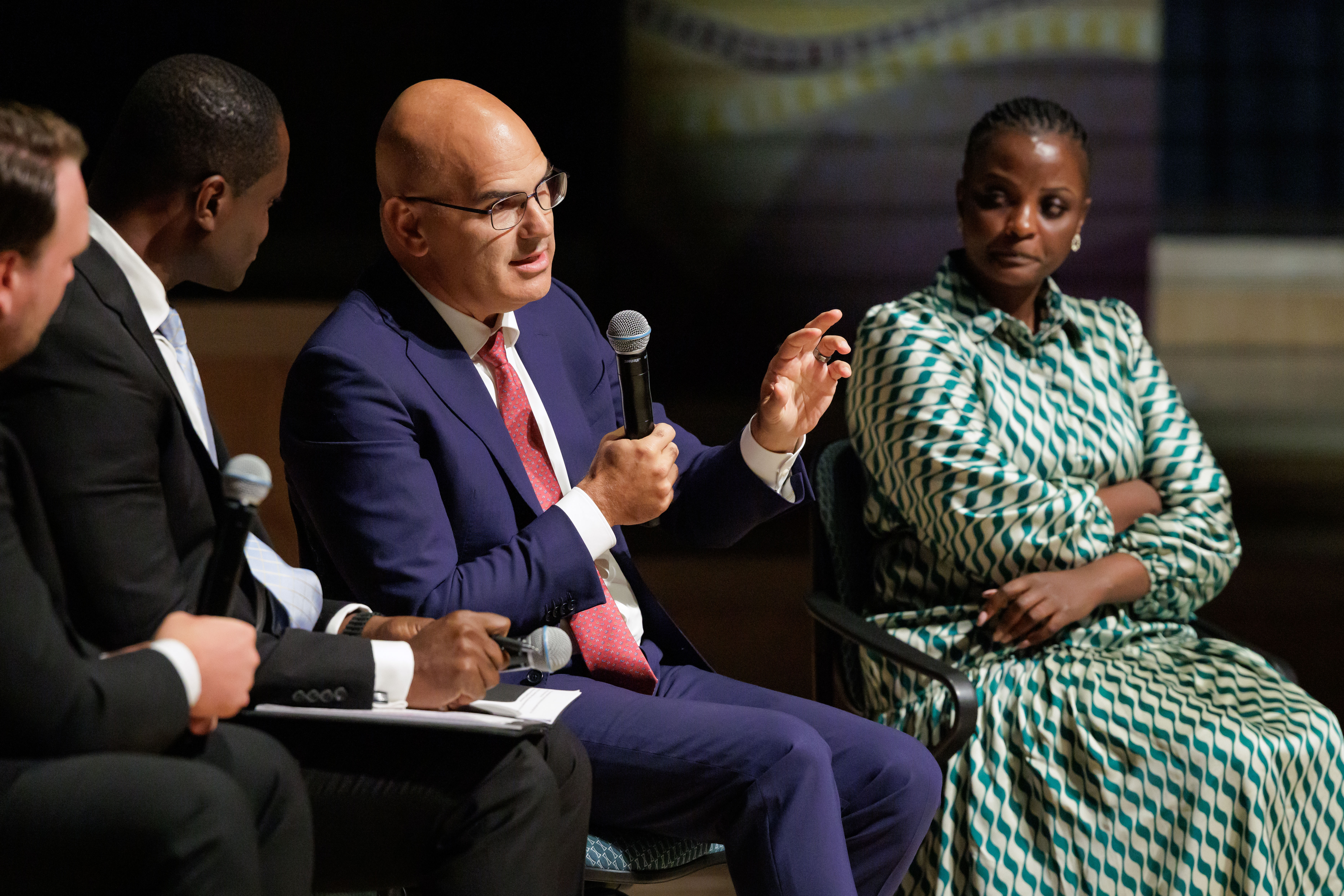
Matt Downs brought a journal entry to the discussion. At a September 2025 screening of Pathway to Hope, he recalled a day when he had hired students from Kenya, Ghana, Uganda, Guatemala and Argentina. Sitting nearby was Grace Ninsiima, one of those hires. An investor’s account of a labor market had, quite literally, someone beside it.
The list of countries gives the moment its scale. The journal gives it its intimacy. Downs had recorded a hiring decision and returned to it in public, alongside a person whose work had made that decision meaningful. Venture capital usually has plenty of documents. Few are this useful for understanding the person holding the microphone.
Downs is co-CEO and managing partner of Sandbox Industries, the Chicago investment firm he joined in 2004. His career runs through Morgan Stanley, Highland Capital Partners and Stanford’s business school. Yet the question running through his work with students is refreshingly ordinary: how does a capable person get close enough to an opportunity to be considered?
A job with a name attached
Ninsiima’s work at Sandbox makes the connection concrete. As a research analyst, she reviewed financial reports and other information, then prepared investment briefs for executives. She was doing work the firm needed, while putting her college learning to use. The arrangement joined an employer’s demand for analysis with a student’s growing ability to supply it.
Downs described her as someone who learned quickly and produced dependable work. That is the language of an employer evaluating a colleague. It matters because the work itself belongs at the center of this story. An introduction can open a conversation; the quality of what comes next gives the relationship a reason to continue.
He has been involved with BYU-Pathway as a donor, service missionary and Career Advisory Board member. Each role approaches the same gap from a different direction. Funding helps make study possible. Mentoring helps someone navigate unfamiliar expectations. An employer can provide a place to use the skills. None of those activities alone guarantees the next step.
There is a practical appeal to that sequence. Education gives a person something to offer; paid work gives the learning somewhere to go. For an investment firm, a well-written brief is useful whether its author lives down the road or across an ocean. The difficulty lies in arranging the relationship, evaluating the work and making the arrangement last.
The investor who joined early and stayed
Before Sandbox, Downs worked in Morgan Stanley’s New York mergers and acquisitions group and became a venture investor at Highland Capital Partners. He earned a BA in economics at Brigham Young University and an MBA at Stanford Graduate School of Business. His public professional profile dates the MBA to 2002-2004, ending in the year he joined Sandbox.
Sandbox was then a young firm, founded the previous year. Joining early gave Downs a long association with an organization whose work centers on bringing established industry participants into contact with emerging companies. Today his remit includes the firm’s culture, expansion into new sectors and the operating processes behind investing and deploying capital.
Those responsibilities put people and procedure in the same job description. A firm can find an interesting company and still have difficult decisions about how to invest, who should be involved and what it expects to happen afterward. Culture shapes how those decisions get discussed. Process gives them a route from discussion to action.
Sandbox’s approach includes industry leaders investing in its funds as strategic limited partners. That creates relationships among the industry participants, financial investors and portfolio companies. An investment can therefore carry more than a financial relationship: it can bring a young company closer to people who understand the market it hopes to serve.
The resemblance to Downs’s hiring work is an editorial observation, rather than a claim that the two activities are identical. Both involve a distance that money alone may leave intact. A company needs a customer who understands its product. A student needs an employer who can recognize useful skills. Introductions become valuable when someone has a reason to act on them.
Who gets to teach whom?
In August 2024, Downs helped facilitate a Zoom call between the BYU football team and 300 BYU-Pathway students in Africa. The participants talked about teamwork, discipline, faith and humility. Football players brought one kind of experience. Students brought another. A screen allowed people with very different daily lives to put those experiences into conversation.
The exchange was described as mutual mentoring. That phrase deserves its space. Mentoring can sound like a tidy arrangement in which an accomplished person speaks and everyone else takes notes. Here, the players also had something to learn. Wide receiver Chase Roberts spoke about gaining perspective from the students’ lives and faith.
Joined the August 2024 Zoom conversation with BYU football players that Downs helped facilitate.
Downs valued the possibility of people learning from one another across geography and economic circumstances. That is a modest description of a substantial change in who gets heard. A university athlete and a remote student can occupy the same conversation without pretending they have the same experience. Difference supplies some of the reason to have the conversation at all.
He had expressed a related thought years earlier, in a discussion of diverse startup teams. His emphasis was on recruiting capable thinkers whose backgrounds and perspectives differ from his own, so that a team can make better decisions. The useful question is what another person can help the group understand.
That has consequences for an investor. If everyone sees a business through the same assumptions, agreement can arrive very quickly. Quick agreement is pleasant company; it is a less dependable substitute for examining an idea. Bringing another perspective into the room gives a decision something to contend with before the market has its turn.
Confidence is a piece of the work
Downs’s involvement in Pearl 27 adds another setting. His LinkedIn profile identifies him as a co-founder, and the company presents its work in marketing and public relations. A public account from Pearl 27 colleague Nancy Kasaya describes his work helping BYU-Pathway students find a footing in digital marketing.
Kasaya’s description emphasizes confidence, curiosity, patience and listening. These are her observations of him, grounded in her experience of the team. They offer a more personal view than an executive biography can. A colleague remembers the way someone meets people and helps them think through their next steps.
Confidence matters in that setting because doing a task and presenting oneself as someone who can do it are separate skills. A student may need practice in both. Mentorship can make unfamiliar professional expectations easier to understand, while leaving the responsibility for the work with the person doing it.
There is an appealing lack of ceremony in the connection. Digital marketing requires actual assignments, actual feedback and people who can explain what good work looks like. The student’s future becomes a little less abstract when a colleague can point to a piece of work and talk about how to improve it.
The customer complaint worth keeping
Downs’s view of feedback becomes especially clear in an account of a portfolio team discouraged by customer criticism. Where the team saw danger, he saw information: the customer was explaining what was wrong. A relationship that produces a specific complaint gives the company something it can attempt to fix.
“They’re telling you why they don’t like you.”Matt Downs, responding to a portfolio team’s customer feedback
The humor is dry enough to survive a board meeting. Being told why someone dislikes your product rarely makes anyone’s calendar highlight reel. Yet the explanation is useful. A silent customer leaves a company guessing. A disappointed customer who explains the disappointment has supplied a starting point for the next conversation.
He also favors growth at a pace a business can support, with attention to operational discipline rather than dependence on another funding round. The practical issue is whether the organization can keep doing its work as it becomes larger. Hiring, communication and decisions all place demands on the business behind the growth chart.
Read alongside his mentoring work, that preference gives his approach a consistent shape: help people and organizations become able to handle the next step. A connection opens a possibility. Feedback helps turn it into better work. The unglamorous middle deserves attention, even when a funding announcement would make a livelier photograph.
Another platform, the same practical question
In 2026, Downs also appears as managing director and CEO of Melody Global, alongside chief investment officer Seth Merrill and chief operating officer Greg Eickbush. The firm describes a platform covering equities, fixed income and alternative assets for institutions, family offices and qualified investors. It adds another business to a career already concerned with organizing capital and relationships.
At home, Downs lives in Alpine, Utah. He enjoys reading and spending time with his wife and seven children. The detail is brief but humanizing: beyond investment processes and executive titles, his stated pleasures include a book and family time. Seven children also make a fairly persuasive case that coordination has uses beyond the office.
Return to the journal entry. At the screening, Downs spoke of the possibility of millions of jobs being created. That was an aspiration, not a tally. The distinction leaves room for both his ambition and the work required to pursue it. One hiring decision can be described precisely. A much larger future still has to be built, person by person.
The enduring image is of an investor explaining a decision with one of the people affected sitting beside him. It brings the argument within conversational distance. A labor market is made of people who can do useful work and people who need it done. Downs’s part in this story is to help them find each other, then give the relationship something to do.