He grew up on a farm that measured nothing. Then he built companies that measure everything - and bet his career on a single idea: what you eat is what you become.
Matt Barnard spends his days trying to slip something into your food without you noticing. Not a trick - a fiber. Odorless, colorless, tasteless, and dosed higher than food has ever carried it. At one.bio, the Sacramento biotech he cofounded and runs, the pitch is disarmingly simple: our food is making us sick, and the fix is a molecule most of us stopped eating enough of.
one.bio began life as BCD Bioscience, a spinout of research at UC Davis. Its founding scientists - among them Matt Amicucci, who built a molecular catalogue of food fibers that the company calls the Glycopedia - had spent years asking a narrow, stubborn question: which specific fibers feed which specific bacteria in the human gut?
In 2023 they brought in Barnard as cofounder and CEO, and the company launched publicly that October. The science underneath it is unglamorous and precise. Take a plant fiber - a long polysaccharide - and break it down into short chains called oligosaccharides. Those shorter chains are a better meal for the good bacteria in your gut. Do it well enough and you can add the result to ordinary food and drink at doses that would normally make a smoothie taste like a haystack. Except nobody tastes anything.
"We're making odorless, colorless, tasteless fibers that can be added to foods at uniquely high doses," Barnard has said. That sentence is the whole company.
In December 2024, one.bio closed a $27 million Series A led by Alpha Edison, with Leaps by Bayer, Mitsui, Morado, ReMY, dsm-firmenich and others joining. The money is aimed at a single, hard problem: making anti-inflammatory plant fiber imperceptible in food and beverage, at scale, for the first time.
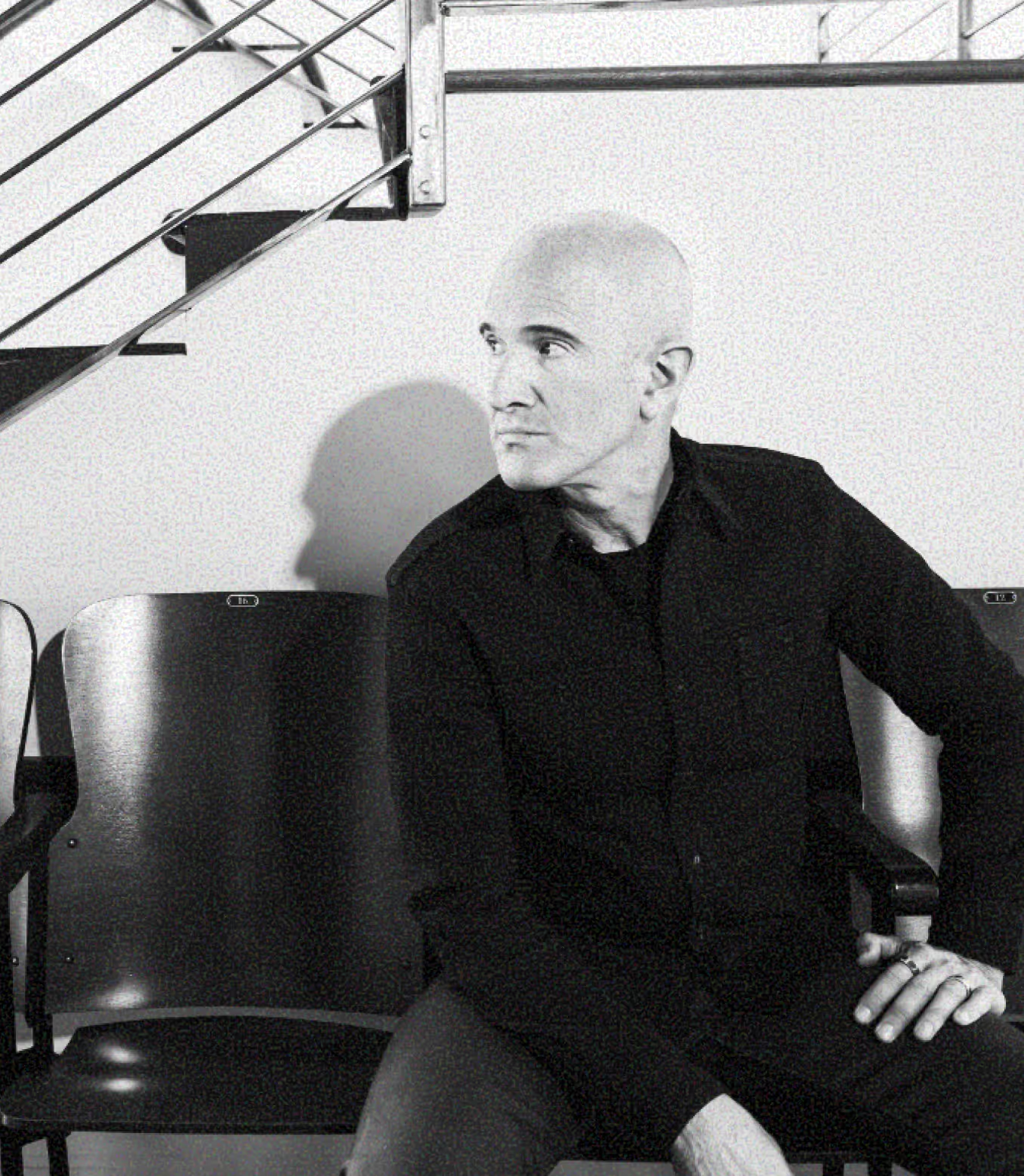
The more you understand and control what exactly is eaten, the more control you have over health.- Matt Barnard, on the lesson he carried out of Plenty
Long before fiber, Barnard was the face of vertical farming's loudest bet. In 2013 he cofounded Plenty and set out to grow greens in stacked indoor towers near cities, year-round, without pesticides. The claim was audacious - yields of up to 350 times the produce per acre on roughly one percent of the water conventional field farming uses.
Audacious raises money. In 2017, SoftBank's Vision Fund led a round north of $140 million, with Jeff Bezos and Eric Schmidt among the backers. Plenty became a unicorn. Barnard - the kid from the Wisconsin orchard - was suddenly the operator investors trusted to reinvent lettuce.
His obsession then was the same as it is now: taste as proof. He liked telling the story of skeptics biting into Plenty's kale and blurting out that it was so good you shouldn't even call it kale. He predicted people would be "addicted" to the strawberries and struggle to get home from the store without finishing the box. Around 2020 he moved from CEO to executive chairman, and Plenty inked a deal to stock hundreds of Albertsons stores across California.
Two companies, one thesis. First he controlled the plant. Now he's after the molecule.
Operating and corporate-development roles across telecom, utilities and tech - including work touching Nest, Dropcam and Mightybell, plus a stint as VP of Deployment at SmartSynch. Teams he led designed and deployed roughly a billion dollars of infrastructure.
Cofounds Plenty and takes the CEO seat, chasing indoor vertical farming near major cities.
SoftBank's Vision Fund leads a $140M+ round; Bezos and Schmidt join. Plenty becomes a unicorn.
Shifts from CEO to executive chairman; Plenty signs to supply hundreds of Albertsons stores in California.
Joins UC Davis spinout BCD Bioscience as cofounder and CEO. The company launches publicly as One Bio in October.
one.bio closes a $27M Series A led by Alpha Edison to commercialize high-dose, imperceptible plant fiber.
Barnard frames the modern diet as inflammatory - one that produces an inflammatory microbiome tied to a long list of chronic diseases. The problem, in his telling, isn't willpower. It's what's on the plate.
Specific fibers nourish specific gut bacteria. Break long fibers into short oligosaccharide chains and you hand those bacteria a better meal - nudging the microbiome and immune function in a healthier direction.
The bet is that people won't take pills or overhaul their lives. So one.bio hides the medicine in the meal - invisible fiber in food you already eat, at doses no one has hit before.
There's a pattern to Barnard's career, and it isn't hype. It's patience wearing a lab coat. He spent years convincing people that a warehouse could out-farm a field, and now he's spending more of them convincing a coffee, a bar, a snack that it can carry a dose of health nobody can taste. The aspiration he keeps returning to is unfashionably modest for a founder: extend the years people feel good, without pills, without lectures, without asking anyone to change a thing. Just better food, quietly rebuilt from the fiber up.