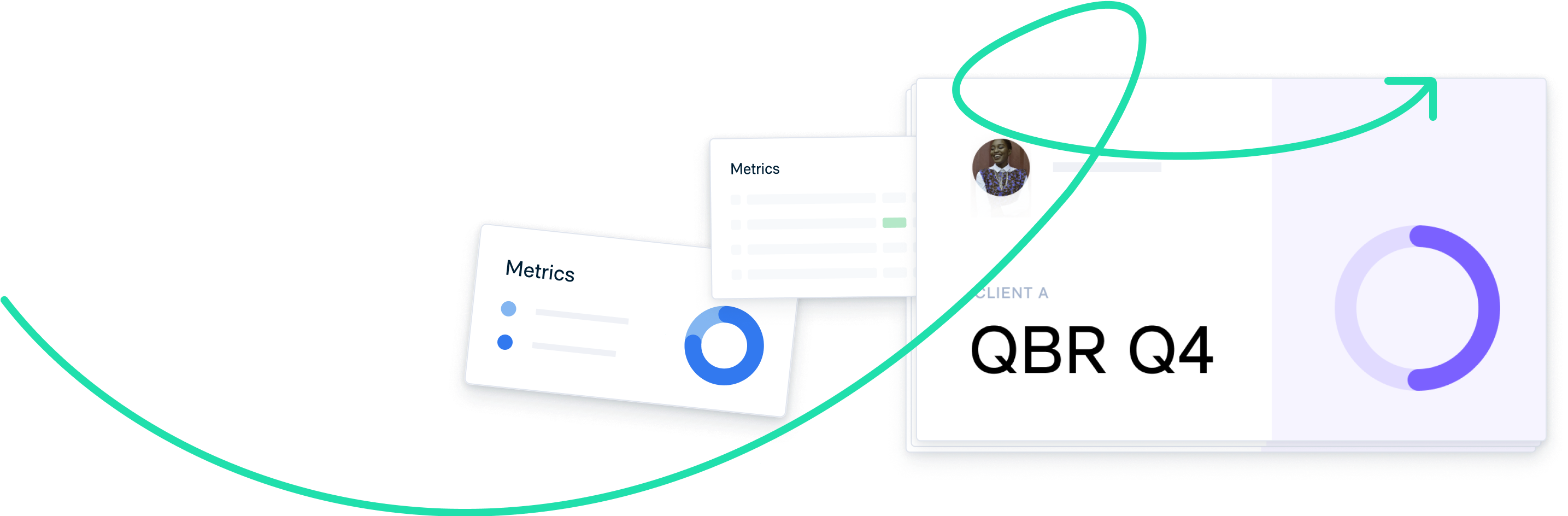
It is 9:47 on a Tuesday. A customer success manager in Austin has a noon QBR with a $480K renewal on the line. She does not open PowerPoint. She opens Matik.
She picks the template, picks the account, and clicks generate. A laptop fan spins for nineteen seconds. Out comes a fifteen-slide deck packed with the customer's real usage data, the right logos, the right tone, the right charts - already inside Google Slides, already on-brand, already saved to the right shared drive. The slides she would have spent two and a half hours assembling assemble themselves. She makes coffee instead.
This is what Matik does. The pitch is small. The implication is enormous.
The Problem
The most-dreaded meeting on the calendar
Quarterly business reviews are a strange genre of office work. Everyone agrees they matter. Almost nobody likes making them. Customer success managers - the people responsible for keeping enterprise customers happy - routinely lose entire days each quarter copying numbers out of Salesforce, screenshotting Tableau dashboards, retyping the customer's name into a template, and praying nothing in the data shifted overnight.
The result is a deck that is part ritual, part liability. One stale chart, one mislabeled logo, one wrong renewal date - and the conversation about expansion becomes a conversation about trust. Multiply that by a few hundred customers a quarter, and a company has a soft, expensive, invisible problem that almost nobody can be promoted for solving.
Nik Mijic noticed.
The Founders' Bet
A LinkedIn engineer with a hunch
Before Matik, Mijic spent years at companies whose job was keeping customers from churning. At LinkedIn, he built internal tools to pump LinkedIn's own data into the slides their teams gave to customers. The tools worked. The teams loved them. The hunch followed him out the door.
In 2019 he teamed up with Zak Stein - a former Box staff engineer - and did something unusually patient for a Bay Area startup. Before writing production code, the two of them spent five to six months on three things: validating that the problem was real, scoping what it would take to build, and stress-testing whether they could survive each other as co-founders. Only then did they start.
The bet was that presentation automation was not a feature. It was a category.
The Product
A templating engine with opinions
Strip away the marketing and Matik is a templating engine with opinions. You point it at your data - Salesforce, Snowflake, Tableau, Looker, Google Sheets, HubSpot, a plain REST API, whatever - and you point it at a template inside Google Slides, PowerPoint, Word, Excel, a PDF, or an email. Matik runs the query, applies the conditional logic ("if NPS is below 30, swap in the gentler chart"), formats the result the way your brand team would have if they were watching, and ships it.
Then it does that a thousand more times, one per customer, without complaint.
The newest layer is Matik AI, which adds generative storytelling on top. The trick is that the AI is fenced in. It does not invent metrics. It does not pick its own colors. It does not get to freelance on a Fortune 500 logo. It writes prose around numbers that already exist, in a voice the brand team already approved. In a market drowning in AI demos that confidently hallucinate, that restraint is the product.
QBRs at scale
Generate hundreds of personalized customer reviews in the time it used to take to make three.
Tailored pitch decks
Pull live account data into a prospect deck before the discovery call ends.
Investor & board reports
Auto-populate the same numbers across PDF, Excel, and Slides without a single copy-paste.
On-brand, on time
Conditional logic and approvals keep the wrong logo, font, or claim from ever shipping.
The short, useful history of Matik
The Proof
Boring software, loud customers
The customer list reads like a B2B SaaS yearbook: Asana. Greenhouse. Zapier. Glassdoor. SalesLoft. Samsara. BazaarVoice. Modern Health. Handshake. Autodesk. Reddit. Okta. These are not companies that buy software lightly. Procurement at any one of them is a small ordeal. Each name on the list is a vote that the QBR problem is real, and that Matik's answer survives the vendor review.
The most-cited number in the Matik universe belongs to Handshake, the campus recruiting platform, which reported saving 4,500 hours of presentation work after rolling Matik out. Four thousand five hundred hours is a little more than two and a half years of one person's working life. It is also, somehow, a side-effect.
Where the time goes - before and after Matik
Translation: roughly an extra workweek per CSM, per quarter. Multiply by team size, then by your renewal rate, then by your patience for grunt work.
The Mission
Trust over magic
Matik publishes four values - trust, compassion, quality, customer first - and the order is not accidental. Trust is first because the product cannot work otherwise. A QBR deck that is 95% right is worse than no deck at all. The whole pitch is consistency: every number sourced, every chart auditable, every customer's name spelled the way they spell it.
That is why Matik AI ships with guardrails instead of glitter. In a year when most AI demos are racing to be impressive, Matik is racing to be boring on purpose. Boring is what enterprises buy.
Why It Matters Tomorrow
The unsexy AI that actually ships
The interesting thing about the current AI moment is not the chatbots. It is the chores. The work that nobody wanted to do, that nobody could be promoted for doing well, that companies tolerated because there was no obvious alternative. Slide decks. Renewal reports. Investor updates. The drudgework that runs on top of clean data and dies on top of dirty data.
Matik's bet is that this layer - the personalized, data-driven, on-brand content layer - is a category, not a feature. Six years in, with $26 million raised, a customer list of names you have heard of, and a team of about 120 people, the bet is starting to look less like a hunch and more like a thesis.
It is 9:47 again. Different Tuesday, different CSM, different city. She opens Matik. The fan spins. The coffee is still warm.
She makes her noon meeting with twelve minutes to spare.