In the spring of 2025, a clock outside Martin Schroeter’s Manhattan boardroom counted down to the end of Kyndryl’s fiscal year. Inside, the chief executive was discussing a less obedient measure of time: how long it takes investors to believe a company has changed. “Nobody needs to own us,” he said. It was an unusually economical sales pitch from someone whose previous job had included selling IBM to the world.
The clock suited the predicament. Kyndryl had a beginning, a stock ticker and a chairman who could point to its birthday. Its work, relationships and obligations were much older. Schroeter had returned from retirement to lead a business that needed to start over while continuing to answer the telephone. The customer systems could hardly observe a thoughtful pause for corporate reinvention.
That tension makes him an interesting kind of founding executive. His raw material was an existing operation, carrying the habits and commitments of a much larger parent. The job required judgment about what deserved to survive, what needed changing and how to persuade people that independence meant more than a different name on their payslips.
A retirement with a short shelf life
Schroeter’s preparation was a long education in the movement of money and the maintenance of relationships. He studied economics and finance at Temple University, earned an MBA at Carnegie Mellon and joined IBM in 1992. Over the following decades, he worked in Japan, Australia and the United States. He holds both American and Australian citizenship.
He became IBM’s treasurer in 2007 and took charge of its global financing business in 2011. That operation had an asset base exceeding $37 billion. He then served as chief financial officer from 2014 through 2017, before moving to global markets, with responsibility for sales, customer relationships and geographic operations. The progression gave him successive views of the same enterprise: its finances, its customers and the organization connecting them.
He retired from IBM in June 2020. By January 2021, IBM had announced his appointment to run the infrastructure services business it planned to separate. The role took effect on January 15. At the time, the future company still answered to the wonderfully provisional name NewCo. Even a veteran of corporate finance could begin again with a working title.
A birthday for an established business
Kyndryl began trading on the New York Stock Exchange on November 4, 2021. There was an opening bell and the familiar choreography of a public company’s arrival. It launched with roughly 90,000 professionals and customers in more than 60 countries. Those were unusual starting conditions for any enterprise expected to introduce itself.
In his message that day, Schroeter described work that most people encounter through its results: card payments, manufacturing, shipping, telecommunications. The shared requirement was continuity. A bank can announce a new digital service with considerable ceremony. Customers generally prefer the existing one to keep functioning without ceremony at all.
The launch message named practical assignments, including an extended relationship with ABN AMRO and a project to move Mondi factories to a new SAP platform. This was a business built around specific customer environments. Independence had to produce useful decisions in those environments, where years of accumulated technology could make a seemingly tidy change remarkably complicated.
Eight days later, a different set of friends
On November 12, Kyndryl and Microsoft announced a global strategic partnership. The timing mattered. Eight days after its stock market debut, the company was demonstrating the freedom Schroeter had promised when he accepted the job: a broader network of technology alliances.
The agreement paired Kyndryl’s experience running customer systems with Microsoft’s cloud. It also provided for a joint innovation lab and a training initiative for Kyndryl professionals. The commercial proposition depended on people learning new tools as well as executives signing documents. A partnership announcement is relatively easy to print. Competence has to be acquired by the people delivering the work.
Relationships with Google Cloud and Amazon Web Services followed in the early phase of independence. Kyndryl reported more than 16,000 hyperscaler certifications among employees in its full-year 2021 results announcement. These were company milestones, achieved across teams. For Schroeter, their significance was strategic: a services business could offer customers a wider range of choices.
The company also had to modernize itself. Its own SAP transformation used Azure infrastructure, an exercise in the sort of change it sold to clients. There is a useful discipline in becoming your own customer. An elegant proposal acquires texture when colleagues have to work with the finished system every morning.
The booklet and the daily decisions
By 2025, Schroeter was carrying a small red booklet of leadership principles. One instruction was to “serve with trust, transparency, and integrity.” The physical object is a pleasing detail in a business devoted to digital systems: organizational change, available in pocket format.
The company calls its cultural framework the Kyndryl Way. It was developed through exchanges between leaders and employees. Its six principles ask the business to be restless, empathetic, devoted, flat, fast and focused. Taken seriously, those words imply obligations: listen across ranks, give teams responsibility and reduce the procedural clutter between a customer’s problem and a useful response.
Schroeter publicly places culture at the center of the turnaround. The logic is understandable in a services company. Its promises are fulfilled through repeated decisions by people who are often far from the chief executive. A central office can set priorities; it cannot personally handle every handover, technical disagreement or conversation with a worried customer.
A booklet can remind people what leadership expects. Whether the organization rewards those behaviors is the harder question. The financial and operational record has to give the language substance. Culture becomes interesting precisely when a decision costs something, when speed competes with care, or when transparency makes a meeting uncomfortable.
Making the invisible legible
Kyndryl Bridge, introduced in September 2022, gave the strategy a technical expression. The platform connects enterprise tools to help customers see and manage complex IT environments. Its purpose includes using analytics and automation to anticipate problems and improve operations.
For a general reader, the useful idea is visibility. Large organizations accumulate systems across locations, suppliers and generations of software. Understanding how those pieces interact is part of changing them safely. Schroeter’s business sits in that untidy middle, where the promise of modernization encounters systems that already have work to do.
His early strategy organized the work around alliances, advanced delivery and accounts. The last part included confronting work with inadequate margins. This introduces a complication into any turnaround story: revenue can fall while management deliberately changes the mix of business. Investors then need evidence that the replacement work will justify the transition. The explanation buys time only if execution earns it.
“Nobody needs to own us.”Martin Schroeter, April 2025
The accounts demand their own attention
By 2026, financial reporting itself had become a central test. Kyndryl disclosed an SEC enforcement investigation concerning cash management practices, related disclosures, internal financial reporting controls and other matters. Its annual filing said the investigation was ongoing and its outcome could not be predicted. The scrutiny concerned the company; an investigation does not establish wrongdoing by Schroeter.
Its June 2026 quarterly filing also reported that disclosure controls remained ineffective because of material weaknesses in financial reporting controls. Management said those weaknesses had not caused misstatements in the covered financial statements and described a remediation plan. For a company whose culture emphasizes transparency, the disclosure gave that principle a concrete test.
The leadership team changed as well. In July, Kyndryl announced Ellen Johnson as incoming chief financial officer and Andrew Bonzani as general counsel and secretary. Johnson was scheduled to take the CFO role on August 6, following interim finance chief Harsh Chugh. Schroeter described the appointments in terms of financial discipline and governance. For a former CFO leading a public company, those responsibilities are close to home.
The August 5 results offered a mixed picture. For the quarter ending June 30, revenue was $3.6 billion, down 3% from a year earlier, and the company reported a $55 million net loss. Results included $152 million in workforce rebalancing charges. Consulting revenue grew 10%, and management reaffirmed its fiscal 2027 outlook. The progress Schroeter described coexisted with costs and declining overall revenue.
That makes a tidy victory lap premature. His stated ambition remains a more profitable business built around higher-value work. The useful measure is the distance between that ambition and delivered results, including the quality of the reporting that allows outsiders to judge them.
AI eventually has to come to work
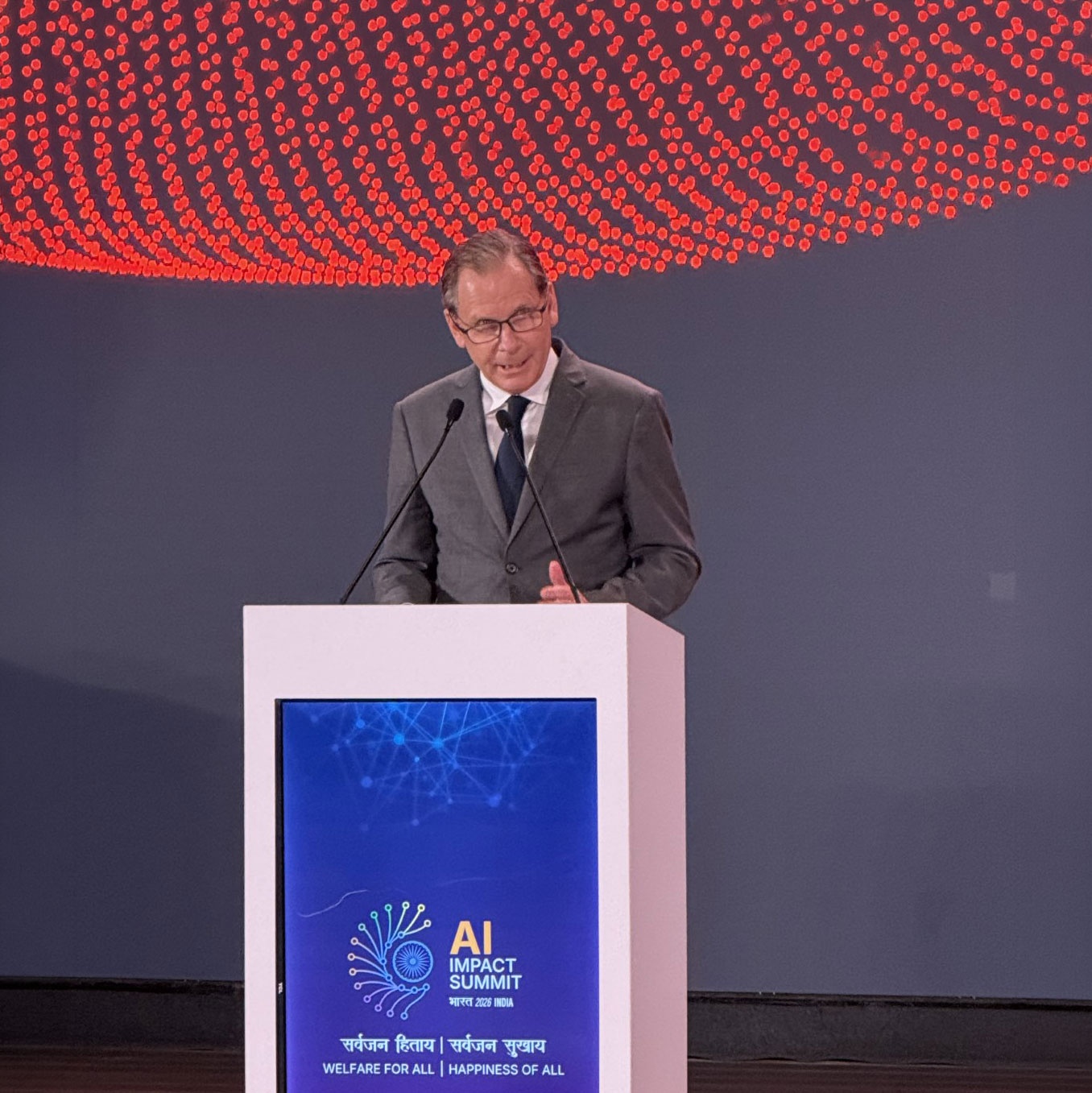
At India’s AI Impact Summit in February 2026, Schroeter brought the discussion back to infrastructure, security, governance and skills. He argued that AI needed to move into dependable daily operations. His interest was in the conditions required for deployment across businesses and public institutions, with systems that people could trust.
It is a commercially convenient argument for Kyndryl, and a substantial one. An enterprise cannot judge a new system solely by a demonstration. It must ask how that system fits existing processes, who can explain its actions and what happens when something goes wrong. Those questions place responsibility on executives as well as engineers.
He has also become an interviewer, sitting down with colleagues including CIO Kim Basile, human resources chief Mark Paulek and strategy leader Kris Lovejoy in Kyndryl Conversations. The subjects include workforce preparation and modernization. The format puts the people responsible for execution alongside the chief executive’s account of where the company should go.
His founding assignment is still recognizable in those conversations. Change the business while people depend on it. Build new capabilities while making the existing ones dependable. Earn confidence through decisions that can be inspected. For Martin Schroeter, starting over has meant accepting a peculiar constraint: the world still expects everything to work on Monday.