Before Bruce Broussard had an office from which to discuss the future of work, he had cars to clean. At a Houston dealership during college, his assignments included errands, lawn mowing, and whatever else the sales team needed. The work supplied an education that came without a syllabus: somebody else’s inconvenient task could become your opportunity to be useful.
He later became an analyst, preparing financial forecasts that other people needed to make decisions. He checked the numbers, organized the material, and studied how to build better spreadsheets. It is an unglamorous beginning for someone who would eventually run public companies. That is part of its appeal. A spreadsheet rarely applauds you. It does, however, reveal whether you bothered.
In March 2023, looking back on that progression, he wrote: “There was no master plan.” The eventual titles make a neat résumé. Living through the jobs was a less orderly business.
The invitation came from inside the room
On February 3, 2026, HP appointed Broussard interim chief executive officer after Enrique Lores stepped down. He had been a director since 2021. The assignment moved him from helping oversee the business to running it while the board searched for a permanent successor.
His appointment statement emphasized stewardship, stability, and continuity. Those are restrained words for an industry that tends to announce breakfast as a revolution. They also describe a real obligation: keep people making decisions while everyone knows another leadership decision is still to come.
HP chairman Chip Bergh pointed to Broussard’s operating experience and knowledge of the company. The choice put an executive trained in accounting and finance at the head of a technology business. His authority would depend on how effectively he worked with people whose product expertise exceeded his own. It is a useful setting for a leader who has become increasingly interested in asking questions.
A detour through College Station
College itself had not been inevitable. Broussard was a first-generation student whose high-school counselor suggested vocational school. Friends helped persuade him to continue his education. He attended a University of Texas orientation, then decided that Texas A&M’s environment and discipline would suit him better.
He called A&M to ask whether his acceptance still stood. It did; a dorm room was another matter. He lived off campus. The decision eventually yielded a business degree in accounting and finance, followed by an MBA in finance from the University of Houston.
Years later, he described annual trips with his former college roommates. The relationships outlasted the timetable and the examinations. His Houston commute also became a classroom: about 45 minutes each way, with motivational tapes for company. There is something pleasingly practical about this version of executive development. The student gets an education; the traffic remains unimpressed.
The numbers were only the beginning
Broussard’s professional route took him through finance and operating responsibilities before the largest assignments arrived. He spent 11 years at US Oncology, holding positions that included chief financial officer, president, chief executive, and chairman. Following its acquisition by McKesson, he became president of the acquiring company’s specialty division.
He joined Humana in 2011 and served as its president and chief executive from January 2013 to July 2024. The length of that tenure matters to understanding his arrival at HP. This was an executive accustomed to staying with an organization through years of decisions, rather than judging the work from a single announcement.
HP’s account of his qualifications emphasizes finance, operations, international business, and public-company governance. These are portable skills, though portability still requires learning. A balance sheet can introduce a business; the people who build, sell, and use its products have to explain the rest.
Sunday, with a notebook
One of Broussard’s more revealing habits appears away from the quarterly calendar. He reads, takes extensive notes, and sets aside time on Sundays to consider what he has learned and what he wants to carry forward. Reflection, in this account, gets an appointment.
In a January 2021 essay, he also described changing how he connected with colleagues. He had previously relied too heavily on being physically present in the office. He began writing weekly messages and contacting people without waiting for a scheduled meeting. The adjustment made him a better listener, he wrote.
An executive’s calendar can make availability look like a mathematical impossibility. His response was small and repeatable: reach out, explain what is happening, invite a reply. The notebook and the messages belong together. One creates a record of what he thinks; the other gives people a chance to tell him what he has missed.
“There was no master plan.”Bruce Broussard, 2023
Learning to pause before the project
Broussard has acknowledged that his early approach to leadership favored control and decisiveness. In July 2025, he wrote about occasions when his determination to produce results had caused him to overlook what people were communicating. The admission gives his later advice some friction. He is describing an adjustment to his own behavior.
His practical example was a pause before getting into the task: ask how the person is doing. It sounds modest enough to escape an executive training budget. Its difficulty lies in remembering to do it when the meeting is late and the numbers are unwelcome.
He continues to argue for clear expectations and difficult conversations. The change concerns how those conversations happen, and whether colleagues feel able to contribute. For someone who began by making financial forecasts useful to other decision-makers, there is a recognizable thread: understand what the person receiving your work actually needs.
A tomato garden at the wedding
In June 2025, Broussard wrote about watching his son Clay get married. His memories traveled from a small hand around his finger to oversized hockey bags and the beginning of an adult career. At the wedding dinner, he recalled a choice more than 30 years earlier that had led him to meet Janine, his wife.
The story brought him back to the way attention accumulates. He compared life to tending a tomato garden with one bucket to distribute each day. Time and effort have to go somewhere. There is no additional bucket marked important executive.
He acknowledged that work had sometimes upset the balance. The observation gives the garden image its usefulness: a person can sincerely value several things and still neglect one of them. The correction happens through ordinary choices about where to spend the next hour. A wedding provides a rather persuasive reason to examine those choices.
Another kind of institution to preserve
Broussard’s interests also extend to the National Mall. He has chaired the Trust for the National Mall, the nonprofit partner that supports its restoration and preservation; its current roster lists him as immediate past chair. It is a different form of stewardship, measured in public places rather than product cycles.
In June 2026, he described visiting the restored Lincoln Memorial Undercroft. The craftsmanship prompted a reflection on institutions that endure while allowing room for change. His emphasis was on what one generation leaves for the next.
There is a connection between that interest and the temporary nature of his HP assignment. Both raise a question about custody: what does it mean to be responsible for something that preceded your arrival and will continue after your departure? For Broussard, the public answer keeps returning to service, responsibility, and leaving an organization stronger.
What an intelligent machine still needs
By August 2026, he was applying his leadership arguments directly to artificial intelligence. He described the leader’s job through an orchestra: people bring different expertise, and someone has to help their work fit together. The conductor does not need to play every instrument. The orchestra would have a difficult evening if he tried.
That analogy also explains the humility required by his move across industries. His account of entering new roles stresses learning from people who know the customers, operations, and technology better. Curiosity becomes a working method.
In October, he turned to the systems surrounding AI models: memory, relevant information, and context. A support system that knows a product manual has one kind of usefulness. A system that also understands what a customer owns and has already tried can do more. His attention is on whether intelligence survives contact with the actual task.
A finished app is still an unfinished job
This concern predates his appointment at HP. In a 2017 essay, Broussard used software development to explain accountability. An engineer could deliver an application that met its specifications and still have work to do if nobody used it. The measure extended beyond handing over the code.
It is an especially relevant example for a leader now responsible for devices, software, and services. A product launch is a visible event. The customer’s experience afterward is a longer and less choreographed test. His argument asks the person doing the work to remain interested in the result after the formal assignment is complete.
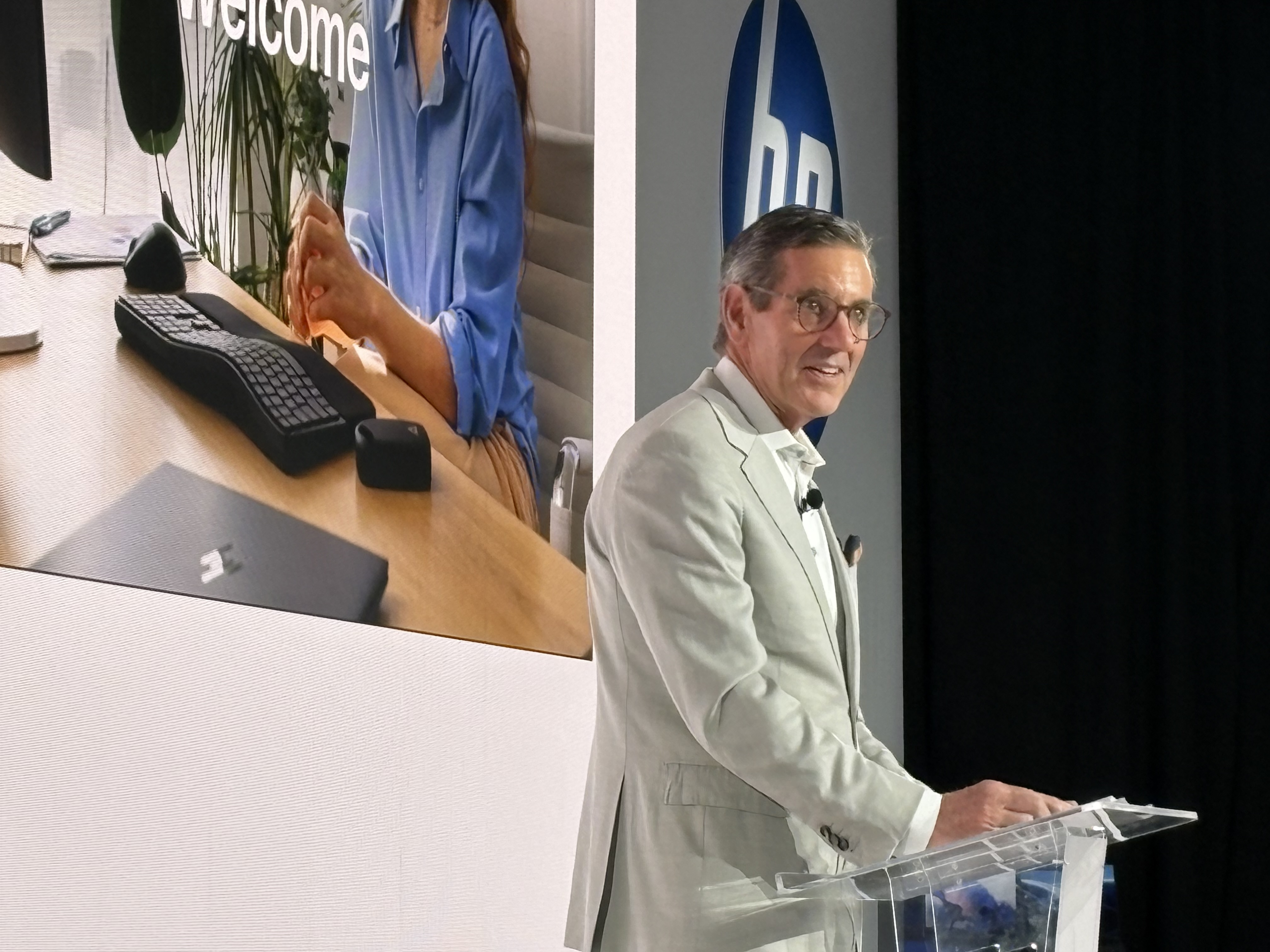
At HP Imagine in New York in March 2026, Broussard introduced the company’s direction around connected technology and simpler work. The ambition has an everyday standard by which it can be judged: does the person using the equipment find the work easier? The question has fewer syllables than a corporate strategy. It can be harder to answer.
The title does not finish the person
Long before the HP appointment, Broussard was thinking aloud about the danger of letting a job consume an identity. In November 2023, as he prepared for his Humana transition, he listed other roles: husband, father, brother, friend, athlete, and community representative. He admitted that being CEO often occupied more than its share of the space.
That willingness to revise the proportions is part of what makes his career interesting. In a 2024 reflection, he argued that personal progress should be measured against one’s own starting point, rather than another person’s achievements. It is advice that leaves room for the college student doing errands and the executive learning a new industry to belong to the same life.
For now, the public title is interim chief executive of HP. The work beneath it continues: listen, learn the business, make decisions, and help other people make theirs. Sunday will come around again. There will presumably be more to write down.