Albert Bourla did not particularly want to leave Thessaloniki. This is an awkward beginning for a career that would involve nine relocations, but careers rarely consult their opening chapters. He wanted to stay in academia. He liked his city. When Pfizer came calling, the opportunity arrived with an inconvenience attached: Athens.
He accepted with an escape clause in his own mind. A year, perhaps two, in business would amount to a sabbatical. Then he could return to university life, the work he imagined doing for the long run. He joined Pfizer in 1993. The sabbatical has become a rather substantial item on his calendar.
In recalling the decision, Bourla has been cheerfully unsparing about his younger self. Thessaloniki seemed to him the center of the world. Leaving it felt difficult. The distance looks modest beside the international career that followed, which is precisely what makes the detail revealing. Before he could manage across borders, he had to discover that he could enjoy living elsewhere.
The story invites a familiar business interpretation: take a chance, broaden your horizons, pack better shoes. Yet Bourla’s subsequent life suggests something more particular. Home continued to matter after he left. The question became how much of it he could carry with him.
A family with reasons to look back
Bourla was born in Thessaloniki on October 21, 1961, into a Sephardic Jewish family. Both his parents had survived the Holocaust. His father, Mois, escaped the deportations that took members of his family to Auschwitz. His mother, Sara, survived an arrest and a narrowly averted execution. Bourla has told their stories publicly, preserving the distinction between his own memories and the experiences they entrusted to him.
In his account of family weekends, cousins gathered while the adults talked about what had happened. The telling had a purpose. The children should remember the people who were lost, and understand the value of the lives that continued. His parents spoke about survival without making revenge the inheritance they handed down.
After the occupation, his father and an uncle built a liquor business together. In Bourla’s recollection, the household had enough, although money was measured. His mother cared for him, his sister and their home. The family history contains catastrophe; his descriptions of growing up also contain ordinary domestic happiness. Allowing both into the picture is essential.
That coexistence helps explain why he returns so often to optimism. His parents had ample evidence of human cruelty. They also made a family and a future. When Bourla credits them for his outlook, the word carries the weight of decisions made long before he had a company to run.
“I did not set out to live a public life”
Albert Bourla, on receiving the 2022 Genesis Prize
Optimism, with the arithmetic left in
In a February 2024 essay, Bourla argued that optimism should be taught as a skill. He described an outlook that acknowledges obstacles while expecting people to find ways through them. His parents’ refusal to let their experience dictate a permanently gloomy view of life was central to his explanation.
There is a practical distinction here between expecting a favorable outcome and assuming one will arrive unaided. The latter leaves everyone waiting. The former gives a team a reason to attempt something difficult. Bourla’s argument belongs to the second category. Hope has work to do.
It is also an argument that deserves to be held to its own standard. A leader’s confidence can encourage people to speak, or make them reluctant to bring unwelcome news. The difference depends on what happens after somebody identifies a problem. Optimism earns its place in management when the arithmetic stays on the table.
His stated company values offer a way to read that tension: courage, excellence, equity and joy. Courage without execution would be expensive theatre. Excellence without permission to question a plan could become obedience. Joy is the surprising entry. A list of corporate values rarely looks as though anyone expects to enjoy the working day.
Before the boardroom, an electorate
Bourla’s early practice in leadership included student government and a school music group. He has described learning to make a case, debate opponents and bring people with different political views toward an agreement. Another early education came at eleven, when he accompanied his father to business meetings and listened to negotiations.
These are useful correctives to the idea that leadership begins with a promotion. A student election offers an early encounter with a stubborn fact: other people are allowed to prefer somebody else. Negotiation offers another. Being convinced of your position does not relieve you of the task of understanding the person across the table.
He also worked taking Greek tourists around European capitals before joining Pfizer. A tour group is a compact management exercise, with the additional complication that the participants may be on holiday. Bourla recalls learning to read body language and anticipate tension. The people skills preceded the corporate vocabulary.
The connection is his own: he later applied that attentiveness to managing colleagues. Read in that light, his career began with several small constituencies. Classmates, tourists, negotiating partners. None owed him automatic agreement. Each offered a lesson in earning cooperation.
Nine relocations, two people packing
His three years in Athens changed his view of business. He liked its pace and the possibility of getting resources behind an idea. Marketing responsibilities followed his original technical work, and a move to Brussels opened another chapter. The temporary departure from academia had acquired momentum.
His account of this period comes with a marital footnote. He speaks fondly of Athens, while acknowledging his wife’s understandable preference for giving the years after their marriage the higher billing. Corporate biographies tend to omit the domestic negotiations over a sentence like that. His version is more entertaining.
He and Myriam married before the move to Brussels. Their subsequent life included Warsaw, where their children were born, and assignments in Belgium, the United States and France. He has counted nine cities in five countries. Promotions have dates; families experience them as addresses, departures and the task of settling in again.
The geographical range matters without needing to turn every move into a moral achievement. Working in a new place makes familiar habits visible. A way of persuading people that feels natural in one setting may land awkwardly in another. A global career repeatedly tests whether confidence can coexist with the willingness to adjust.
The title changed. So did the work.
Bourla became Pfizer’s chief operating officer in January 2018 and chief executive on January 1, 2019, succeeding Ian Read. He added the chairmanship on January 1, 2020. Those dates mark a progression through an existing institution. He had joined it more than a quarter of a century before taking its top job.
The distinction matters to the portrait. An executive who has held several jobs inside an organization knows how its habits feel from below. That experience can help a new chief identify where decisions get stuck. It can also make familiar arrangements difficult to question. An internal appointment brings both kinds of baggage.
Bourla has been candid about learning to depend on others. Describing a transition into responsibilities beyond his original expertise, he said he had to manage work he did not fully understand. The old satisfaction of personally knowing the answer became less useful as the responsibilities expanded.
There is a recognizably human difficulty in that admission. Expertise gets a person noticed; authority eventually requires trusting somebody else’s expertise. The reward for doing a job well can be a new job in which doing everything yourself becomes an obstruction. A larger title does not remove the need to learn. It changes the curriculum.
Three dates. Three different responsibilities.
- Chief operating officer
- Chief executive officer
- Chairman and CEO
A prize travels back to Thessaloniki
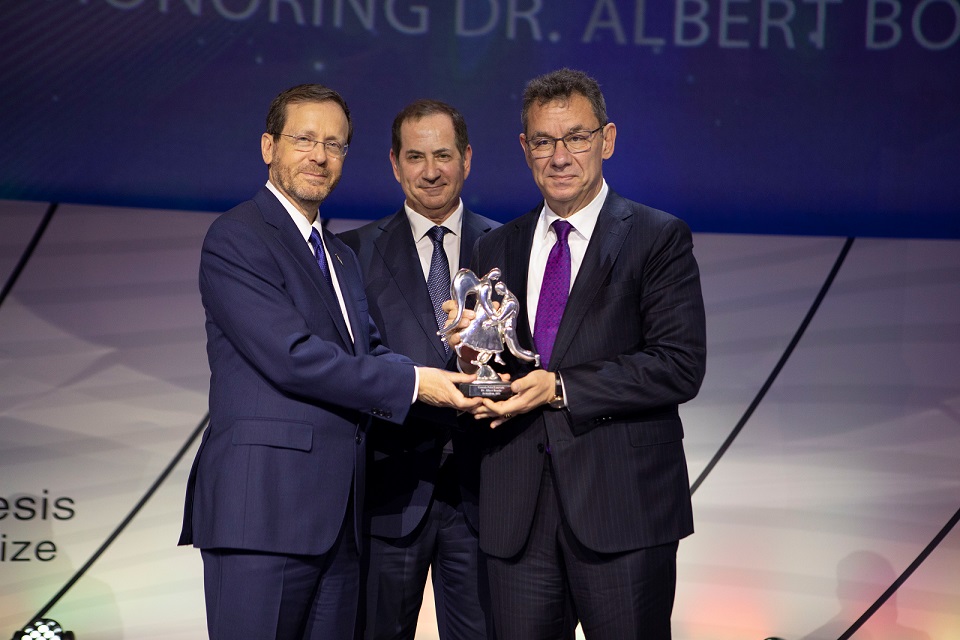
On June 29, 2022, Bourla received the Genesis Prize at the Jerusalem Theatre. Israel’s president, Isaac Herzog, presented it. The occasion placed him on a public stage alongside the institutions and people recognizing his professional work. His choice for the accompanying $1 million gave the event a distinctly personal direction.
He asked that the award support the establishment of a Holocaust museum in Thessaloniki. An international honor would help preserve the history of the place he had once found so difficult to leave. The connection did not require a metaphor. It had a city, a purpose and a specified sum.
He had already discussed his family’s history with Robert Krulwich in a Museum of Jewish Heritage conversation. These public retellings move the story beyond the family gathering: listeners who never knew Mois or Sara can hear their son recount what they survived. Remembering becomes something other people can participate in.
His recognition also includes Carnegie Corporation’s 2021 Great Immigrants tribute and the Franklin Institute’s 2022 Bower Award for Business Leadership. Awards can make a biography read like a cabinet inventory. The museum decision is more revealing because it records a choice. Given an honor, Bourla pointed it toward home.
The next argument is about who decides
By August 2026, Bourla was publicly making a case about artificial intelligence and the organization of work. His emphasis went beyond choosing a technology platform. He argued for giving teams close to a task responsibility for changing how it gets done, supported by shared infrastructure.
The proposal has a familiar managerial problem at its center. Large organizations can acquire new tools while preserving every old delay. Putting a faster instrument on a desk does little if each decision still has to climb the same ladder. Bourla identifies organizational inertia as an obstacle. That is his diagnosis, and the work of overcoming it remains an ongoing assignment.
For younger people, his published advice in June 2024 was less technical: collaborate, keep learning, welcome different perspectives and work with purpose. He explicitly acknowledged that hard work offers no guarantee of success. It is an unusually useful qualification in advice from someone whose career ended up on the favorable side of the odds.
The younger Bourla could hardly have planned the route from a university career in Thessaloniki to the chairmanship of Pfizer. He could decide whether to go to Athens. The rest required further decisions, other people and time. Decades later, the interesting detail remains that first reluctance. He left a city he loved, found work he wanted to keep doing, and continued finding reasons to return.
Continue the conversation
Interviews, essays and places to follow Bourla.
- Pfizer biography
- X / Twitter
- Optimism in Leadership
- The family story, in his words
- Watch: a conversation with Robert Krulwich
- Listen: Leadership Matters
- The Genesis Prize
- Career advice for recent graduates
- His 2026 essay on AI
- The Atlantic Council conversation
- Career conversation at Duke
- The Posse interview
- Carnegie’s Great Immigrants tribute