Before there were AI voice agents, international customers or a $28 million funding announcement, there was a customer who wanted a phone system in a language they could use. Martin Malych and Viktor Vanek were running an IT development business. The request was modest enough: build something simple because the available options did not fit. It is an unusually sensible beginning for a technology company. Somebody had a problem and was willing to describe it.
The founders began asking other customers about their difficulties with telephone software. The answers kept returning to cost, awkward interfaces, limited room to grow and tools that would not connect to other business software. They developed features around those requests, tested locally, then expanded abroad. By February 2020, they said they had customers in more than 30 countries. The first conversation had acquired quite a substantial guest list.
CloudTalk's early product was a click-to-call widget, the small website feature that lets a visitor start a call. The business grew around the work that followed: routing callers, keeping records and helping sales and support teams use the telephone alongside their other tools. Malych's career since has followed that expanding circle. A request becomes a product; the product creates a company; the company needs its own systems for listening.
The agency before the platform
Malych came to that problem with experience building things for other businesses. Before CloudTalk, he founded the digital agency Adbee. Its work included custom IT systems, websites, ecommerce development and marketing strategies. By the time his biography appeared among Slovakia's national finalists for the 2020 Central European Startup Awards, the agency had operated for more than five years and employed 25 people. His CloudTalk responsibilities were described as product development and daily operations.
That earlier chapter helps explain the distance between a software demonstration and a working business. Agency clients bring requirements, budgets and existing habits. A new system has to fit somewhere in the middle. In Malych's case, the phone-system request supplied a route from commissioned development to a product that other customers could use too. The useful insight was repeatability: several businesses were describing versions of the same irritation.
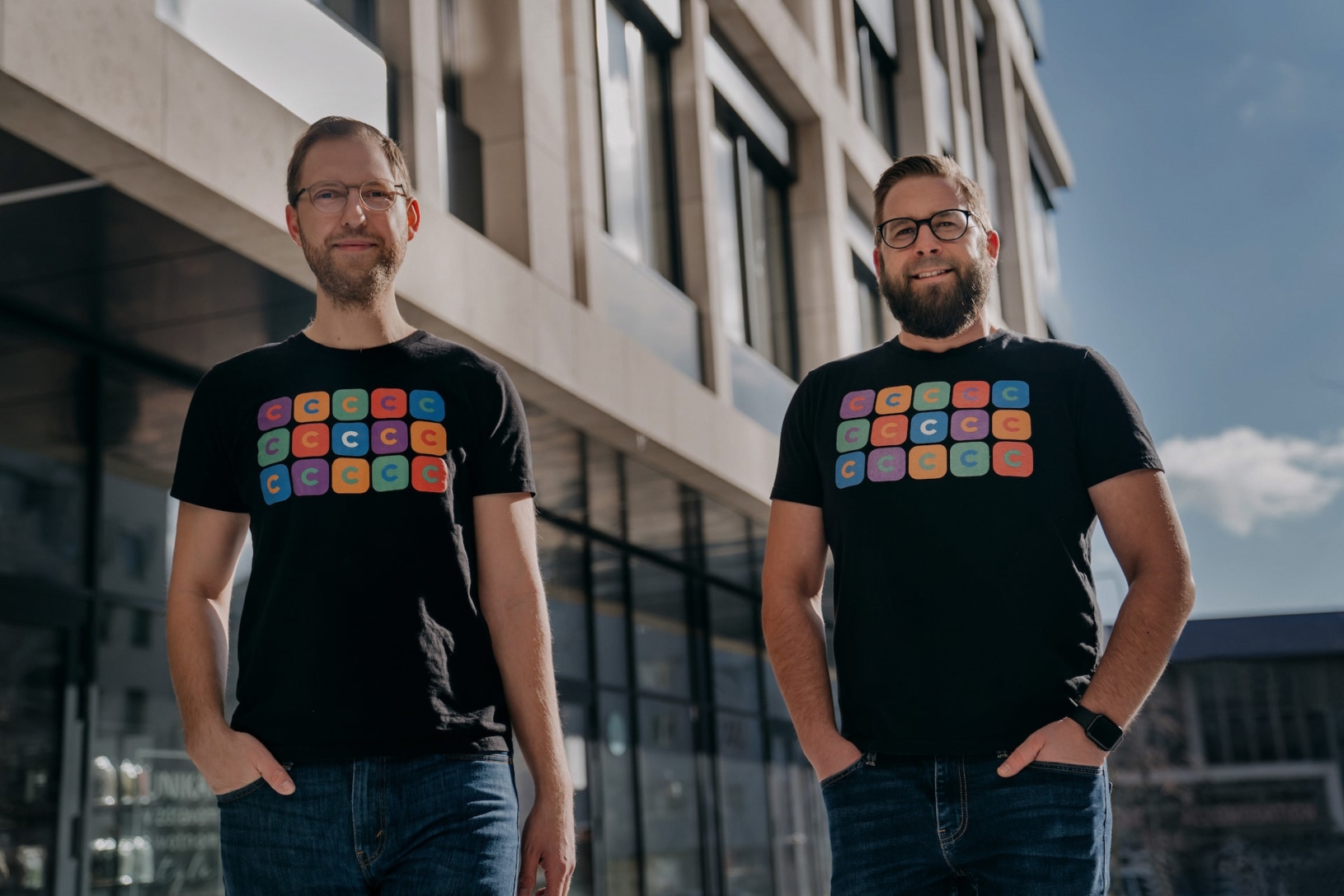
He and Vanek built CloudTalk from Bratislava. The company dates its founding to 2016, and Malych remains its co-founder and CEO. The photograph of the pair in matching CloudTalk shirts offers a pleasingly economical account of the partnership: two founders, one company, no confusion about the dress code. The work would soon require considerably more coordination than ordering two T-shirts.
Nine months behind one announcement
The funding milestones provide a second clock for the story. A €1.3 million seed investment from Presto Ventures in 2019 was followed by a €6 million Series A announced in February 2021. HenQ led that round, joined by Point Nine Capital. The money was intended to expand marketing, sales and product development into new regions. Reaching customers abroad meant building the organisation that could serve them there.
In January 2024, CloudTalk announced its $28 million Series B, co-led by KPN Ventures and Lead Ventures, with existing investors participating. At that point, the company reported serving more than 4,000 teams across over 100 countries. Malych discussed AI summaries, automated notes and sentiment analysis as practical uses for the new investment. The telephone call was becoming a place where software could do more of the surrounding paperwork.
The announcement was brief. Raising the money had taken about nine months, he later explained. He described a tougher Series B market and greater pressure on the quality of companies seeking capital. He was also wary of treating a billion-dollar valuation as a founder's main motivation: a valuation does not guarantee a sale at that price. There is dry arithmetic beneath the celebratory funding photograph. Malych seemed prepared to talk about the arithmetic.
A remote company still buys plane tickets
The organisational problem appears repeatedly in his public writing. In 2021, Malych described a team of 132 people representing 22 nationalities. Many worked remotely. His concern was whether shared values and a common direction would feel tangible to colleagues who did not meet each day. Hiring talented people, in his telling, did not by itself settle the question of how they would work together.
Later, he wrote about supporting remote work while continuing to meet in offices in Prague, Málaga and Bratislava. Football, a beer and time spent talking appeared alongside the language of company building. These details matter because communication software can make distance look deceptively tidy. A meeting link supplies an address. It cannot supply the familiarity that makes a difficult conversation easier.
After an all-company gathering in Barcelona in 2025, Malych offered a straightforward verdict on flying everyone in: the investment had been worthwhile. Hard subjects moved faster in person, he said, and three days together produced clearer priorities and fresh ideas. For a founder selling tools for conversations across distance, spending money to get people into the same place is a useful admission. Some conversations still benefit from sharing a room.
“We want to grow a business with a soul”Martin Malych, on building an international team
The phone must work before it gets clever
Malych's writing about AI is most revealing when he starts with something less fashionable. In a 2025 post, he described the reasons smaller businesses switch phone providers: unreliable calls, time lost logging conversations and disconnected tools. A sales representative whose voice sounds as though it is coming from underwater has a fairly immediate problem. The customer's interest in a sophisticated feature may have to wait until everyone can hear.
His prescription was to build in layers. One team might want straightforward manual dialling, clean records and a quick setup. Another might need tools that help representatives make more calls. A third might be ready for AI agents to handle initial contact or repetitive conversations. The sequence leaves room for different customers to move at different speeds. It also makes a product easier to explain without requiring a lecture on artificial intelligence.
That preference for usable starting points surfaced again when he introduced an AI Receptionist. His description centred on getting it running quickly: upload frequently asked questions, set rules and try it with an initial allocation of free minutes. A small business owner could test what callers would hear. The appeal is easy to understand. A telephone system usually enters the working day as a task to finish, rather than a hobby to cultivate.
- 01Connect the callQuality and reliability
- 02Keep the contextRecords and connected tools
- 03Automate the repeat workAI where a team can use it
When the customer supplies the punchline
The customer stories Malych chooses to share often turn on what happens between departments. He described Unzer, a fintech business supporting more than 20 teams across Europe, dealing with five different phone systems. Different rules and integrations made it hard to see what was happening. His retelling focused on the agents' response when they saw CloudTalk: they wanted to know how quickly it could be integrated.
Another example involved Aira. Malych wrote that the company initially wanted a dialler to support outbound sales, then returned with a wider question about coordinating the customer journey. Calls were slipping through and support did not always know what sales had promised. In his account, sales, support and installation teams came to work from one system, with missed calls creating tickets and caller information carrying more context.
His choice of customer stories reveals what he finds worth repeating. He dwells on handoffs, visibility and the moment a team wants to use a tool. There is a particular kind of satisfaction in making ordinary work less annoying. It rarely gets its own launch event. It does, however, explain why someone might keep paying for a piece of software after the novelty has worn off.
The next change reaches his own desk
CloudTalk introduced its AI Voice Agent in 2025. Malych described agents that could make outbound calls, hold conversations and connect to customers' workflows. He publicly credited product, engineering and go-to-market colleagues for the release. The shift widened his company's responsibilities: software that once helped people place calls was also being built to participate in the conversation.
By 2026, he was discussing another consequence of AI: the changing route into software work. In an interview published in May, Malych argued that the familiar progression from university to a junior role and, eventually, a senior title could no longer be taken for granted. His concern was that AI could perform many of the tasks through which beginners traditionally learned. He paired that warning with the view that panic was excessive.
In his own accompanying commentary, he said CloudTalk's strongest engineers were delivering more value and spending time on harder problems. He also said new engineering hires were expected to build with AI from the start. Those are his assessments of his workplace, rather than universal measurements. They place him inside the change he is selling. The CEO asking customers to revise their routines is also revising expectations inside his own company.
Still listening for the next request
Malych's June 2024 conversation with entrepreneur Michal Truban ranged through hiring salespeople, selling abroad, performance marketing, investors and remote work. The breadth is telling. A founder can begin with a fairly narrow technical problem and end up responsible for deciding how a business acquires customers, spends money and brings people together. Product development remains on the agenda; it now shares the table with everything else.
The ambition running through these chapters is to give customer-facing teams more useful conversations and less friction around them. The means have changed from a small calling widget to a broader software platform and AI agents. Malych's public examples keep returning to people trying to finish a day's work: a representative with an incomplete record, a manager trying to follow a handoff, a business owner who needs the phone answered.
A simpler phone system was a reasonable thing for that first customer to request. Fulfilling it turned out to involve years of product decisions, fundraising, recruitment and occasional plane tickets. There is something quietly comic about the scale of the answer. Ask a developer to make one conversation easier and, several countries later, you may find you have helped start an entire company.
Keep the conversation going
Interviews, company history and Malych's own writing.