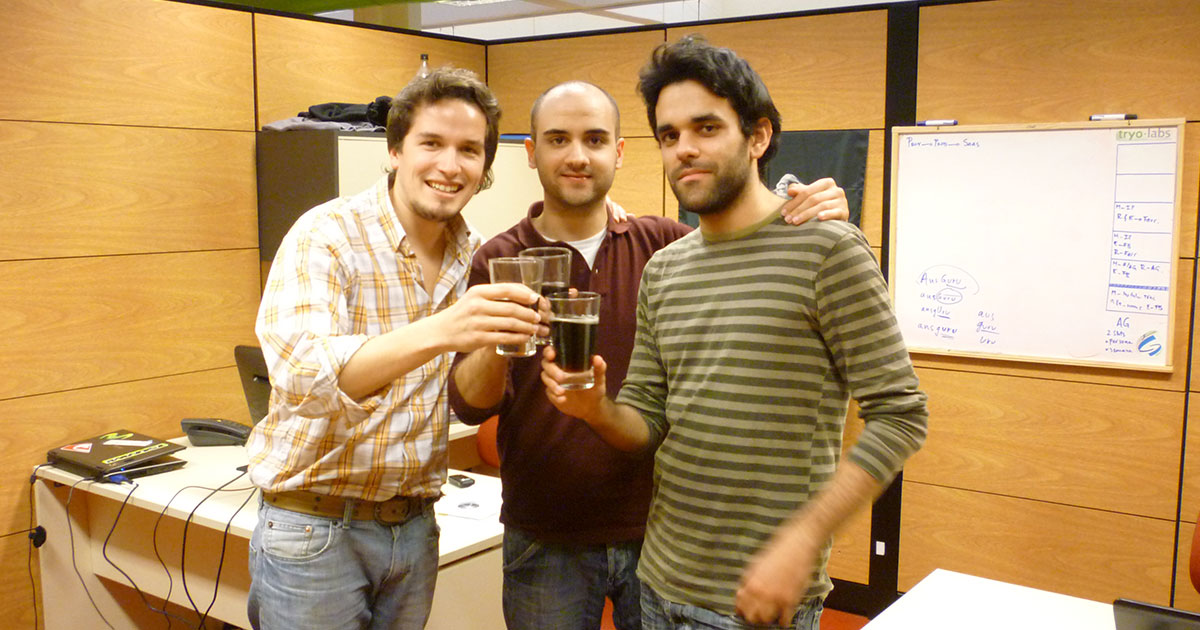
The barbecue space was available. That was its chief qualification as an office. In Montevideo in 2009, Martín Alcalá Rubí, Raúl Garreta, and Ernesto Rodríguez Di Paolo began the venture that became Tryolabs in surroundings better suited to lunch than software. The arrangement had seasonal drawbacks: heat in summer, cold in winter, and almost no roof. Artificial intelligence had found a home. Central heating would have to wait.
It is tempting to treat the grill as an amusing footnote before proceeding to the acquisitions and investment rounds. But it belongs near the center of Alcalá Rubí’s story. He has repeatedly worked at the point where a technical possibility needs a practical arrangement: somewhere to sit, someone to buy it, a way to reach the next customer. The large ideas have required small, rather tangible solutions.
His career has since taken him through enterprise machine learning, a text-analysis platform, consumer AI, angel investing, and music. The music requires its own equipment. Nobody should mistake the guitar for office decoration.
A company with a grill, then a market
The early Tryolabs experiments included Ansguru, a Python application that classified people’s expertise using questions and answers. It did not become the business the founders hoped for. Client development work helped keep the company going. Another product, DayWatch, analyzed the daily-deals market during the Groupon era.
The sequence matters because Tryolabs did not arrive with its eventual identity neatly printed on the door. The founders tested products, earned money through services, and gradually learned where their expertise had buyers. By 2013, text analysis was opening another possibility. MonkeyLearn emerged from that work and later became a separate company.
A makeshift office is a setting, rather than a business model. The useful part of this beginning is the willingness to revise what the company would sell while keeping the working relationship intact. Three founders could change the product. They still had to turn up together the next morning.
The keyboard came before the company
Alcalá Rubí’s technical education began well before university. A Spectrum computer arrived as a childhood gift; using it meant learning commands. Later came computer repairs and programming. By the time he entered engineering, computers were familiar enough that he chose telecommunications and electronics. The career would eventually bring him back to software by a less direct route.
He completed his studies at Universidad de la República in 2005. His final engineering project, UMANIS, was an autonomous robotic manipulator developed with Nicolás de Mula and Andrés Pietrafesa. It was designed to integrate with an existing robot. Intelligence, in that setting, involved a physical arm and constraints on movement, force, and precision.
His early professional roles crossed mobile-network optimization at Ericsson, technical leadership at Security Advisor, and value-added services and charging systems at Movistar. These are useful foundations for an AI entrepreneur: systems have to work, and their behavior has consequences beyond a demonstration. Python became part of his working life along the way.
By 2017, he was leading a company selling AI to more than 100 companies worldwide. The childhood keyboard had become a commercial practice.
A monkey gets a passport
MonkeyLearn took a recurring problem and made it accessible: businesses had text they needed to classify or extract information from, but many lacked machine-learning specialists. The platform let them customize and integrate that work. In 2015, the founders described the choice between doing more individual projects and giving other companies a tool to build with.
That decision changed the audience. A consultancy sells the expertise of its team. A platform has to let customers accomplish something with less direct help from that team. The interface, the demonstration, and the explanation become part of the engineering problem.
In 2015, MonkeyLearn joined 500 Startups’ fourteenth San Francisco batch. Alcalá Rubí described the advantage of being within walking distance of people who could help. If someone arranged coffee for the following afternoon, he could attend. From Uruguay, the same invitation would have been considerably more complicated.
There is an agreeable lack of mysticism in that observation. International expansion sometimes means funding and corporate structures. Sometimes it means being able to get to a café on time. MonkeyLearn was acquired by Medallia in 2022. Its path there included both technical work and the less photogenic work of making introductions.
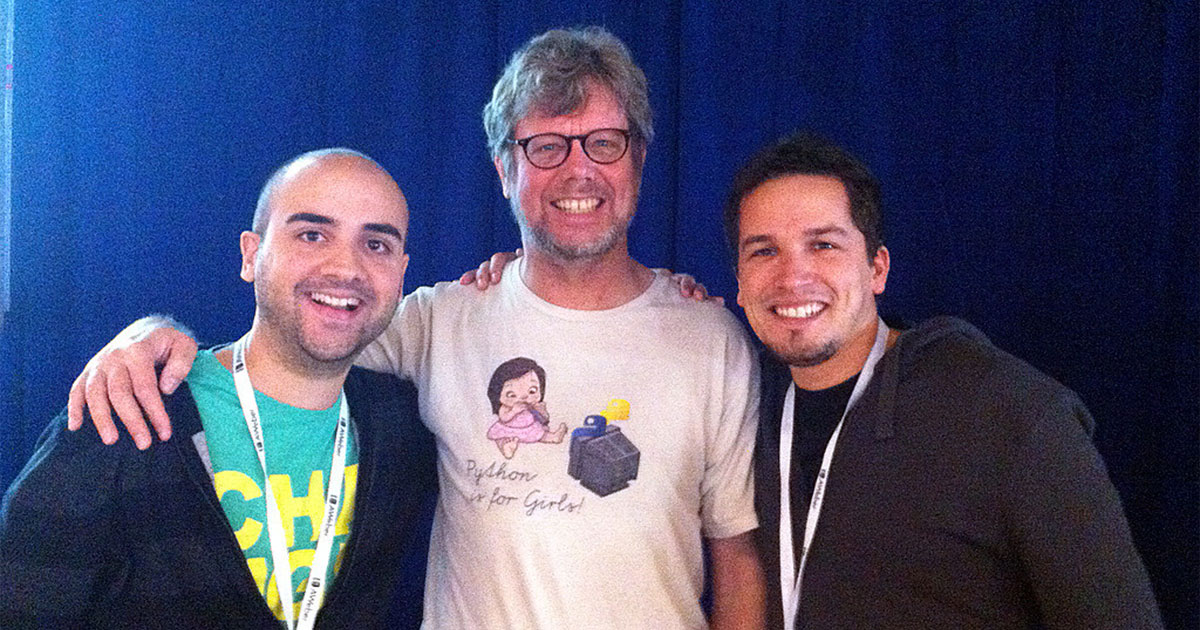
Tryolabs also released Luminoth in 2017, an open source computer-vision toolkit. Its launch addressed the difficulty of turning research into usable software and training models on a company’s own data. The tool’s name came from the Metroid games. A computer-vision project could apparently accommodate an alien reference without losing its commercial purpose.
The bakery recruitment department
Recruiting engineers called for a different sort of distribution. When an advertisement near the engineering faculty proved impractical, Tryolabs put machine-learning puzzles on bakery bags. Students already visited the bakery. Successful solvers could win pastries. The company had found a way into the daily routine of the people it wanted to hire.
The educational connection also had a more sustained form. In 2017, Tryolabs launched a scholarship with Fundación Julio Ricaldoni and Udelar. The original offer combined 60,000 Uruguayan pesos across twelve monthly payments, a laptop, and access to company learning activities. Free university tuition still left students with transport, materials, and living costs.
The amount belongs to that 2017 offer. The principle is broader: a place in a classroom does not by itself pay for getting there. For a company dependent on engineers, support for students connects the future workforce to the circumstances of actual people.
Alcalá Rubí also became an angel investor. A 2023 Urucap directory lists AI and deep tech as his investment interests and names companies including Foliume, Meitre, Loog Guitars, and Rewind AI. In 2020, he recommended Jason Calacanis’s book Angel. Building a business had expanded into helping evaluate other people’s beginnings.
In November 2019, Uruguay’s engineering association gave him a special recognition for his professional work. The association’s annual record places the ceremony at the Club de Golf del Uruguay. The barbecue venture had acquired a rather more formal venue.
“Make it happen”
The words on Alcalá Rubí’s early Tryolabs business cards.
A guitar in the other carry-on
Alongside the engineering work, Alcalá Rubí makes music as Damoosic. The project combines pop and hip-hop elements with acoustic guitar and live drums played by Gabriel Acosta. Its biography describes a working musician and producer, rather than a founder occasionally borrowing a microphone at a company party.
The Camino EP arrived in 2019, produced by Sebastián Peralta. Damoosic presented it at Montevideo’s Antel Arena before performances in Spain and the Netherlands. The video for Jugar was filmed in Amsterdam. Travel could now involve a stage as well as a meeting.

In December 2020, Primavera joined that body of work, again produced by Peralta. The song had been two years in the making. There is no need to turn that into a theory about startups. It is simply another project to which he gave time, collaborators, and an eventual release.
The distinction gives the biography some welcome air. A founder’s interests can become achievements in their own right. The songs have listeners; the companies have customers. Both deserve their proper names.
An assistant that speaks the neighborhood
In 2023, Alcalá Rubí co-founded BrainLogic AI, the company behind Zapia. The new audience was the consumer in Latin America. Zapia initially worked through WhatsApp, accepting text and audio requests and offering a familiar route into AI.
His 2024 description of the ambition was grounded in everyday errands: finding somewhere to eat, checking what was showing locally, locating a hairdresser. He imagined the assistant eventually making a reservation as well as finding an answer. An intelligence system would need to understand the neighborhood in which its user lived.
The founding team brought together Nicolás Loeff, Juan Pablo Pereira, Juan Olloniego, and Pablo Rodríguez alongside Alcalá Rubí. Today, Zapia identifies Pereira as CEO and Alcalá Rubí as co-founder and former CEO. A founding role and the current operating role are different entries in the same company’s life.
In a May 2024 interview, Alcalá Rubí expressed his support for Latin American technical talent. His ambition was to create products from the region, drawing on its engineers and institutions. Years of selling expertise abroad had led to a product intended for people closer to home.
“Soy muy hincha del talento latinoamericano.”
Martín Alcalá Rubí, 2024. “I’m a big supporter of Latin American talent.”
- 2009Tryolabs begins
- 2013MonkeyLearn emerges
- 2019The Camino EP
- 2023Zapia’s founding chapter
- 2026Tryolabs joins Qubika
Selected milestones across software and music. The 2009 date marks Tryolabs’ early venture; its acquisition announcement dates the company’s formal founding to 2010.
The next experiment is already open
By March 2026, Zapia reported more than six million users in Latin America and US$19.3 million in cumulative funding. Its newly announced US$7 million extension would support Zapia Max, intended to execute tasks with permissions and user controls. The company had also moved users toward its own mobile application following changes to WhatsApp’s platform policies.
On August 12, 2026, Tryolabs announced that it was joining Qubika. Alan Descoins, Tryolabs’ CEO, became Qubika’s chief AI officer. The business that began with improvised space now belonged to a larger engineering organization, with its work extending across machine learning, computer vision, and generative AI.
Alcalá Rubí’s own public project notebook gives the present chapter a more personal scale. Its experiments include creative AI tools, a digital pádel companion, and Alcatz, a game made with his family. The list makes room for work whose audience may be quite different from an enterprise customer.
The grill has long since served its purpose in this story. The habit it represents is still recognizable: find somewhere to work, bring people into the project, and see what can be made there. Sometimes the result becomes a company. Sometimes it becomes a song. The next item in the notebook is allowed to be either.
Follow the work, hear the music
Projects, conversations, and further reading.