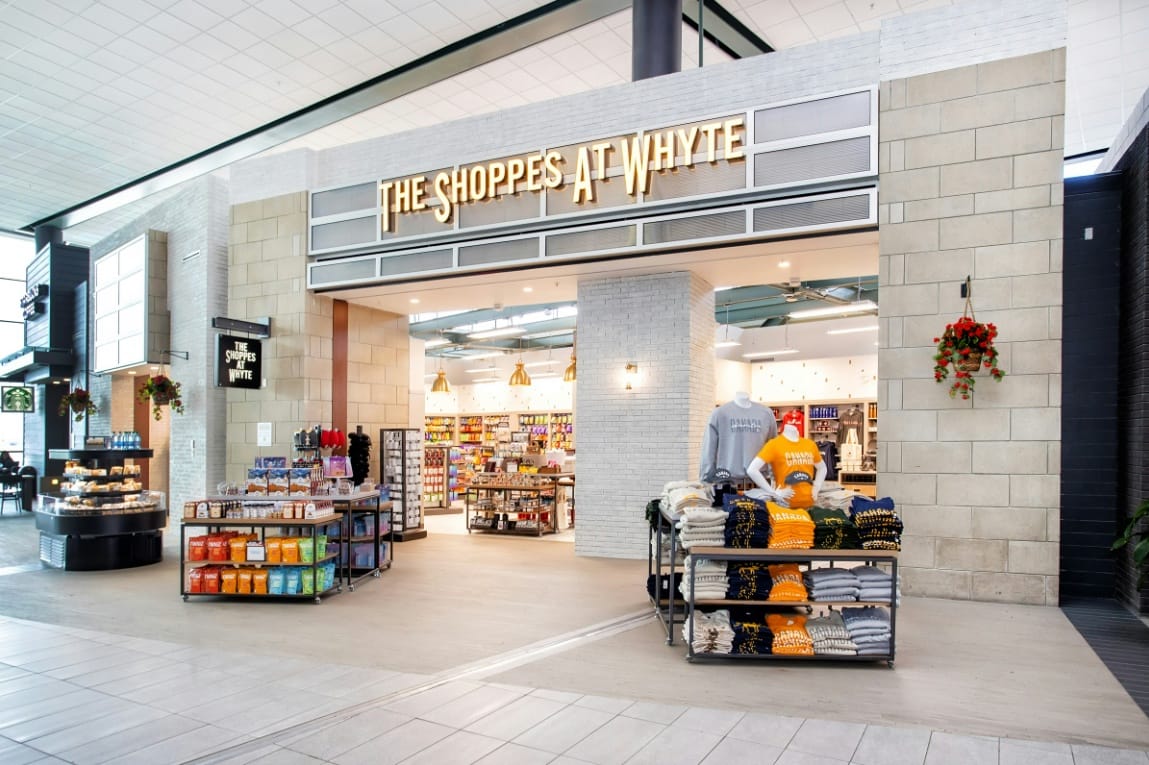
At Edmonton International Airport, a shop called Postcards from Edmonton decorates its space with old suitcases and trunks. Nearby, The Shoppes at Whyte borrows its name from a city avenue and greets travelers with a mural by local artist Adriana Cruces. The shelves include Alberta candles, leather handbags and chocolates. These are airport shops with unusually specific hometown references. Their operator belongs to a British retail group.
- MRG builds and runs stores for airports and resorts, selling essentials, gifts and branded goods.
- Its local identities sit on a shared retail operation.
- WHSmith bought it in 2019; the parent is now reducing resort fashion exposure.
Marshall Retail Group’s useful trick is that the sign above the door need not advertise the company doing the work. A traveler can buy something that feels particular to Edmonton while the operator draws on a much larger organization. Local specificity and corporate scale share a checkout. That arrangement is the starting point for understanding MRG.
A Las Vegas education
The business began somewhere equally attentive to visitors. In 1955, Art Marshall and his brother-in-law Herb Rousso established Marshall-Rousso in Las Vegas. UNLV’s historical account traces the family’s clothing business to Sara’s of Las Vegas, owned by Marshall’s father-in-law. Expansion eventually brought the company into Strip hotels, beginning with the Sahara Hotel and Casino in 1964.
A resort concentrates people who are temporarily away from home. They need ordinary things, and they also want objects that mark the trip. Airports present a related opportunity, with a sharper deadline. A traveler who needs a snack before boarding cannot treat delivery tomorrow as an equivalent offer. The value of the shelf includes its position in the journey.
MRG grew into an operator of several kinds of shops: souvenir and sundry stores, fashion and accessories, and licensed brands. It learned to supply different storefronts rather than insist on one identity. By 2014, when Brentwood Associates acquired it, the company had 155 locations across ten states and Washington, DC.
Two customers, one storefront
The person buying the chocolate is only one customer. The airport or resort choosing a retail partner is the other. MRG supplies the practical machinery: concepts, design, sourcing, distribution, merchandising and store operations. For a landlord, the attraction is a retailer able to carry an idea from drawing to daily trading.
At LaGuardia Terminal B, the 2020 opening of Bowery Bay Shops made that proposition tangible. Its 15,000 square feet brought together names including Brooklyn Roasting Company, Magnolia Bakery and Strand Book Store. A separate, 5,000-square-foot menswear concept, The DEAN, addressed another shopping occasion. One operator could present both a New York marketplace and a different specialist format.
“a true New York City shopping experience”Stewart Steeves, LaGuardia Gateway Partners, on the 2020 opening
The range stretches beyond local souvenirs. MRG announced the first US airport LEGO store at Salt Lake City in December 2020. In 2021, its partnership with The Neon Museum put Las Vegas sign history into a Harry Reid International Airport shop. Stardust-inspired merchandise makes a different promise from a bottle of water, even when both belong in travel retail.
Speed is another part of the offer. In February 2022, a WHSmith store at LaGuardia introduced Amazon’s Just Walk Out technology: customers entered using a payment card, took their items and left without a conventional checkout queue. The launch addressed a specific friction in a place where time matters. It also illustrates the distinction between MRG’s operating expertise and the wider group’s collection of brands and technology partners.
The price of a boarding pass
Ownership changed several times as the business expanded. ICV acquired Marshall from the family in 2003, sold it to BRS in 2005 and bought it back in 2008. Brentwood followed in 2014. During Brentwood’s ownership, MRG’s airport presence increased from eight airports to 15. By the announced sale in 2019, more than 170 stores included 70 airport locations.
Approximate announced acquisition price. WHSmith’s accounts subsequently recorded a $402 million total cash payment.
WHSmith completed the acquisition that December. It had bought electronics retailer InMotion the previous year. The distinction matters: InMotion and MRG sit within the same North American business, but InMotion was a separate purchase. Combining their footprints into an MRG-only store count would make the story tidier and the numbers misleading.
The places that stopped paying
Having visitors nearby does not guarantee profitable retail. WHSmith’s December 2025 review identified unprofitable resort fashion and specialty stores. In April 2026, it described a controlled exit from fashion and reductions in specialty shops, with lease terms helping determine the sequence. The company was also strengthening financial controls across North America after accounting problems. Scale had brought operational complexity alongside opportunity. In August, Inside Retail reported that Maceoo had acquired WHSmith’s fashion division, including 13 stores.
The September 2026 update showed the divide. North American Air revenue rose 13% in the fourth quarter, while Resorts fell 26%, both in reported currency. Resort closures contributed to that decline. Airport like-for-like revenue still slipped 2%, reflecting weaker passenger volumes and demand. These are parent-division figures, but they make the strategic pressure visible: opening space can lift total sales while existing shops soften.
MRG competes in a market that includes Hudson and other airport concessionaires. Its pitch to a landlord depends on turning shared retail capabilities into several distinct storefronts. The local assortment is part of that differentiation, alongside licensed brands and the ability to run the shops after opening day.
What travels well
For another retailer, the transferable idea is an inference: standardize the work customers do not see, then spend attention on what makes a location recognizable. Edmonton’s local makers, New York’s books and Las Vegas’s signs give the proposition substance. A place name above generic shelves would be a thinner version.
Copying it requires more than attractive design. The location needs enough spending, the merchandise needs to suit the journey, and the occupancy agreement must leave room for profit. MRG’s resort retreat supplies the qualification. A concentrated audience helps; it cannot rescue every format. The question behind the inviting storefront remains wonderfully ordinary: will enough people buy the right things to keep this particular door open?