An insurance company can promise to look after money for decades and still take an age to make a decision on Tuesday. Mark Pearson saw room to shorten the second timescale. Equitable, the New York institution he had led since 2011, was preparing for life outside AXA. It needed its own habits, its own priorities and a less exhausting journey between a useful idea and the person allowed to approve it.
Pearson would later describe cutting the company’s hierarchy from 26 levels to five. That is a rather substantial renovation. In a business whose raw material is a promise about the future, however, removing layers requires more care than removing wallpaper. People need enough authority to act and enough discipline to understand the consequences. His career at Equitable has revolved around that uneasy, productive combination.
By October 2026, the renovation has acquired a new dimension. Equitable and Corebridge Financial have agreed to combine. Shareholders have approved the transaction; completion remains subject to regulatory approvals and other conditions. Pearson is due to become executive chair, with Corebridge’s Marc Costantini taking the chief executive role. The next question is how much of the house Pearson rebuilt can travel.
An accountant takes the long route
Pearson reached the American chief executive’s office through an international insurance career. His earlier employers included Hill Samuel, Schroders, National Mutual and Friends Provident. He joined AXA in 1995 when it acquired National Mutual, became regional chief executive of AXA Asia Life in 2001, and ran AXA Japan from 2008 to 2011. He is a fellow of the Association of Chartered Certified Accountants.
That sequence matters. Pearson’s route ran through established businesses, acquisitions and different markets. He inherited organizations with histories and obligations already attached. The task was to make them work under new circumstances. In January 2011 he joined Equitable Holdings’ board; the following month he became chief executive of Equitable. He had arrived at another institution with a considerable past.
His early American interviews sound interested in the machinery of service. In 2012 he talked about customers moving between advisers, call centres and mobile devices. Selling an inventive product was only part of the job. Distribution and explanation mattered too. An investment feature has little practical value if the person buying it cannot understand how it fits into a life.
A mural makes its exit
One of Pearson’s early New York decisions involved a different sort of long-term asset. Thomas Hart Benton’s ten-panel mural cycle, America Today, had spent years in the company’s Manhattan headquarters. Created in 1930-31, it filled its world with workers, machines and the restless activity of American life. Equitable had acquired the work in 1984, helping keep the panels together in New York.
A lobby renovation forced the mural’s removal. In December 2012, Pearson and Metropolitan Museum director Thomas P. Campbell announced that AXA Equitable was giving it to the museum. The corporate lobby’s loss became the public gallery’s gain. There are less useful ways for an insurer to deal with a decorating problem.
For Pearson, the work represented American ingenuity and working people. The gift also gave permanence to an earlier effort to preserve it in the city. When he discussed the decision the following year, he described his own attachment to New York after working around the world. It is a small but revealing detour in a career otherwise recorded in appointments, business lines and balance sheets.
Thomas Hart Benton’s America Today moved from Equitable’s collection to The Metropolitan Museum of Art.
Independence comes with homework
The 2018 stock-market flotation changed the context of Pearson’s American job. AXA was selling shares in the business that became an independent Equitable. The IPO launch documents made the mechanics plain: AXA was the selling shareholder, and the company itself would receive no proceeds from the offering. A debut on Wall Street could create a new identity without depositing a fresh pot of spending money in the operating company.
The first year brought tangible financial results. Equitable reported about $2.2 billion in non-GAAP operating earnings for 2018 and more than $1 billion returned to shareholders since the IPO. Those measures offered one account of the separation. Inside the business, a second task remained: deciding how a newly independent organization should behave once the celebratory photographs were taken.
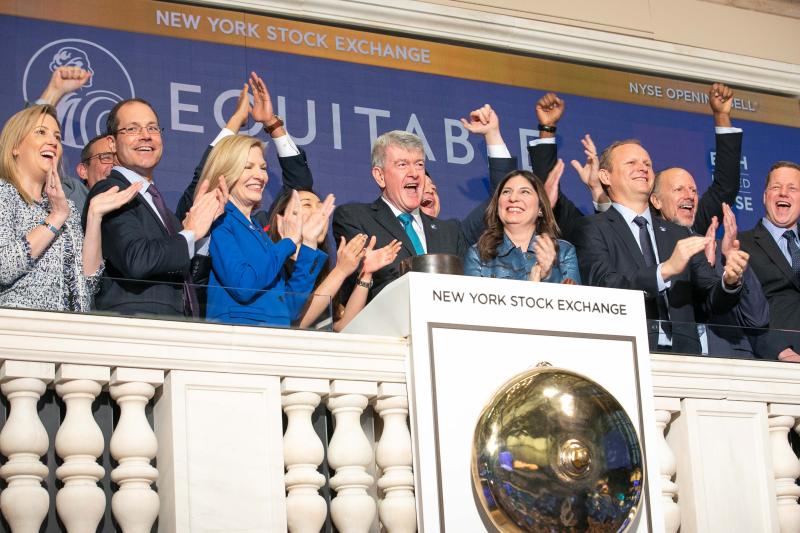
The name changed in January 2020, when AXA Equitable Life unveiled its Equitable identity. Pearson rang the New York Stock Exchange bell to mark the occasion. The old name returned to prominence, accompanied by a new visual identity. Branding could announce independence in a morning; changing daily working habits would require rather more mornings.
The house he wanted to live in
Pearson’s phrase for the ambition was domestic: “build the house we wanted to live in.” The programme became New Ways of Working. Its ingredients included objectives and key results, adaptive leadership, design thinking, enterprise agile practices and changes to the structures supporting employees. The names belonged to management; the underlying concern was familiar to anyone who has waited for a decision.
The rollout had a measurable progression. Equitable’s 2021 proxy recorded implementation across a third of the organization during 2020. The following proxy said more than half was operating in the framework by the end of 2021. Those milestones are useful because organizational change usually arrives with an abundance of verbs and a shortage of dates. Here, the company had put dates against its own adoption.
In his 2023 responsibility report letter, Pearson described the framework as something built within Equitable and extending across the organization. Giving employees a role in shaping the company was part of the employment proposition. That shifts the meaning of participation. Staff were being asked to influence how work happened, as well as complete whatever work arrived.
The tension is especially sharp in insurance. Faster decisions can improve service, but a company that takes risks for a living still needs controls. Pearson put it succinctly: “Adaptive leadership helped us strike the right balance between empowerment and risk management.” Freedom and accountability have to survive in the same room. Otherwise, a shorter approval chain merely delivers a mistake more efficiently.
“Adaptive leadership helped us strike the right balance between empowerment and risk management.”Mark Pearson
What changes when people can act
The programme’s delivery partner, Intent-Based Leadership International, reports that Equitable trained more than 30 internal coaches and had reached 80% adoption of New Ways of Working by 2025. Its case study also records operations employee Net Promoter Score moving from 0.7 to 29.5, and $70 million of additional Group Retirement sales. These are reported programme outcomes, rather than proof that one management intervention caused every improvement.
A separate account of the business gives the idea a practical setting. In an Oliver Wyman conversation, Equitable president Nick Lane described volunteers from different disciplines working together on problems. He pointed to a team tackling the mathematics behind a retirement-income solution connected to BlackRock. Actuarial, finance and marketing skills could gather around the problem instead of waiting for it to travel through their departments.
That account makes Pearson’s interest in structure easier to understand. A complicated client need can cross several professional boundaries before lunch. A company organized entirely around those boundaries risks spending the afternoon arranging introductions. Bringing expertise together earlier offers a way to preserve specialist knowledge while making it more useful to the customer.
The financial work continued alongside the organizational work. In 2021 Equitable closed a variable-annuity reinsurance transaction with Venerable, reporting $1 billion of economic value unlocked. It also announced an $80 million expense-saving target for 2023. Pearson’s tenure combines these two forms of engineering: changing the balance sheet and changing the way the people responsible for it work together.
Share of the organization using the framework. 2020 and 2021: Equitable proxy disclosures; 2025: implementation partner’s reported adoption. The 2021 bar marks the reported lower bound.
A larger house, a different chair
The Corebridge agreement, announced on March 26, 2026, proposes another change of scale. At announcement, the companies put the combined business at more than 12 million customers and $1.5 trillion in assets under management and administration. Those are combination figures, not a count of Pearson’s personal clients or a measure of his wealth. Their significance is the breadth of the organization he would help oversee.
The proposed leadership arrangements are unusually clear. Costantini would become president and chief executive; Pearson would be executive chair. The combined company would retain the Equitable name and ticker and be headquartered in Houston. Pearson’s New York chapter would therefore lead into a business with a familiar name, a different headquarters and a different division of responsibility at the top.
On July 30, both shareholder groups approved the deal. Preliminary counts showed support from 97.24% of Equitable votes cast and 99.96% of Corebridge votes cast. Approval was a significant milestone, while the closing conditions remained. The distinction matters for a profile of someone whose next title depends on a transaction: executive chair is the planned destination, rather than his present job.
Announcement figures for Corebridge and Equitable combined. Shareholders approved the merger in July; completion remains conditional.
Promises still have to add up
There is ordinary operating business beneath the merger’s large numbers. For the second quarter of 2026, Equitable reported a $453 million net loss attributable to Holdings alongside $488 million in non-GAAP operating earnings. It also recorded net inflows in retirement, wealth management and asset management. Reading both earnings measures keeps the picture more useful than selecting whichever number best suits the occasion.
Pearson’s letter accompanying the 2025 annual report looks ahead to supporting Costantini and the management team after completion. It also thanks clients, shareholders and colleagues. His stated ambition remains connected to the business he already runs: helping people prepare for retirement and delivering value over time. The new chair would inherit a larger setting for those familiar obligations.
The interesting test of Pearson’s work will be what employees can do when he is further from the daily decision. Can expertise reach the right problem? Can a team act without losing sight of risk? After years spent reducing the distance between an idea and an answer, he is preparing to occupy a different chair. The house will have to show how well its new habits hold.