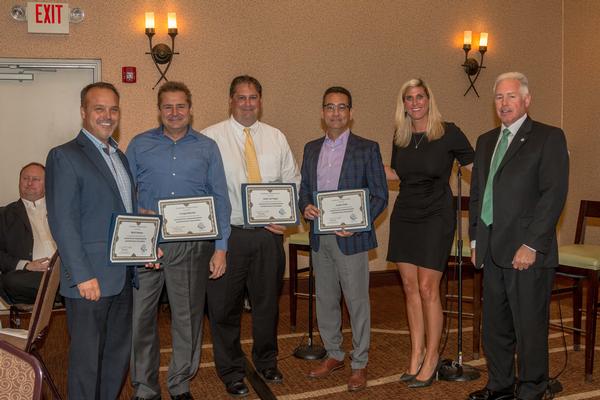
In the photograph, Mark Human stands at the far left, holding a framed certificate. Five other participants stand beside him. Behind them are wall lamps, banquet chairs and an exit sign. The subject of the gathering was cloud migration. The setting was considerably closer to earth.
It was August 2019, at a luncheon of AFCEA’s Dayton-Wright chapter. More than 100 people came to hear Air Force and industry representatives discuss moving systems to the cloud. Human, already president and CEO of HumanIT Solutions, moderated the panel. John Garringer and Lenny Getts represented the Air Force; Craig Kabealo represented Development Consultants Incorporated.
A moderator occupies an interesting position in a technology business. The job requires enough understanding to ask a useful question, and enough restraint to let somebody else answer it. That afternoon offers a concrete entry into Human’s working world: people from different organizations, gathered around a technical problem that none of them could settle with a slogan.
HumanIT was founded in 2016. Three years later, its chief executive was helping convene a conversation among potential collaborators and customers. Read the photograph that way and the certificate becomes the least interesting thing in it. The relationships are the story.
A career with institutions attached
Human is a United States Air Force veteran. He now leads a company that integrates and implements enterprise technology, including work supporting Department of Defense missions. There is a continuity in those facts. His professional world has kept large institutions, their systems and their operational needs close together.
His LinkedIn profile places him in the Dayton metropolitan area and lists the University of Maryland University College, with study dates of 2012 to 2016. It also uses the descriptions chief technologist and enterprise strategist. Those terms help locate his work between the engineering of a system and the decisions about what an organization should do with it.
That is an awkward border to inhabit. Engineers need requirements they can implement. Customers need systems that fit their work. Executives need a reason for the investment. A project can satisfy one group and still disappoint the others. Human’s combination of technical and executive responsibilities puts him in the middle of that negotiation.
At HumanIT, he is co-founder, president and chief executive. The company is based in Beavercreek, Ohio, and serves government and commercial customers. Its business includes systems integration, software modernization and the maintenance of applications that organizations continue to depend on. Even the vocabulary makes a useful point: after the launch comes the obligation to keep things working.
The audience grows beyond the luncheon
The growth became visible outside the company. HumanIT entered the Inc. 5000 at No. 513 in 2021, then reached No. 498 in 2022. It continued to appear in 2023, 2024, 2025 and 2026. The latest entry lists 95 percent growth over three years.
Those six appearances trace a business expanding over successive measurement periods. They do not describe a straight climb up a league table. The rank moved to No. 1,008 in 2023, No. 2,399 in 2024, No. 3,877 in 2025 and No. 3,164 in 2026. Growth rankings compare companies; they are hardly a personality test for their founders.
A separate local milestone put Human in another photograph. On October 10, 2024, he appeared with Dayton Business Journal publisher Cory Earl at the publication’s fastest-growing companies event at NCR Country Club. HumanIT placed second in the Dayton ranking that year. Coverage described average growth of 50 percent across four years and revenue approaching three times its 2020 level.
In November 2025, the company was recognized as Dayton’s Veteran-Owned Business of the Year. The sequence gives Human’s work a public chronology: a new company, a technical community gathering, repeated national growth recognition and a local business award. It also keeps the honors in their proper place. These were company achievements, shared with the people doing the work.
NASA has paperwork, too
For an example of what that work involves, consider NASA’s contract management. Space exploration brings rockets to mind. Procurement brings requirements, approvals, contract documents, workload allocation and reporting. The latter has fewer admirers, but an agency still has to buy what it needs.
HumanIT worked with NASA and Appian on the NASA Contract Writing Management System, known as NCMS. The company describes the application as supporting contract writing, administration, workload management and data reporting. These are ordinary sounding functions with a considerable institutional burden behind them: many people need to use the same information without losing track of what happens next.
Human attended Appian World 2025 in Colorado with Kevin Kiser, HumanIT’s director of public sector. NASA’s Stephen Shiplett presented the partnership’s work. In a public comment on the company’s conference post, Human expressed pride in the team and its accomplishments. The response assigns the achievement to a group. It is also refreshingly shorter than most software announcements.
NASA returned to the subject at Appian World in April 2026. HumanIT’s account described this as the second consecutive year the agency had presented its work with the company. An Appian session on NASA’s procurement workforce described a unified platform launched in nine months, using a phased rollout and implementation partnerships.
A public conference also changes the audience for that work. A project discussed inside one agency becomes something other organizations can examine. The presentations in 2025 and 2026 give the NASA relationship a visible life beyond a single announcement, while keeping attention on the system and the workforce using it.
The appeal of the example lies in its practical scale. A procurement platform has to support a workforce as well as a process. Contract writing, administration and reporting belong together because the work itself belongs together. For Human, the NASA relationship puts a recognizable customer beside the less recognizable labor of integrating institutional software.
“Very proud of the team and our accomplishments!”Mark Human, commenting on the Appian World 2025 partnership presentation
What a company promises its people
There is another way to examine a technology executive’s business: read what it offers the people expected to deliver the projects. HumanIT advertises 20 days of leave and 11 federal holidays, including three floating holidays. It also describes an annual employer retirement contribution of approximately five percent, whether an employee contributes or not.
These are concrete recruitment commitments. A prospective employee can ask about them, compare them and decide whether they matter. They give more substance to a company’s account of its culture than a page full of cheerful adjectives would manage. The calendar, at least, can be checked.
The careers material also emphasizes training and certifications, flexibility, team outings and community projects. Recruiting and retaining veterans is an explicit priority, including members of the National Guard and Reserve. Human’s own military background sits within that wider employment policy; the company describes veterans from every branch as part of its workforce.
For a services company, this belongs close to the customer story. People carry the technical knowledge and the knowledge of how a particular organization works. An employee who understands a customer’s processes can bring something to a project that a product demonstration cannot show. The hiring proposition and the delivery proposition meet at that person’s desk.
An invitation before the company
One small item on Human’s LinkedIn profile predates HumanIT. In July 2015, he published an invitation to the sixth annual SMGA golf outing, scheduled for September 11 that year. He addressed both individuals and their companies. Before the business had its 2016 founding date, he was already using a professional network to invite people to a community event.
His current leadership biography names the Salute Military Golf Association among the initiatives he supports, alongside Dayton Special Olympics. It also lists membership in AFCEA and Technology First, and describes his mentoring of small disadvantaged businesses seeking relationships and opportunities in federal contracting.
Taken together, these activities show several kinds of connection: a professional association, a regional technology organization, community support and guidance for other businesses. They should not be turned into an invented scene of a typical weekend or a grand theory of his private character. The visible actions carry enough interest on their own.
The mentoring is especially relevant to his working terrain. A smaller business approaching the federal market needs to understand organizations and relationships as well as technology. Human has chosen to spend some of his experience helping other businesses navigate that terrain. There is a connection between the moderator’s seat in 2019 and that work: both involve helping people enter a conversation.
The next useful question
Human’s stated professional priorities include aligning technology with customer needs, protecting critical assets and encouraging further training. Cloud architecture, data management, cybersecurity and program management all appear in that account. They describe an agenda for continuing to learn while running a business whose customers must also keep operating.
By 2026, the public milestones include six consecutive Inc. 5000 appearances and a NASA partnership discussed at two successive Appian conferences. Those markers provide scale and continuity. The personal thread remains the same one visible in the earlier luncheon: Human working where technical expertise meets an organization’s expectations.
The photograph is worth returning to. There is no product on a pedestal. There are people from different institutions, lined up after a discussion about how to change the systems they depend on. Human stands among them with his certificate. Somewhere beyond the photograph, there is more work to do, and another useful question to ask.