Mark George’s early assignment at Otis Elevator involved putting barcodes on office furniture. New furniture arrived; someone had to account for it. The future railroad chief also handled accounts-payable vouchers and chased signatures. It was a modest introduction to the machinery of corporate life, with rather more furniture than glamour.
He responded by suggesting ways to change procedures and automate the tasks. There was an awkward possibility: success might remove his own position. He pressed on anyway. Instead of becoming unnecessary, he became useful for something else. Solving one problem brought him another.
That small episode offers a way into a career that eventually reached the presidency of Norfolk Southern. George keeps returning to the inconvenience inside an accepted process. First came the question of why a young finance employee had to do so much by hand. Decades later, the question concerns why freight crossing America must change railroads.
An industrial education, with six years in Asia
George arrived in rail with a working life already behind him. He earned a bachelor’s degree in finance at Central Connecticut State University and an MBA at Rensselaer Polytechnic Institute. His professional education continued inside United Technologies, whose businesses gave him a view of industry beyond a single product or market.
He spent six years in Asia as a regional finance chief for Otis. Over the period from 2008 to 2019, his responsibilities included global CFO roles at Carrier and Otis. Elevators, building systems and freight trains have different customers and operating demands. Each also forces a finance leader to reckon with the physical business underneath the accounts.
On November 1, 2019, George joined Norfolk Southern as its finance chief, succeeding Cynthia Earhart. He would spend nearly five years in that job before becoming CEO. The move gave him time to learn the railroad from inside: its investment choices, its costs, its promises to investors and the strategic decisions that tied those things together.
His connection to the wider industrial world continued. In October 2022, he joined Trane Technologies’ board as an independent director. The appointment came while he was still Norfolk Southern’s CFO. Rail had become his day job; it had not erased the rest of his professional vocabulary.
- Otis + CarrierIndustrial finance
and global CFO roles - 2019Norfolk Southern
Chief Financial Officer - 2024Norfolk Southern
President and CEO
A promotion without a quiet first week
The board appointed George president and chief executive on September 11, 2024, after dismissing Alan Shaw following an ethics investigation. George also joined the board. A succession plan became an immediate responsibility, with little room for the ceremonial version of taking charge.
He inherited a company that had endured the 2023 East Palestine derailment and a contested shareholder campaign. The job carried obligations to customers, employees, communities and investors who had different reasons to demand improvement. An executive could not satisfy all of them merely by making a persuasive first appearance.
The independent directors chose him unanimously. His years as CFO meant that the company’s finances and strategic commitments were familiar territory. Running the whole enterprise brought a wider test: whether he could turn that familiarity into consistent decisions across a railroad.
Two days after his appointment, at an investor conference in Laguna Beach, California, he was already discussing operational standards. There was no elaborate theory of leadership to decode. The new chief wanted the railroad to serve customers well enough that they would keep sending it freight.
The customer is allowed to leave
George’s early public remarks had the impatience of someone who had worked in other industries. He had seen businesses where operational shortcomings received little indulgence. Rail customers, he argued, had alternatives. Poor service carried a commercial consequence, however impressive the network might look on a map.
He praised the problem-solving rooms established under then-COO John Orr: teams using screens to identify breakdowns, examine causes and work toward lasting fixes. What interested George was the method. An explanation for yesterday’s failure had limited value if the same failure returned tomorrow.
His comments about information technology were similarly practical. Having data did not mean that the people running trains could easily use it. He wanted operational information available through the organization, including to trainmasters in the field. The distinction matters in a business where a delay becomes someone else’s problem down the line.
By January 2025, George was making a more optimistic case on television. He pointed to train speeds up about 10 percent and volume growth of 5 percent during 2024. His argument linked operating performance to the ability to accept more business. A faster network could give the commercial team something tangible to sell.
“We’ve got really good productivity momentum right now.”
Mark George · January 2025 CNBC interview
Two CEOs, several conversations, one proposal
The next turn was considerably larger than a process improvement inside Norfolk Southern. On July 29, 2025, the company and Union Pacific announced their proposed combination. George and Union Pacific CEO Jim Vena then faced the inevitable question about the deal’s beginnings. Had it started over an expensive steak?
The explanation was less cinematic. The two had held a series of conversations about their companies and the industry’s prospects. A relationship developed into a proposal to connect their networks. There is a certain appropriateness in a railroad transaction beginning with repeated exchanges rather than a single grand arrival.
The proposed system would span roughly 50,000 route miles across 43 states. Those dimensions describe an ambition, not a completed network under common ownership. For George, the commercial attraction lay in giving freight a continuous journey through businesses that currently have to coordinate across company boundaries.
Alongside Vena, he took that case into interviews with national and trade outlets. The CFO who had once explained a railroad’s financial performance was now helping sell a change in its corporate future. He also emphasized deliberate integration planning. Combining organizations on paper would be only the beginning of the work.
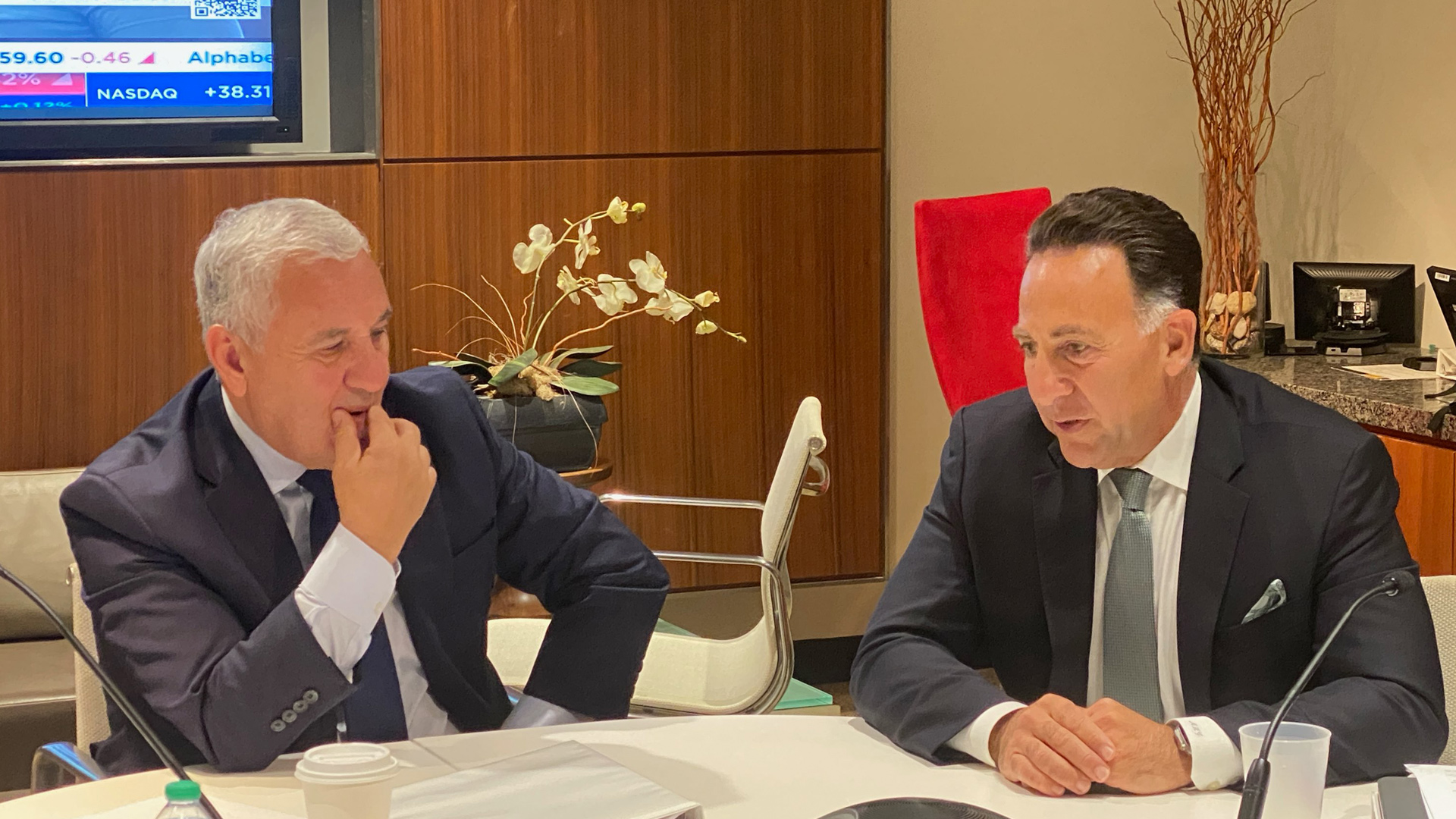
The luggage problem, applied to freight
In a television interview, George reached for an experience more familiar than a rail interchange. Imagine flying west from New York, reaching Chicago and having to leave one airline for another. The second leg requires another ticket. Vena supplied a further annoyance: transferring the luggage.
The analogy made an industrial process feel personal. A passenger experiences a connection as waiting, uncertainty and extra handling. George wanted listeners to think about freight in similar terms. A boundary between companies can become an interruption for the customer, even when it is perfectly ordinary to the companies themselves.
This is also where his merger argument becomes a proposition to be tested. Removing a handoff sounds attractive. Customers still need dependable service, usable connections and competitive choices. A journey that looks simpler in a diagram must become simpler for the shipper booking it. The merit of an analogy lies in how clearly it explains the problem; the result must be demonstrated in operations.
railroad→Interchange→Eastern
railroad
The timetable belongs to somebody else
George continued pressing the growth argument in April 2026, speaking to the American Short Line and Regional Railroad Association in Minneapolis. He described an industry struggling to recover freight from trucks. He also acknowledged the difficulties of past integrations and the work needed on the pending application.
His focus on interchange delays connected his earlier interest in processes to a much bigger organizational choice. The proposed remedy now involved ownership. That raised questions which a manager could not settle simply by deciding that the existing arrangement was inefficient.
The regulatory record supplies the necessary punctuation. In January 2026, the Surface Transportation Board rejected the initial application as incomplete. It expressly said that decision did not indicate how a revised application might ultimately be judged. A revised filing followed in April.
In August, the board adopted a procedural schedule and removed the proceeding from abeyance. In September, it denied motions seeking summary rejection. An October 6 decision accepted late descriptions of anticipated responsive applications. As of October 21, 2026, review continued. Each procedural step mattered, but none amounted to final approval. George could advocate a destination; he could not issue the regulator’s timetable.
The railroad still has to run on Tuesday
In June 2026, George published an essay called “The Long and Short Game.” Its subject was the tension built into his job: operating the present company while pursuing a different future. Customers sending freight today have no reason to accept a merger presentation as a substitute for service.
He acknowledged that some recent performance had fallen short of customer expectations and the company’s own. Brian Barr, appointed COO effective June 1, was leading the operations team. George’s willingness to name the shortfall gave the essay more substance than a declaration that everything was proceeding to plan.
The July results illustrated why the daily job resists a tidy victory narrative. Second-quarter revenue reached $3.5 billion, up 11 percent, with freight volume up 4 percent. Six percentage points of revenue growth came from higher fuel surcharges. Revenue alone could therefore tell only part of the story.
Reported income from railway operations fell 4 percent to $1.1 billion. On the company’s adjusted basis, which excluded specified charges and incident effects, it rose 5 percent to approximately $1.2 billion. For a former CFO, the distinction is familiar. For everyone else, it is a useful reminder to read past the largest number.
The two jobs continue together. George must make a case for a future network while being accountable for the one customers use now. The early habit of looking for an avoidable inconvenience remains recognizable. The scale has changed, along with the number of people entitled to examine his proposed solution. A barcode was a small problem. Crossing a continent comes with rather more paperwork.
Follow the conversation
- Mark George on LinkedIn
- The Long and Short Game · George’s essay
- Norfolk Southern · official website
- A Mandate to Improve · career interview and audio
- George and Vena · FreightWaves video interview
- The proposed merger · STB proceeding
- Second-quarter 2026 results
- Norfolk Southern on Instagram · company account
- Norfolk Southern on X · company account
- Norfolk Southern on Facebook · company account
- Norfolk Southern on YouTube · company channel