At lunch at Lure Fishbar in SoHo, Mark Egerman ordered a Niçoise salad and helped himself to fries from Andrew Cove’s burger plate. The two were building Cover, an app for settling restaurant bills. Apparently, the boundary between one person’s lunch and another’s was already negotiable.
That small scene, from 2014, is a good place to meet Egerman. He was working on a financial transaction embedded in a social occasion. At a table, people share food, attention, stories, and sometimes an imprecise understanding of who owes what. The payment system arrives toward the end, when everyone would quite like it to behave itself.
“We want you to keep your phone in your pocket,” he said then. A peculiar sales pitch for a mobile app, perhaps. But it gave Cover a clear purpose: let the machinery handle the money while the people got on with dinner.
A lawyer with a computer science degree
Egerman’s route to the restaurant table passed through several different ways of thinking about systems. He studied computer science at Carnegie Mellon, completed a master’s in development studies at Cambridge, and earned a JD at Harvard Law School. The sequence put code, institutions, and public consequences into the same education.
As a third-year law student in 2008, he wrote that his interests lay where computing met society. He was thinking about access to information, free speech, and technical innovation. His stated plan was to start a public-interest law firm. He closed his introduction with a warning that he might end up suing his classmates. The legal profession had acquired a recruit who could at least write an amusing introduction.
Before Cover, he joined the early staff of the Consumer Financial Protection Bureau. Within its Cards and Payments team, he became the bureauwide lead on mobile payments. There, the subject involved rules, markets, and the interests of consumers. A payments product had to make sense beyond the device displaying it.
The later startup brought that subject down to the scale of a dinner table. Egerman and Cove founded Cover in 2012. By its public launch in October 2013, they had spent months testing a question that sounds easier than it is: how do you improve paying without giving the guest more to do?
Carnegie Mellon
Harvard
Co-founder
Acquisition
Product work
The bill-splitting feature that did too much
Early Cover experiments allowed diners to divide a bill by percentage, dish, or dollar amount. That offered plenty of control. It also required people to retrieve their phones and assign items or shares. The developers had reproduced the work of settling up, with a screen added to the proceedings.
They favored equal splitting instead. Guests created or joined a table, told their server they were using Cover, and left payment details and tipping preferences on file. Once the meal was over, they could leave. The restaurant handled the close of the tab.
There is an ordinary social compromise inside that decision. Equal shares suit people willing to accept equal shares. An interface cannot make a disputed bottle of wine fair. Cover’s choice recognized that a tool could become more cumbersome as it became more exact. Dinner already had enough opportunities for arithmetic.
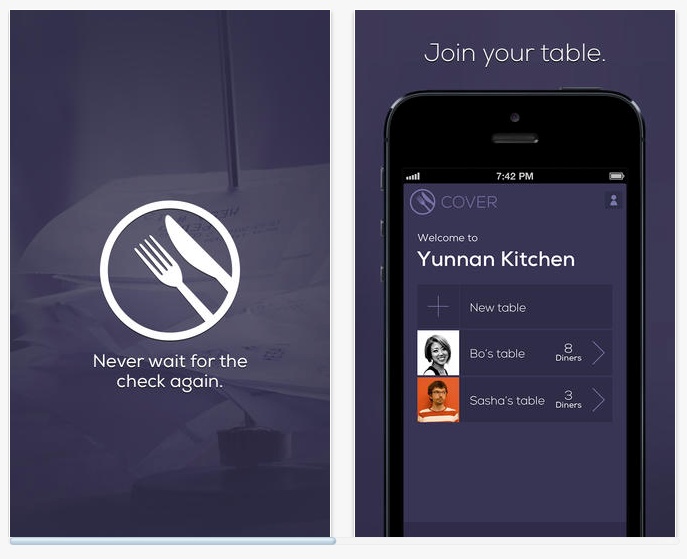
Egerman was skeptical of mobile wallets that merely moved the same chore onto a phone. Unlocking a device and opening an app needed to offer a benefit over producing a card. “Customers don’t want an app for the sake of having an app,” he said in 2014. The practical test was whether dinner became easier.
Hospitality has an engine room
Cover’s quiet exit required active work elsewhere. If a card failed, the company still paid the restaurant and included the gratuity, then contacted the diner afterward to resolve the problem. The guest could avoid an awkward conversation at the table because Cover had taken responsibility for a less pleasant conversation later.
Its business model also lived behind the scenes. The company processed restaurant payments, charging venues more than its underlying processing cost and keeping the difference. The experience could feel almost ceremonial to the diner: arrive, eat, leave. Behind it sat settlement, risk, and a margin that had to support the service.
This helps explain the particular appeal of Egerman’s project. He understood both the evening and the transaction. A restaurant could be warm, generous, and personal while still needing its money. Software promising a gracious departure had to ensure that the people doing the hosting were paid.
“Sorry if I sue you.”
Mark Egerman, introducing himself to a Harvard law class, 2008
In a 2014 essay, he argued that restaurant technology too often distracted from the experience it claimed to improve. Ordering tools, notifications, and games could compete with the people sitting together. He wanted technology to respect the atmosphere that made a restaurant different from an ordinary purchase.
That argument gave the product a demanding standard. A working button was insufficient if pressing it disturbed the occasion. For a founder with a computer science education, the instruction to leave the computer in a pocket was a considered design choice.
Getting invited into the restaurant
Building Cover also meant persuading establishments to use it. A payment app gains little from a delighted diner if the next restaurant cannot accept it. The company needed guests and venues to grow together, a coordination problem that could hardly be solved by polishing the download screen.
When Cover entered Los Angeles in March 2015, its partners there included République, Kendall’s Brasserie and Bar, and Porta Via. Egerman emphasized careful expansion. Staff with hospitality backgrounds mattered, including a former New York server who had moved west and joined the team managing restaurant relationships.
That detail gives the business a human scale. Someone who had encountered Cover while serving meals could bring knowledge of the dining room into the company selling to it. The restaurant was a workplace as well as a destination. Successful software had to fit both uses of the room.
Cover had raised $1.5 million in seed funding, followed by a $5.5 million Series A in 2014. Backers included Spark, O’Reilly AlphaTech Ventures, and Lerer. The combined $7 million financed a company trying to build a network one restaurant relationship at a time.
restaurants accepting Cover across New York, San Francisco, and Los Angeles
The arithmetic behind the exit
In September 2015, Velocity bought Cover. Egerman became executive vice president of payments, while Cove joined Velocity’s advisory board. Venues were offered a choice between keeping Cover’s standalone iPad setup and moving to Velocity’s integrated payment and loyalty platform.
The acquisition joined a narrowly focused payments service to a broader hospitality business. For restaurants, the combined proposition included customer-management tools alongside payment. For Egerman, it changed the setting in which he would build the service.
The economics help explain the moment. At the time of the sale, he said Cover had processed more than $10 million since the start of that year, but expected no more than $150,000 in annual revenue after passing along fees. Money moving through a company can make an impressive number. The amount left to run it can tell a much sterner story.
The two figures describe different periods and measures, so they do not form a tidy profit calculation. They do expose a practical tension: every apparently effortless departure needed a business capable of paying for the effort. The bill still arrived somewhere.
Other tables, other institutions
Egerman’s career continued beyond Cover. His public professional profile dates his Google Maps product work to 2016. A 2017 submission by Petal to the CFPB also named him as an adviser. He had moved between government, a startup, and a large technology company while remaining close to the questions raised by financial products.
His writing reached beyond payments, too. In 2015, he challenged the assumption that speed and disruption would adequately address problems in food production and distribution. He pointed instead toward the patient construction of shared technical foundations, drawing a comparison with the development of internet infrastructure.
More recently, he has helped govern a publication. As co-chair of the Jewish Currents board alongside Kathleen Peratis, he participates in an institution concerned with politics, culture, and ideas. In a December 2024 appeal, the two chairs offered to match readers’ holiday contributions.
The public-interest thread also reappeared in May 2026. With Merici Vinton, Egerman co-authored a proposal to use New York’s Economic Development Corporation to build public options and deliver services. He had served on the Mamdani administration’s transition committee for economic development and workforce development.
There is room in this institutional life for mischief. At a Jewish Currents party in 2022, he introduced himself to a reporter as David Klion, the magazine’s newsletter editor. After years of making restaurant transactions less conspicuous, he apparently enjoyed making a social introduction less reliable.
The settings have changed, but they give his career a recognizable concern: the arrangements that let people do things together. A shared payment, a public service, a magazine all depend on work their users need not constantly see. Cover supplied the most literal version of that idea. Enjoy the company. Let dinner end pleasantly. Leave the machinery to someone who has thought about it.
Read, listen, follow
- Professional profile
- Twitter / X
- GitHub
- Founder profile
- Cover product interview, 2013
- His essay on dining, 2014
- Restaurant payments in practice
- Velocity acquisition announcement
- Food-system infrastructure essay
- Jewish Currents board
- New York public options essay, 2026
- Listen: Tech Bites conversation
- Watch: Cover at Food+Tech Meetup (Vimeo)
- A party introduction, 2022