A guidance counselor once returned J. Mario Molina’s tenth-grade career essay with a D and two words in red ink: “hopelessly unrealistic.” He had written that he wanted to become a doctor. Years later, the boy with the disappointing grade would run the company his father founded, take it public, and find himself responsible for a business whose name was also his own.
There is an earlier ambition worth keeping in the picture. Molina had wanted to play first base. By his own account, he was terrible at baseball. The counselor, it appears, had missed an opportunity to apply the red pen to a more deserving proposal.
The small joke belongs in a life often reduced to a corporate title. Molina led Molina Healthcare from 1996 until May 2017. He also grew orchids and collected old books. Those interests existed alongside the executive career, and the collecting eventually became part of a substantial commitment to public institutions. To follow him beyond the office is to encounter another kind of succession: deciding what knowledge survives, where it lives, and who gets to use it.
A name with more than one future
C. David Molina founded Molina Healthcare in 1980. His son inherited responsibility for it in 1996, after his father’s death. His brother John served as chief financial officer. A surname on the company door made the relationship unusually visible. Every mention of the business could also sound like a mention of the family.
Seven years into Mario’s tenure, the company went public. The 2003 offering placed the enterprise in a new setting, with the disclosures, outside investors, and expectations that accompany public ownership. The family’s history remained attached to it, while its future increasingly belonged to a wider set of people.
In 2005, TIME included Molina in its list of the 25 most influential Hispanics in America. His explanation of his career was quieter than the honor: he had grown up with the family’s work and built upon it. That is a useful starting point for understanding him. The origin mattered; so did what happened when an inherited operation expanded beyond its original setting.
The education before the office
Molina’s route into leadership passed through several universities. He earned his undergraduate degree at California State University, Long Beach, where he was elected to Phi Beta Kappa, and his M.D. at the University of Southern California. Further training took him to Johns Hopkins and the University of California, San Diego. He returned to USC as a faculty member before joining the family company.
His qualifications also included a management certificate from UCLA’s Anderson school. The sequence puts some substance behind the familiar phrase “the founder’s son.” Family provided the connection. Study and work supplied a separate record of preparation.
Within Molina Healthcare, his responsibilities widened in stages. He was medical director from 1991 through 1994, then vice president from 1994 to 1996. The latter role included contracting, member services, marketing, and quality assurance. By the time he became president and CEO, he had worked across several parts of the operation. The title at the top came after jobs closer to its machinery.
May 2, and the year after
On May 2, 2017, the company replaced Mario as chief executive and John as chief financial officer. Its board cited financial performance in announcing the change. Joseph White became interim CEO, and Dale Wolf became chairman. A family business that had become a public company demonstrated just how much authority now rested with its board.
Mario remained a director for several months. In December, he stepped down from the board to pursue other opportunities. By then, he was president of Golden Shore Medical Group. The executive chapter had ended in two installments: first the job, then the board seat.
On the first anniversary of the departure, he published an essay about the unexpected route his life had taken. He thanked the people who had supported the launch of Golden Shore and urged employers to consider former colleagues seeking work. His attention moved outward, toward people whose careers had changed along with his.
He also described his siblings’ activities in Long Beach: John’s redevelopment work, Martha’s literacy efforts, Josephine’s support for music and the arts, and Janet’s preschool. The essay reads as a family taking stock after a disruption. It is also evidence of how many projects had grown around a single shared beginning.
The other ledger
Long before the departure, there were books. Molina’s collecting had a social life as well as a private one. A report in a bibliophilic societies newsletter describes a keepsake banquet at his 1909 Craftsman home, where examples from his collection were displayed. The setting was domestic, the company was fellow enthusiasts, and the objects invited discussion.
That scene offers a different scale from the public-company biography. A banquet has places at a table. A book can be opened between two people. A collector’s interests become visible through what he chooses to bring out for guests, rather than through the size of an organization he runs.
His collecting also connected him to the Osler Library, where he has served as a curator, and to The Huntington. There, he participates in an advisory group concerned with acquisitions, digitization, exhibitions, and research. Those are practical decisions about the life of a collection. Owning an interesting volume is one pleasure; making it useful to someone else requires a rather longer conversation.
A job for someone who knows the shelves
Molina joined The Huntington’s Board of Governors in 2011. He later endowed a curatorial position, and in 2018 the institution announced Joel A. Klein as its first Molina Curator. The gift supported a professional role devoted to understanding and developing a particular collection.
A curator’s name seldom attracts the attention given to a donor’s. Yet the appointment is where a gift turns into continuing work. Books need knowledgeable advocates inside an institution: people who recognize a promising acquisition, understand a collection’s gaps, and help researchers find material they might otherwise pass over.
Molina also funded a digitization project documented in 2020. It brought electronic facsimiles of early printed volumes to an online audience. Some of these books belong to the period before 1501, the first decades after printing began to spread through Europe. Their age makes careful handling important; digital copies let more readers examine them without bringing every inquiry to the same physical object.
The two forms of support complement each other. A curatorial position helps an institution understand what it holds. Digitization gives people elsewhere a way to encounter it. Both extend the usefulness of a collection beyond the person who paid for its growth.
Books become public resources through the work around them. Molina’s support includes acquisitions, curatorship, and digitization.
The stamp that brought a book home
In 2024, a bookseller contacted Klein about a first edition printed in 1543. The volume carried a stamp from the Los Angeles County Medical Association. It had once belonged to that association’s library, whose older collections had been placed at The Huntington in the early 1990s.
Some duplicate volumes had been auctioned at the time, including this one. The stamp made its earlier home identifiable. After decades elsewhere, the book could be reunited with material from the same collection.
Mario and his wife were among the donors who helped fund the purchase, alongside foundations, individuals, and other supporters. The acquisition was a collective effort. Its significance lay partly in restoring a relationship between books that had become separated.
There is something satisfying about that kind of return. A book can travel through sales and collections for years, carrying a small piece of evidence about where it began. An institutional stamp, easily overlooked beside the grandeur of an old binding, turns out to be a return address.
A family name becomes a public room
The Molina family’s cultural support also reached Washington. A $10 million lead gift from the family of C. David and Mary Molina helped establish the Molina Family Latino Gallery at the Smithsonian’s National Museum of American History. It opened in June 2022.
The gallery became the first physical presence of the National Museum of the American Latino. Its opening exhibition, ¡Presente! A Latino History of the United States, placed Latino experiences inside a national historical setting. A family gift helped create space for stories far beyond that family.
The distinction matters. A gallery carrying a donor’s name can still direct visitors toward other names, other lives, other histories. Here, the family’s visible contribution supports a broader account of the country. Their surname appears at the entrance; the subject expands once visitors walk inside.
“This is a legacy project.”J. MARIO MOLINA · ON THE LIBRARY/ART BUILDING
The next hundred years
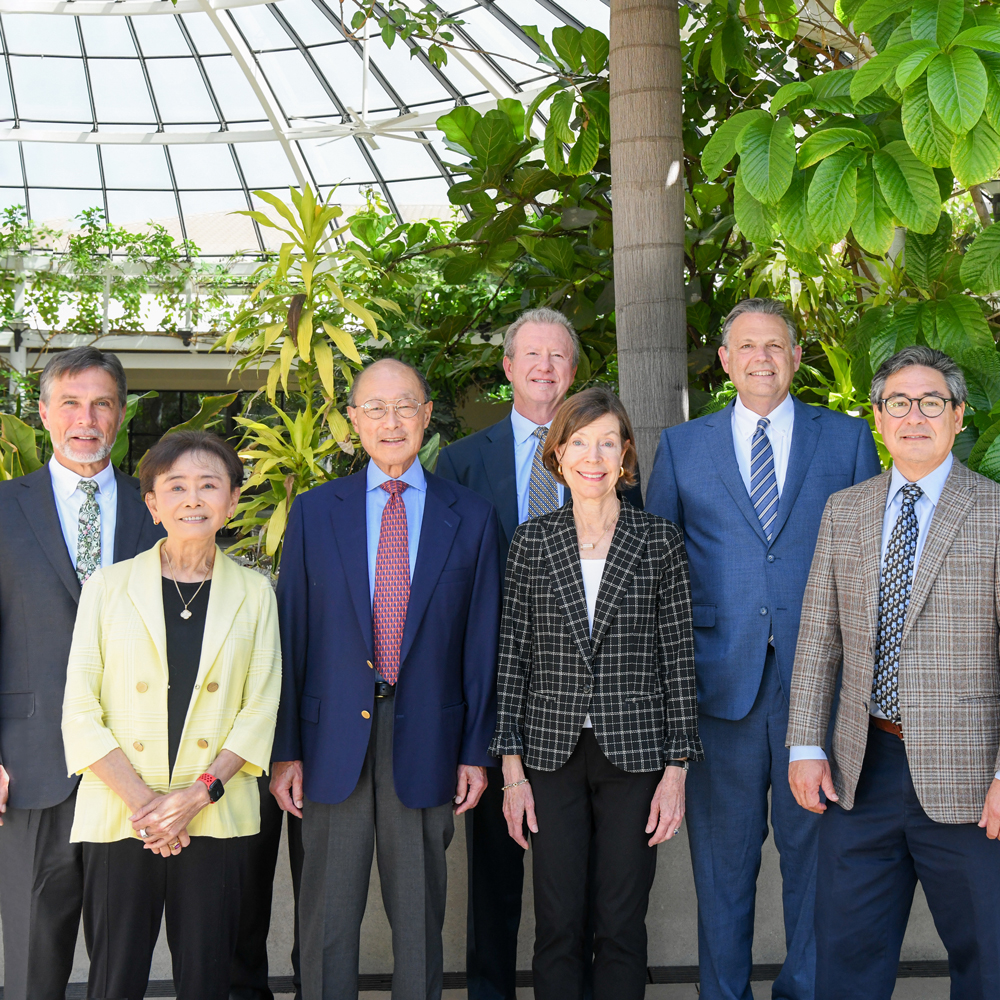
In 2021, Molina became a trustee of The Huntington. The role formalized a relationship that had already lasted a decade. More recently, he has helped generate support for its Library/Art Building project, a modernization designed to bring library and art museum work closer together.
The plans combine preservation with access: improved storage, conservation studios, and spaces for researchers and visitors. Molina has described the undertaking as a legacy project. Its horizon extends a century beyond the present, a considerable change of pace from the calendar of quarterly corporate results.
It is an apt place to leave him. His father’s company gave him a name to carry and an operation to lead. His books and institutional work show another way to carry something forward: help build the conditions under which other people can learn from it.
The teenager’s essay received a D. The adult’s life has produced rather more interesting paperwork: company filings, a trustee appointment, a curator’s position, and records of books finding their way into public use. Somewhere between those documents sits a collector who has made room for the future by taking the past seriously.