A delivery schedule can be mathematically efficient and still start an argument. Give one driver a crowded day and another an easy afternoon, and the saved miles may come with a management problem. Marin Šarić has spent part of his career teaching software to accommodate that awkward fact. At OptimoRoute, the company he co-founded, fairness became something a customer could adjust.
It is an unexpected destination for an engineer whose earlier work included Google Books and robots learning to handle everyday objects. Yet the connection is there. A book refuses to lie perfectly flat. A hand has an inconvenient number of moving parts. A worker needs a break. Each looks simple until someone asks a computer to deal with it.
Šarić’s career has moved between those small complications and large ambitions: from Croatia to the United States, from Google to a Swedish robotics lab, and back to Zagreb. The interesting part is how often the supposedly minor detail turns out to be the whole job.
The book has a spine. This is a problem.
Šarić joined Google in 2003. A former pupil of Zagreb’s XV Gymnasium, known as MIOC, he continued his education in the United States and attended the Illinois Institute of Technology. His old schoolteacher remembered his success in computing competitions. The passage abroad had begun early, with a Cranbrook scholarship at sixteen.
At Google, he helped build the book-search project and led its library-scanning engineering team. The public-facing idea was wonderfully straightforward: make the contents of books searchable. The engineering underneath had to contend with actual books, which possess bindings, curved pages and very little interest in a software company’s timetable.
A patent co-invented with François-Marie Lefevere makes the challenge concrete. Filed in September 2004 and granted in March 2009, it concerns detecting grooves in scanned images. The groove is the valley where an open book meets its spine. The system uses three-dimensional image information to locate it.
That is a satisfying detail to find beneath the broad phrase “worked on Google Books.” Search begins with something physical. Before a reader can discover a sentence, somebody has to make the page legible to a machine. A grand digital library depends, among other things, on understanding a crease.
There was a research strand, too. In 2003, Šarić co-authored a paper with Shlomo Argamon and Sterling S. Stein on identifying the authors of electronic messages through writing style. Their experiments considered as many as twenty authors. Long before the route-planning business, he was working on ways to extract useful distinctions from apparently ordinary material.
- 2003Joins Google; works on book search.
- 2008–11KTH studies and robotics research in Stockholm.
- 2011Releases LibHand, a hand articulation library.
- 2015All three OptimoRoute founders are working full-time.
A Swedish detour, with fingers
After five years at Google, Šarić went to Sweden to study systems, control and robotics at KTH. It was a substantial change of direction: an experienced software engineer returning to the position of student, faced with demanding mathematics and the slow work of making machines perform familiar movements.
His research record puts some technical substance behind that chapter. A 2011 report, written with Carl Henrik Ek and Danica Kragić, investigated dimensionality reduction through Euclidean distance embeddings. Its subject was how to represent complex data in fewer dimensions. The title is unlikely to fit on a motivational mug; the problem belongs squarely to the business of making complicated information usable.
Another product of that period is easier to picture. Šarić released LibHand in 2011, an open-source library for rendering and studying human hand poses. It combined C++ with a MATLAB interface, giving researchers tools to manipulate a model hand and examine the images it produced.
The supplied model had more than 70,000 triangles. Fingers could be posed, rendered and analysed. For a researcher trying to understand a grasp, a controllable digital hand offers a useful laboratory: change the pose, look again, repeat. The software’s stated applications included computer graphics, computer vision and robotics.
LibHand also made the work available to other people. Its permissive licence allowed commercial as well as academic uses, with attribution requirements. Alongside the CEO’s job title sits this rather different professional trace: a reusable research tool, complete with code, examples and a hand that will hold still while you inspect it.
Three founders, one crowded working day
OptimoRoute grew out of a different sort of observation. Goran Kukolj, who had worked on vehicle tracking through Smartivo, saw a gap between what businesses needed from route planning and what the available systems delivered. He brought the problem to Šarić and his brother Frane.
The brothers were already doing consulting work for Yelp from Zagreb. Kukolj kept developing the proposal and showing prototypes. His connection with Frane went back to school and university. The eventual partnership brought together that long acquaintance, the brothers’ technical experience and a problem encountered through customers.
The idea dates to 2012; by 2015, all three co-founders were working on it full-time. Those are different milestones, and both matter. A company takes shape over a period of persuasion, experiments and decisions about what to give up. A clean anniversary date tends to conceal the untidy bit.
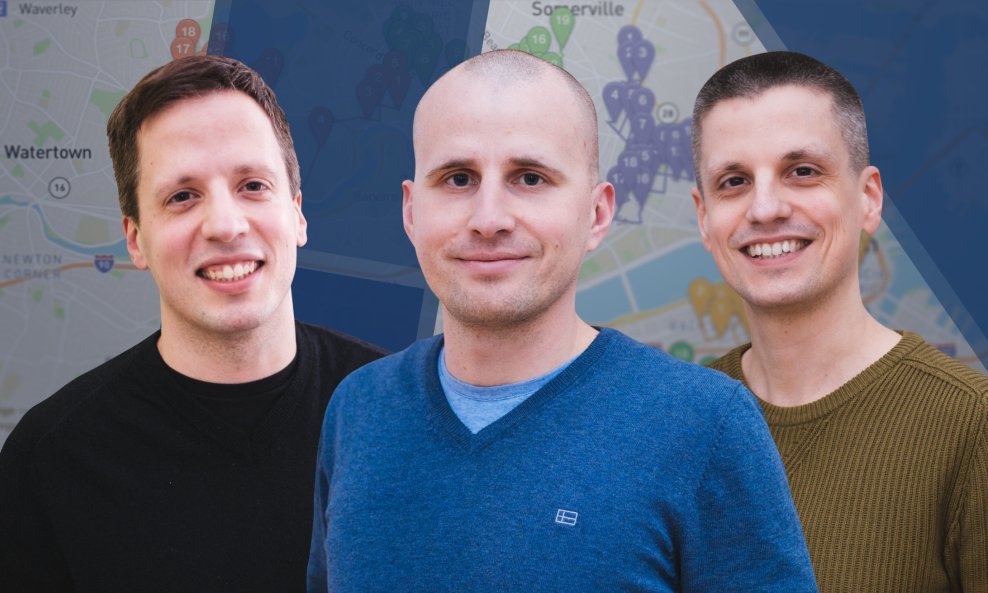
They raised seed funding in July 2016. Early backers included Pathbreaker Ventures, Hoxton Ventures and Yelp’s chief executive. By March 2017, the company was serving customers in fifteen countries, with examples ranging from a Saudi bakery to a London laundry service. The geography was international before the organisation was large.
A bakery and a laundry service might appear to have little in common. Both, however, have promises to keep at particular places and times. For the founders, the shared opportunity lay in the scheduling underneath those promises. A customer buys the ability to organise a working day; the mathematics has to earn its place there.
The shortest route can be unfair
Routing is often introduced as a question of finding the shortest path between stops. Put several workers into the picture and the question acquires conditions. Which worker is available? When can the customer receive a delivery? Who can do the job? When does a shift finish?
Šarić’s explanation of OptimoRoute included a further condition: the workload should be something people can live with. A plan that leaves one employee idle while others are overloaded invites resentment. The company offered a balancing control so businesses could decide how much weight to give that concern.
“These people are not robots, they need breaks.”
Marin Šarić, 2017
His earlier robotics work gives the remark a pleasing echo, although the practical point needs no laboratory experience. A route is carried out by a person. Breaks, working hours and uneven assignments remain part of the operation whether the optimiser acknowledges them or leaves a dispatcher to sort them out afterward.
Conceptual diagram of scheduling constraints - not a product screenshot or performance comparison.
There is a modest but consequential decision here about what software should make visible. If the only number displayed is distance, distance gets the attention. Add working time and the distribution of jobs, and the conversation changes. The balancing feature puts a management choice into the planning process instead of pretending that efficiency has only one definition.
Zagreb, with an international customer list
In 2020, OptimoRoute’s financing became a larger part of its public story. A $6.5 million investment led by Prelude Ventures was reported that February; Prelude dates its investment to 2019. Its portfolio places the business in mobility and describes a connection between better routing, lower fuel costs and reduced emissions.
By April 2022, the company reported more than 2,500 paying customers worldwide. The United States accounted for seventy percent of revenue, while the engineering operation remained in Croatia. Šarić and his co-founders were building a business whose customers and colleagues extended well beyond the place where the software was developed.
The same period brought a broader management team. Beth Kirsch joined in marketing, Nina Đorđević in sales and Kuan Foo in product. The company described an organisation of about forty people. For Šarić, the work now included attracting experienced colleagues to a business that had begun with three founders and an algorithmic problem.
A young engineer’s experience offers a view from the other side of that hiring process. In a 2021 account of joining OptimoRoute, developer Dorian described being impressed by Marin and Frane’s breadth of computing knowledge. Difficult interviews and substantial learning were part of the appeal. The founders’ engineering backgrounds were still visible to people arriving at the company.
The argument inside the algorithm
Šarić appeared on the Croatian interview programme Poduzetnički mindset in 2021, discussing his return to Croatia and plans for OptimoRoute. The episode’s title urged viewers to keep their ambitions large. In his case, ambition had already involved several changes of setting rather than a single climb through one institution.
The book scanner, the digital hand and the delivery schedule make an unusual collection. Each asks an engineer to describe the world precisely enough that software can help with it. Each also supplies an immediate correction when the description is inadequate: a distorted page, an implausible grasp, a day’s work nobody wants to perform.
That last correction is especially revealing. A business can count stops and miles with admirable precision while overlooking the person expected to complete them. Šarić’s balancing control leaves room for the argument before the vans depart. Somewhere between the shortest route and the longest afternoon, there is a working day worth planning.
Follow the next turn
- OptimoRoute ↗
- Marin Šarić on LinkedIn ↗
- LibHand project ↗
- LibHand code ↗
- Watch: Poduzetnički mindset interview (Croatian) ↗
- Google scanning patent ↗
- 2011 KTH research report ↗
- 2003 authorship research ↗
- The founders in conversation, 2020 (Croatian) ↗
- Company milestones, April 2022 (Croatian) ↗
- A new engineer’s experience, 2021 (Croatian) ↗
- 2017 interview and robotics profile ↗
- Prelude Ventures portfolio ↗