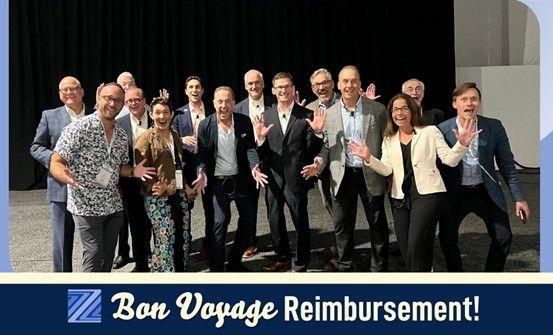
A reimbursement conference is an unlikely place to go looking for show business. Marc Zimmet has spent years making that assumption unsafe. His annual gathering has sailed under the banner “Bon Voyage Reimbursement!” and borrowed the spirit of a music festival for “Peace, Love and Reimbursement.” The subject is specialist business. The invitation has a plot.
There is a practical idea beneath the theatrical packaging. Zimmet wants people who occupy different corners of an organization to sit together and hear the same argument. A manager can attend alongside the people whose decisions intersect with theirs. For a few hours, the departmental walls come down. The stage gives everyone something to look at while that happens.
It is a useful opening scene for the founder and chief executive of Zimmet Healthcare Services Group. His career keeps changing the size and shape of the room: a consulting practice, a software business, a gathering of developers, a publishing partnership. Each new format brings another group into the discussion.
The desk before the stage
His first ambitions involved a smaller audience. As a seventh grader in 1982, Zimmet put up flyers for an unofficial software business. Later came an accounting degree, a year as a trader’s assistant at Lehman Brothers, and a move into his father’s professional orbit. The early software venture faded. The interest in building something of his own proved more durable.
In 1993, he began preparing cost reports and appeals. The firm that bears his name dates its beginnings to that year. This was a business built around knowing how a complicated system worked, then helping a client navigate it. There was a specific job to do, a document to understand, and a consequence if someone misunderstood it.
That origin matters because it puts the expertise before the platform. Zimmet did not begin by announcing a broad technology mission and hunting for a problem to attach to it. His early work supplied problems in abundance. Over time, the question became how much of the accumulated knowledge could travel beyond an individual engagement.
A specialist at the next table
His work also took him toward the people financing businesses. In 2018, he joined Greystone as a managing director while continuing to lead his own firm. The arrangement brought his advisory experience into a real estate lending and investment business. It was an additional seat at the table, with different questions attached.
A consultant and a lender can study the same enterprise from different directions. One is concerned with how the operation functions. The other must consider the business behind a financing decision. Zimmet’s dual appointment put those perspectives in the same working relationship. It also illustrated how a narrow specialty can become useful well beyond its original assignment.
His professional biography includes another business role: founder and managing member of Z capital, the firm’s investment vehicle. Taken together, these positions show a career moving across advice, ownership and finance. The connective work is less photogenic than a launch announcement. It often begins with recognizing that the person at the next table needs to understand the same system.
When advice becomes a product
CORE Analytics gave the consulting knowledge a software form. In August 2022, Netsmart announced that it had acquired the offering developed by Zimmet Healthcare. The announcement also established a continuing consulting collaboration between the organizations. Expertise and software would remain in conversation after the transaction.
It is a revealing business turn. A consultant can explain a method in a meeting; an application must make that method usable when the consultant has left. Product development demands choices about what can be repeated, what needs interpretation, and where the user needs help. The familiar professional skill has to fit inside a different kind of working relationship.
The acquisition is a clear marker in Zimmet’s career, but his subsequent work makes the sequence more interesting than a sale alone. There is a move from doing the work, to building a tool, to considering the environment in which other tools might be built. The ambition expands from answering questions to organizing how answers become available.
“It’s all connected.”
Marc Zimmet
A platform needs other builders
With z-PAX, the Post-Acute eXchange, Zimmet has argued for a standardized, open development platform. In a public account of its beginnings, he recalled bringing 150 innovators, developers and investors together in Miami. Some doubted the idea would work. He described their assessment with a grin in the prose: “Well, they were half right.”
The joke leaves the skepticism in the story. That is welcome. Platforms need participants who have their own priorities, and a founder’s confidence cannot supply everyone else’s reason to join. The difficult work is making participation useful enough that people choose it. A room full of potential partners is a beginning; each participant still has to go back to work.
The published z-PAX Live program in Nashville put that practical side on display. Zimmet’s opening session addressed the software market. Other sessions covered development, integration, growth and funding. The agenda made space for operators, investors and developers, groups whose vocabulary can differ even when they are discussing the same product.
An editorial map of the career, rather than a product architecture.
The conference has a plot
Long before the platform conversations, Zimmet was assembling people in person. The 2018 conference was billed as the twentieth annual seminar, with more than 1,100 participants expected at a sold-out event in Atlantic City. “Peace, Love and Reimbursement” supplied the theme. The program brought business and investment questions into the same gathering.
The names are amusing because the work is serious enough to resist amusement. A conference on reimbursement has no automatic claim on anyone’s affection. Giving it a theme imposes a small creative obligation: there should be a reason for the audience to remember how the sessions belong together. A title can make a technical agenda feel like a shared undertaking.
By 2026, the program had become “The Reimbursement Symphony.” The musical metaphor is almost suspiciously convenient for a founder who keeps talking about connections. Separate players, separate parts, one performance. The conceit offers a way into his professional argument without requiring the audience to begin with a diagram. The diagram can arrive after everyone has taken a seat.
The people behind the curtain
Zimmet’s public reflections on the conference are often more personal than the event titles. After the 2024 gathering, he reported 1,450 attendees and emphasized the sense of community. He wanted people from the same organization to hear the same message. He also directed attention to the conference staff, whose work rarely receives the visibility of a stage appearance.
In another reflection, he described an earlier habit of micromanaging every moment. Now, he wrote, he could watch what the team put together. The admission gives the founder story a useful crease. Building a larger organization involves changing the founder’s job. A person accustomed to doing the work must make room for colleagues who can carry it.
The company’s current account of itself places value on long employee tenures, including people who have stayed for decades. That is a revealing choice of emphasis. Alongside its business reach, the firm treats continuity among colleagues as a measure of success. The founder gets the billing. The organization needs people who know the production.
Another room, this time online
His interest in bringing specialties together also appears outside the firm. SHOPP, the Society for Healthcare Organization Procurement Professionals, names Zimmet among its founders alongside Josh Silverberg and Michael Greenfield. It organizes education and networking around purchasing. The association brings a different set of professional decisions into a common conversation.
In August 2025, another collaboration opened. Park Place launched with Mark Parkinson and Zimmet Healthcare, hosted on zPAX. Its plans included expert commentary, videos and podcasts. Parkinson, formerly the longtime head of the American Health Care Association, supplied another perspective and another network. The publishing project gave the platform a place for recurring discussion.
The format changes the timing of the meeting. Readers can arrive when they have a question. A video or an article can introduce an idea before a conference session, or give a conversation somewhere to continue afterward. For Zimmet, the online room adds another way for specialist knowledge to circulate beyond the original consulting desk.
The next invitation
Recognition has accompanied that public work. In March 2025, the American College of Health Care Administrators named Zimmet its Public Service Award recipient. The following year, his firm’s event archive listed an April presentation at LTC100 on the evolution of industry software. The recurring subject was still changing, and he was still taking it to an audience.
His career offers a rather human view of business expansion. A person learns a complicated job, discovers other people need the explanation, and keeps trying new ways to deliver it. Some versions require software. Some require partners. Some require a conference team capable of making a specialist agenda feel like an occasion.
There is room in that story for both the accountant and the producer. Zimmet can concern himself with the method and still give the gathering a title worth putting on a banner. After three decades, he is still making room for another conversation. Someone should check that the microphones work.