In early October 2007, Manish Gurukula met Wayne Brown at the Edison Diner to discuss Brown’s interest in joining Alacriti. The company had one bank client. Years later, Brown would remember the meeting well enough to name the diner, the month, and the reason he wanted in: Gurukula had described a business he believed could grow.
It is an agreeably unceremonious scene for a payments company. Money movement summons images of trading floors and glass towers; here, the remembered setting is a New Jersey diner. The useful detail is the size of the business: one bank. There was plenty left to persuade someone to imagine.
By May 2026, Alacriti was reporting more than 96 million transactions and more than $233 billion in annual payment value. Gurukula remained its CEO and co-founder. The distance between those two moments is the interesting part of his story. How does an engineer build a company around an activity people tend to notice only when it goes wrong?
A school called IIT
Gurukula’s own telling has a habit of understating the entrance. During a conversation with Hiten Patel and Cosimo Schiavone, recorded in May 2025, he described his undergraduate education at IIT in India so casually that Patel stopped him and asked for a little more ceremony.
His degree came from the Indian Institute of Technology in Chennai. Patel heard the modest introduction as a missed opportunity to advertise the institution. The exchange is funny because Gurukula appears ready to get on with the next part, while his interviewer insists that the educational stop deserves its own spotlight.
That next part began with his move to the United States in December 1997. He worked in financial services, and Western Union gave him his first opportunity in payments. He joined work on modernizing its money-transfer technology, later leading global teams in money transfer and bill payment. Before the strategy presentations came the software.
It makes his eventual choice of business easier to understand. A payment has a wonderfully simple public face: choose a recipient, enter an amount, press a button. Behind it sit systems, institutions, messages, and obligations. Gurukula’s working life developed on that less photogenic side of the button.
The first customer was an education
He and Sai Raavi founded Alacriti in 2003. It began as a specialist firm building custom payment software for banks. HSBC became the first anchor customer, giving the young company work that required it to build substantial systems from the drawing board onward.
Gurukula describes that early relationship as an education in global, mission-critical software. The projects included transfers between HSBC Premier customers’ accounts around the world, wire-transfer modernization, and an enterprise bill-payment platform serving seven North American business lines. Different jobs, with a shared requirement: the machinery had to function beyond the demonstration.
Raavi brought a complementary background. He had worked on money-transfer systems for HSBC and bill-payment solutions for banks including Capital One, and began his career as a database architect. Today he oversees engineering and delivery as executive vice president and co-founder. Their division of responsibilities puts Gurukula on strategy, business development, and growth, with Raavi responsible for building and delivering.
There is a particular discipline in having a bank as an early customer. The buyer already has customers of its own, existing systems, and promises it must keep. A supplier enters the middle of those relationships. Reading Alacriti’s beginnings this way, the diner conversation becomes more concrete: Gurukula was inviting Brown into a company learning its trade through demanding, consequential work.
A conceptual view of Alacriti’s connections. Each network still has its own rules.
The bill, the bot, and the paper check
One way into Gurukula’s work is through some thoroughly familiar irritations. A bill needs paying. A customer has a question. A business owes somebody money. These situations rarely receive a standing ovation when resolved, which makes them useful tests of a technology company’s priorities.
In May 2017, Alacriti introduced Ella, an AI-powered conversational bot integrated with its payment solutions. Customers could use Facebook Messenger to receive notifications, ask about bills, and make payments. The product was later renamed AI chatbot, but the original announcement records the practical intention: meet customers in a digital channel they were already using.
In January 2019, digital disbursements joined Orbipay. Gurukula’s explanation focused on the expense of issuing paper checks, especially for businesses making frequent payouts. The service supported electronic payments into bank accounts, including situations where the payer did not already have the recipient’s account information on file.
Neither example requires a futuristic vocabulary to make sense. A conversation should help someone finish a task. A payout should reach its recipient without unnecessary manual work. Across these launches, Gurukula’s public explanations return to the person or business trying to complete something. The technological ambition travels inside an everyday inconvenience.
When the network went live
In July 2020, Alacriti joined the U.S. Faster Payments Council. Gurukula spoke about rising demand for immediate payments and the opportunity to help financial institutions of different sizes make the transition. It was a commitment to a wider ecosystem, where a supplier’s progress depends partly on how many other participants can connect.
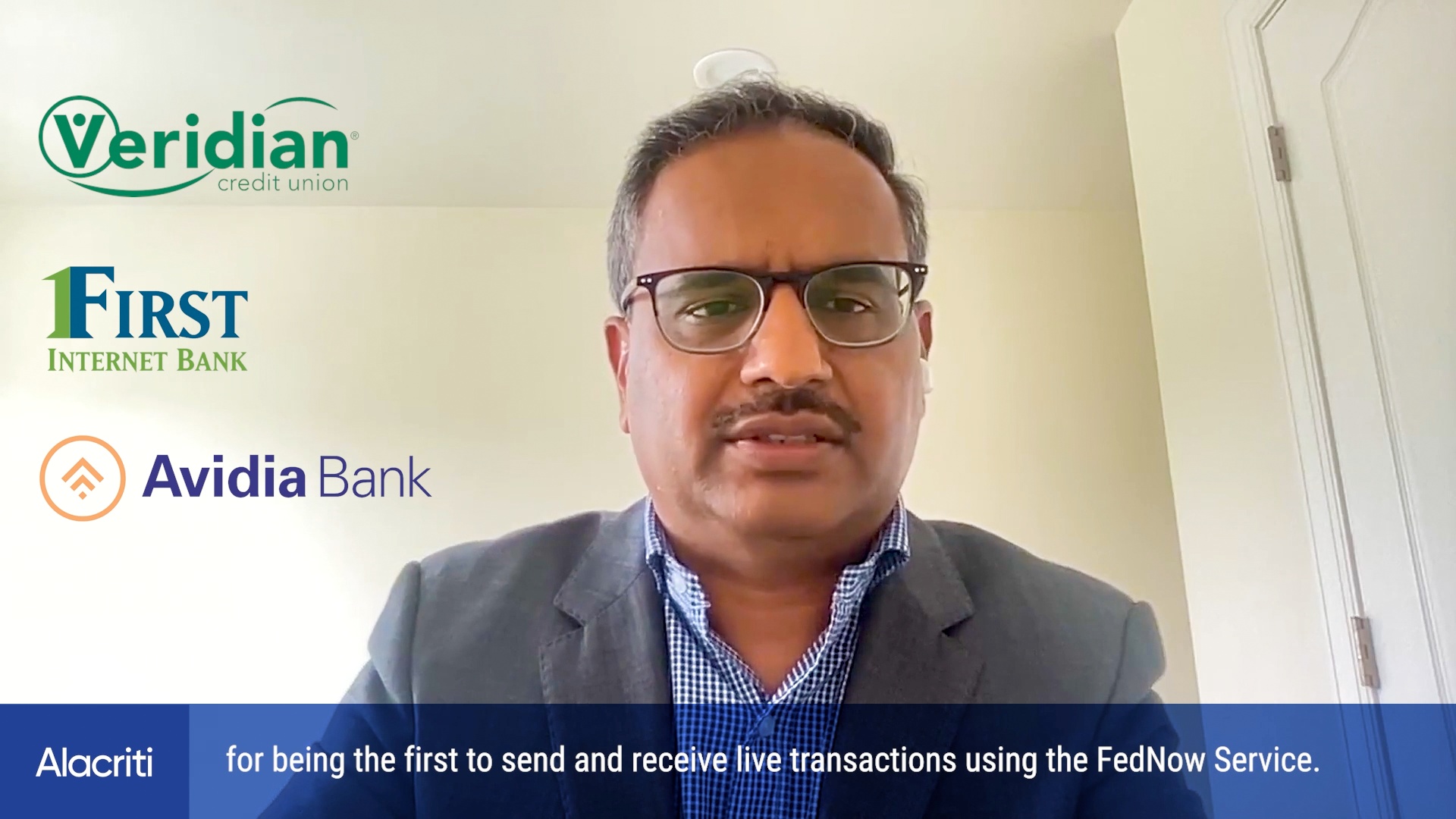
Three years later, on July 20, 2023, he delivered a video message marking the FedNow Service launch. He congratulated the Federal Reserve and Alacriti customers who were among the first to send and receive live transactions. For someone whose career had involved building payment systems for banks, this was a concrete moment to mark: the work had reached live money movement.
Alacriti’s present-day platform connects institutions to several payment networks through a common hub. The distinction matters because a bank cannot simply behave as though all payments take the same route. ACH, wires, RTP, FedNow, Zelle, and Visa Direct form a set of choices, each with its own operating requirements.
The company offers incremental modernization: adding capabilities while integrating with existing core and digital-banking systems. That is an engineering proposition with a human consequence. The institution gets to change while continuing to serve people who expect their money to arrive. Nobody wants to discover they were the dress rehearsal.
“This milestone is yours.”
Manish Gurukula, thanking Alacriti’s employees in his investment announcement
A company needs room to bend
Gurukula has also addressed the obligations inside the company. In a June 2020 message, he reaffirmed Alacriti’s commitment to inclusion and rejected discrimination based on ethnicity, gender, culture, or sexual orientation. The message connected the company’s growth to its responsibility to make people feel included.
His reflections on management are similarly concerned with how an organization operates as it gets bigger. Asked about challenges in building Alacriti, he emphasized the need for processes, frameworks, and playbooks, while allowing flexibility across product, engineering, sales, marketing, and operations. A process that cannot adapt becomes another problem to manage.
Patel pictured a Japanese skyscraper flexing in the wind. It is a useful image for a software founder serving institutions with long histories: enough structure to carry the weight, enough give to respond when conditions change. Gurukula’s account of leadership leaves room for both.
Outside work, he plays tennis. He credits it with sharpening strategic thinking, adaptability, and resilience: read the situation, make a decision, adjust. The connection is his own. A plan on court lasts only until the next ball arrives; a business playbook also needs somebody willing to look up from the page.
OFF THE CLOCK“I like playing tennis.”
Manish Gurukula, in conversation with Hiten Patel and Cosimo Schiavone
What the next rally asks of him
In May 2026, Alacriti announced growth equity led by Sageview Capital, with BMO Capital Partners and Curql Fund participating. Gurukula described the company as having built a profitable foundation. The expansion plans included AI-driven intelligence, fraud prevention, stablecoins, and tokenized deposits.
Alacriti figures announced May 20, 2026. Transaction volume and value describe the platform; retention describes customers.
His announcement on LinkedIn began by thanking employees and customers. He also acknowledged Sashi Narahari as a friend and trusted adviser whose guidance had helped over the preceding years. Brown’s diner recollection appeared in the responses. An investment announcement had become an occasion for people to remember the work that preceded it.
Asked to point listeners toward another company, Gurukula chose Cursor, the AI coding tool, and said Alacriti used it. His enthusiasm provides a small glimpse of the engineer inside the executive. Even while describing an established payments business, he was watching how a younger software company worked. The invitation to share the spotlight became a chance to talk about a tool his own team had adopted.
The public ambition is measurable. In the 2025 interview, Gurukula set a goal of growing Alacriti to $100 million in annual recurring revenue over the following few years. It remains a stated aspiration, rather than a result to chalk up. The distinction preserves the interesting question: how will he get there?
By autumn 2026, he was discussing how banks should prepare their infrastructure for stablecoins. An October event announcement paired him with BitGo’s Frank Wang to examine digital money alongside ACH and wires, including decisions about custody, partners, and operating responsibilities. The vocabulary has changed since the early HSBC projects. The work of making systems cooperate continues.
There is something fitting about the tennis habit here. Gurukula has spent decades in a business where the next technical development demands another adjustment, and where a useful plan must survive contact with other people’s systems. At the Edison Diner, there was one bank client and an argument about what could follow. He has been working through that argument ever since.