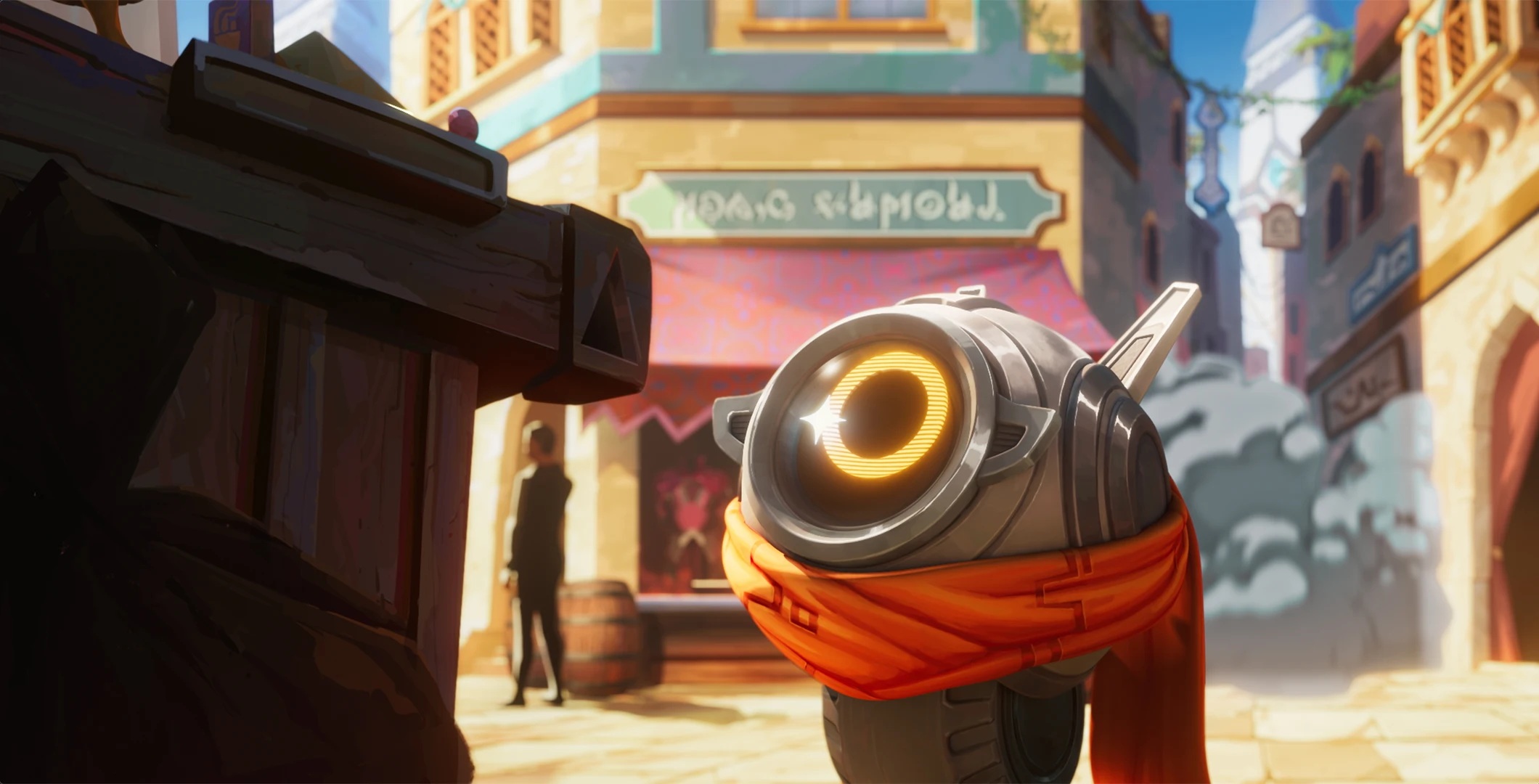
Dooley, a small robot with a bright circular eye and an orange scarf, peers around a market stall. The street behind him looks brushed into existence: warm walls, painted signs, soft edges. He belongs there. That is the trick Mana Animation Studio had to pull off for The Bazaar, a card game whose illustrated universe needed to survive the trip into a moving, three-dimensional trailer.
For Tempo Storm’s launch film, Mana combined digitally painted backgrounds with hand-painted 3D characters and assets. Three-dimensional animation supplied the performances and camera work; 2D cel effects supplied another layer of movement. The result has the volume of a modeled world while retaining the texture of an illustration. Technology serves a particular visual promise: this should feel like the game people came to see.
That promise helps explain the Los Angeles studio’s place in commercial animation. Mana makes trailers, advertising, explainers and narrative shorts for clients whose needs differ considerably. A game publisher wants players to meet a new character. A technology company needs an abstract service to make sense. A sports brand wants a familiar athlete to become someone viewers have never quite seen before.
Mana’s portfolio moves among those jobs with conspicuous changes of style. The interesting question is how it chooses. Look through the production breakdowns and a pattern emerges: preserve what gives the subject its identity, then assemble the techniques and people that can make it move.
02Deadpool gets the cartoon treatment
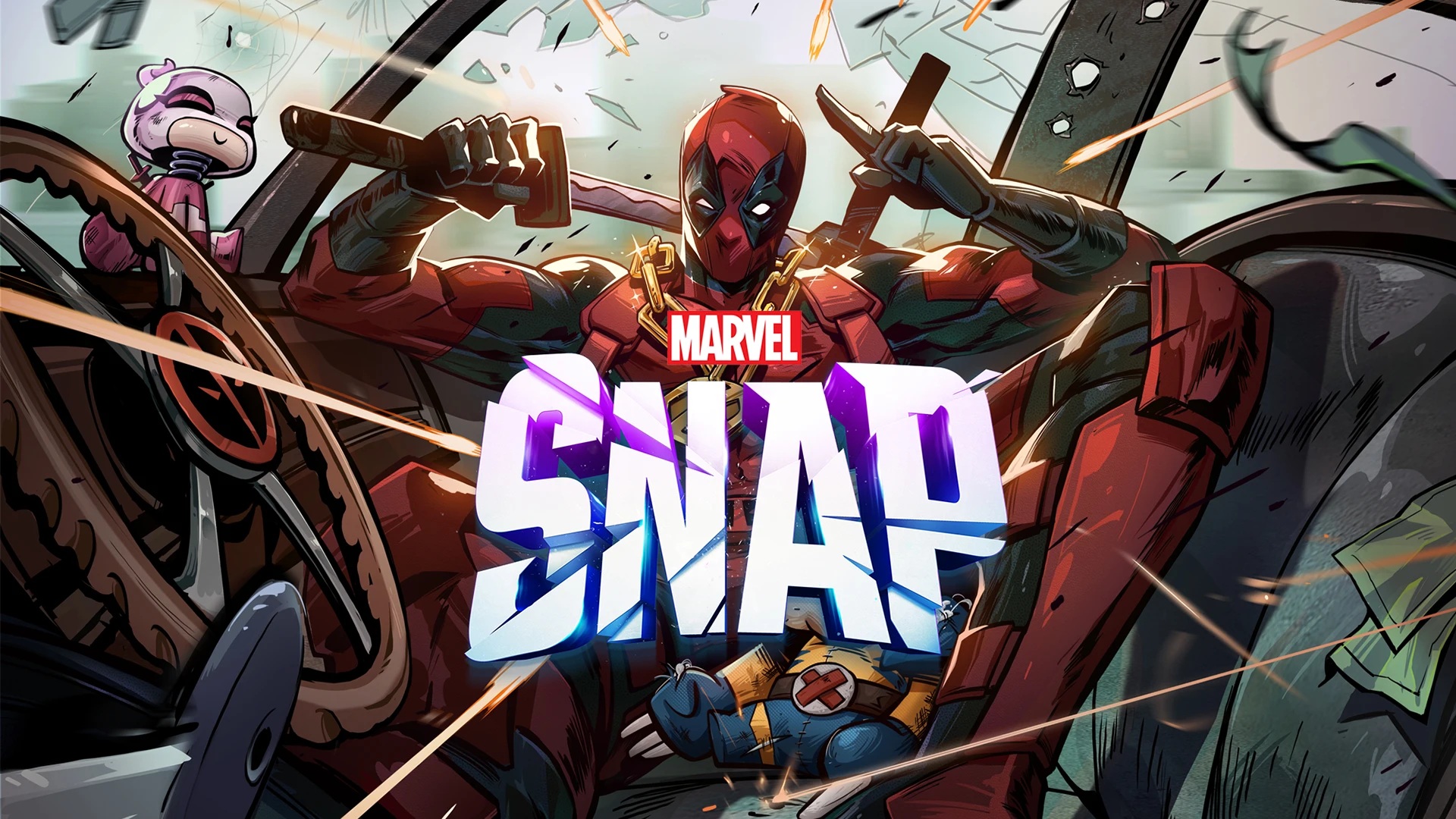
Mana’s Deadpool and Wolverine project began with a small act of wish fulfillment. The studio liked the idea of a 2D Deadpool series and was disappointed when that prospect disappeared. For a Marvel SNAP seasonal animation timed to the movie’s release, the team imagined a taste of the cartoon it wanted to watch.
It chose digital frame-by-frame animation, added separate shadows and highlights, and placed the characters against matte-painted backgrounds. Compositing brought the layers and effects together. The credits identify Daniel Cuervo as animation lead, Alex Valle as character designer and Jorik Feskens as director. Grafit Art handled background layouts and paintings.
The film belonged to what Mana described as a monthly series introducing Marvel SNAP seasons. That recurring assignment offers room for a recognizable voice and the occasional detour. Here, affection for a character led the studio to take the treatment further. For a buyer, the lesson is useful: the calendar can remain consistent while the creative ambition changes from installment to installment.
03Six seconds to make Ohtani an anime hero
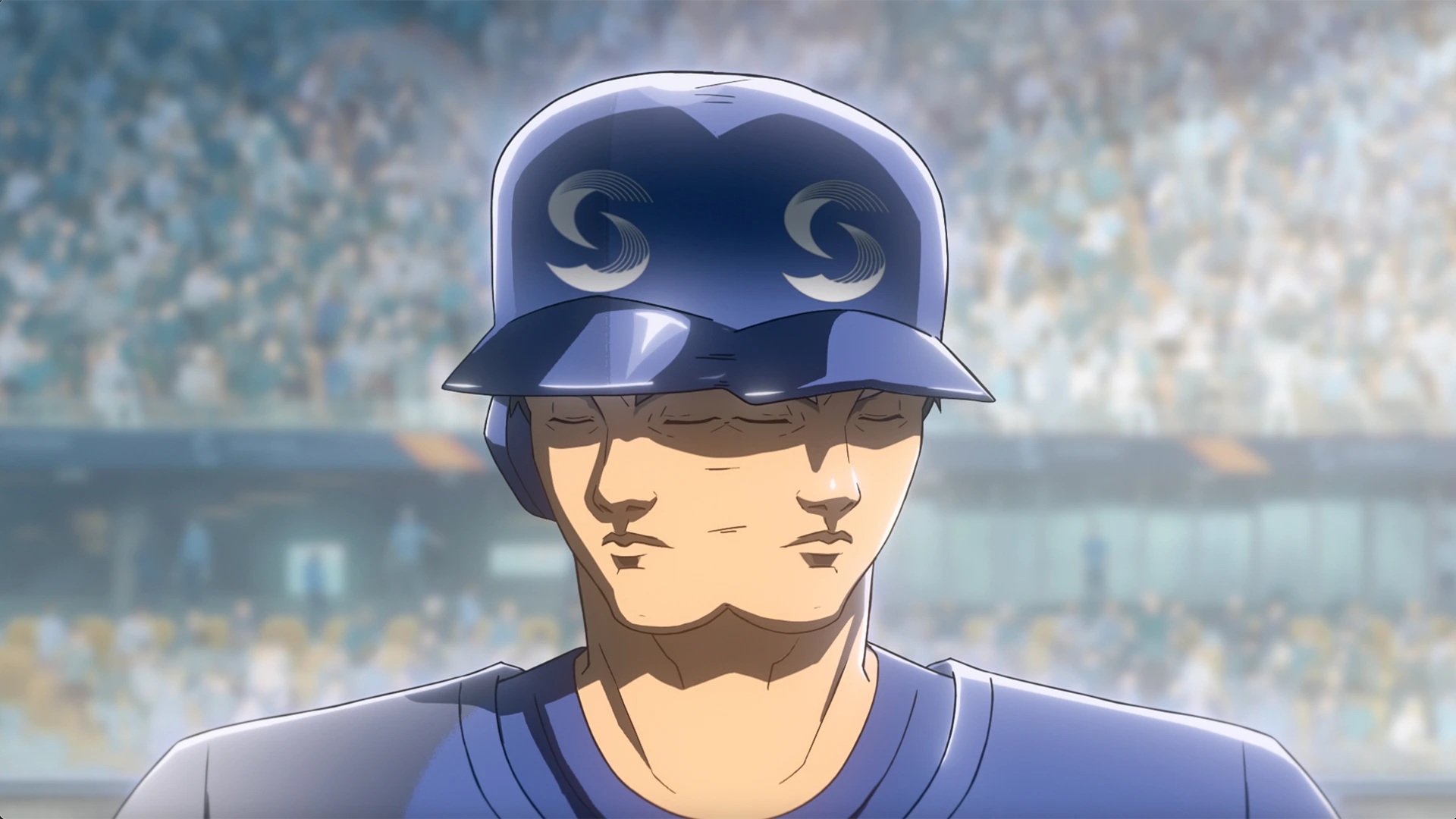
The Syncron campaign poses another problem: how do you make Shohei Ohtani’s athletic identity legible almost immediately? Working through Common Good, with Patio Weather also credited, Mana translated scripts and miniature stories into anime-inspired spots. Some run just six seconds. Longer pieces explore the same visual territory.
The campaign uses Ohtani’s two roles, pitcher and hitter, as creative material. Painted environments and character designs combine athletic realism with anime exaggeration. The connection is specific enough to do more than decorate a sports advertisement: a player associated with two disciplines becomes a protagonist whose abilities can expand across an animated world.
The credits show the work behind those few seconds. Art direction, animatics, layouts, character design, rough animation, effects, cleanup, lighting, backgrounds and compositing each have named contributors. A short running time still carries a substantial chain of decisions. The economy happens on screen, where every pose and transition has less time to explain itself.
This is one reason a commissioning team should arrive with an idea of what viewers must remember. A six-second film has little room for competing messages. Mana’s campaign gives each small piece a shared aesthetic, allowing the collection to feel related without making every spot carry the entire argument.
04The picture decides the pipeline
For Star Trek Fleet Command’s Hurak Invasion, Mana used a different form again: the motion comic. Christina Chong reprised La’an Noonien-Singh, while the production moved through approvals with Scopely and Paramount. The starting point was Brian Lelas’ script, followed by storyboards and carefully composed shots.
Artists developed environment and character layouts, then digitally painted each shot. Characters were divided into layers, including body parts and facial features, so animators could create movement and lip-sync. Camera moves, effects and a final color grade helped complete the sequence. Static artwork carried much of the storytelling; selective movement supplied performance.
That distinction matters when choosing a format. A motion comic can make strong illustrations feel cinematic, but its compositions must carry the weight that constant full-body animation might otherwise bear. Hurak Invasion shows how the studio plans for that condition early, in the transition from one shot to the next.
The Sorcery: Arthurian Legends trailer began with existing card-game artwork. Mana animated it in 2.5D, doing most of the work in After Effects. For the closing product shot, it modeled and textured the booster box in Zbrush and Maya, then animated and lit it in Blender. The same deliverable could accommodate several tools because the original art and the physical-looking package asked for different treatment.
Teleport’s assignment removed another familiar device: narration. Mana told the story through shapes, patterns, movement and sound design, without a voice-over. For Brother Printers, it combined photographs and graphic design across six online advertisements. Styleframes established the look before complete designboards and animation. The range is practical: preserve existing art, explain through abstraction, or make product imagery move.
05Three weeks, a fast talker and a car flip
Then there is High Voltage. To promote Marvel SNAP’s new game mode, Mana joined Aether Films on a commercial featuring John “Motormouth” Moschitta Jr., remembered for his rapid-fire Micro Machines advertising. The reference was deliberate: an affectionate collision of 1980s toy-commercial energy, escalating demands for speed and a stunt sequence.
Both studios describe a three-week production. Mana’s account runs from concept to render and includes capturing high-resolution gameplay, editing it to match the voice-over, and designing an animated end card. It also describes changing the edit to improve pace. That is a documented creative adjustment, with a clear reason: the assembled commercial needed a better rhythm.
Delivery mattered too. The end card was made for 16:9, 9:16 and 4:5 placements. Those proportions change the available space for the message. Treating them as part of production gives the composition a chance to work wherever the ad appears. Mana reports that the spot exceeded a million views in a day, a studio-reported result rather than a measure of purchases or player retention.
Another project offers a useful contrast. Gear Games’ Arcane Rush: Battlegrounds trailer lasted 35 seconds and took roughly two months to produce, according to Mana. It used stylized 3D modeling and texturing, with a fully matte-painted opening shot integrated into the environment. Duration alone tells a buyer very little about the schedule; what must be built matters.
High Voltage
Concept to render
Arcane Rush
35-second 3D trailer
06The commission behind the cartoon
Mana operates as a commissioned creative studio, working with brands, agencies and entertainment clients. Its service is the production of a finished piece and, where agreed, supporting assets. The portfolio spans game marketing, enterprise technology, television promotion and educational storytelling. This is a business built around briefs, people and deliverables.
A 2021 client interview provides a concrete buying example. OneNinth Media’s Jason Haffley reported spending about $12,000 with Mana. He had sought a particular style, discovered the studio on Vimeo and hired it after speaking with founder Jorik Feskens. The solar-company assignment expanded to include usable illustration files.
In another 2021 review, Bonsai Media Group’s Jason LaBaw reported investment of about $100,000-$120,000. The educational project covered eight topics, each with a 90-second introduction and an eight-minute explanation. He also described client delays of a day or two putting pressure on a tightly connected schedule. These are historical engagement figures, not prices for the entertainment campaigns.
The two examples show different reasons to commission animation: finding a visual language and making complicated material teachable. They also locate Mana in a crowded market of independent animation studios, agency production teams and specialist freelancers. Its case rests on the work it can show across techniques, plus the ability to coordinate that work through delivery.
“A great animation partner does more than create beautiful work.”Mana / its production philosophy
07The less glamorous art of getting it made
Mana says it opened its doors in 2016. Its representation profile at B&A explains the name as a reminder to put artists’ spirit into the work, with a playful reference to casting animations. That philosophy has an operational counterpart: the studio describes a distributed team, a Los Angeles production hub and frequent use of freelance specialists.
The Bazaar credits make that arrangement tangible. Alongside director Feskens are 3D lead Alexandre Bucsky, animation lead Hannry Pschera and art director Diego Barcellos. Separate contributors handle modeling, rigging, textures, backgrounds, effects, compositing, rendering and sound. Studio Climb and Grafit Art appear among the collaborators. The film was a coordinated production, with work undertaken in 2022 and 2023.
Mana’s stated process puts a detailed schedule and feedback at each stage in front of the client. “A great animation partner does more than create beautiful work,” the studio says. The proposition is straightforward: make the creative process understandable enough that the person buying the film can participate without having to become an animator.
There is plenty here a smaller creative team can copy. Test the visual direction before animating it. Decide which existing assets deserve preservation. Make room for the final viewing formats. Give each specialist a clear part of the job. Above all, agree on what the audience should understand before filling the frame with activity.
Those choices depend on a client willing to make decisions while the work is still rough. A storyboard needs to communicate structure before it can impress as a finished image. When the brief keeps changing, or every delivery format is deferred until the end, the production has more work to absorb. Mana’s most revealing achievement is how often its polished pictures lead back to such ordinary decisions.
Step into the screening room
Watch the films, inspect the artwork or start a brief.